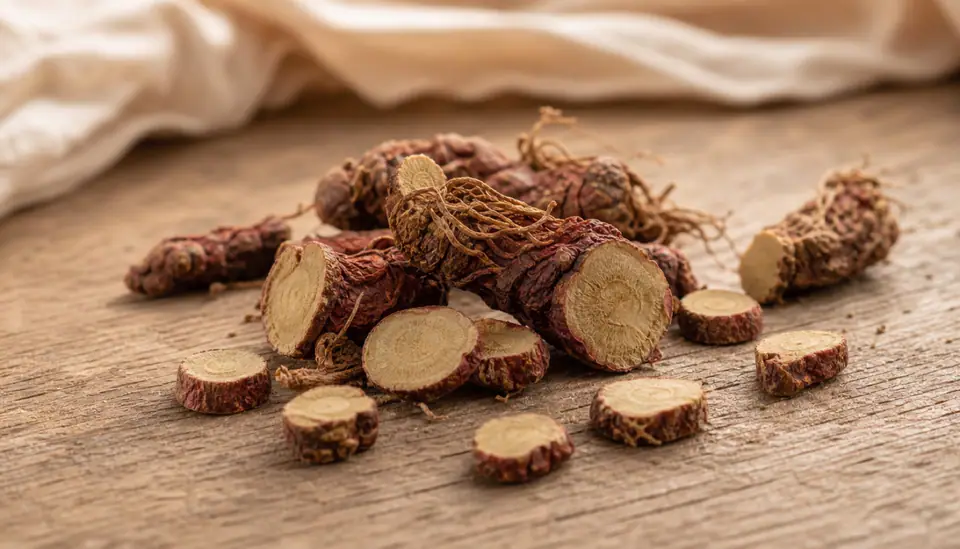
Red Stone Flower Root, an adapter from the extreme lands
Rhodiola rosea ( Rhodiola rosea) has a name that reflects its appearance. 'Gyeong-cheon' refers to the old name of plants in the Crassulaceae family, and 'Hong' evokes the reddish hue of this plant that grows in Arctic and alpine regions. In the West, it is called 'rose root' because of the subtle rose scent when the root is cut or boiled, 'golden root' for its golden-colored root, and 'arctic root' for its habitat that withstands extreme cold. In Korean folk medicine, the name 'Cham-dol-kkot' is also used based on reports of it growing wild on Baekdu Mountain.
While this medicinal herb is commonly known only as a 'fatigue recovery supplement,' the reality is slightly more complex. The European Medicines Agency (EMA) recognizes Rhodiola rosea as a traditional herbal medicine for 'fatigue, exhaustion, and anxiety caused by stress,' and the National Center for Complementary and Integrative Health (NCCIH) and the MSD Manual also describe its use in the traditional medicine of Russia, Scandinavia, and Europe for work efficiency, endurance, and altitude sickness. However, these institutions emphasize one point, that there is still insufficient reliable evidence for health-related purposes. In other words, Rhodiola rosea is not a 'guaranteed universal tonic,' but a medicinal herb that must be handled carefully between long-standing tradition and limited modern evidence.
Therefore, how much, who, and how it is used becomes important. It cannot be used for pregnant women, and medical consultation is essential for those taking anticoagulants or antidepressants, or those awaiting surgery. This is because the power of this root, which has adapted to extreme environments, can change its effect depending on the user's condition, dosage, and duration. On this page, we will guide you step-by-step on what kind of medicinal herb Rhodiola rosea is and in which cases you should be cautious.
Summary at a Glance
Summary at a Glance
For those learning about Rhodiola rosea for the first time, we have summarized the key information in a table. By looking at this table alone, you can quickly understand where this medicinal herb comes from, its properties, and what precautions to take.
| Category | Content |
|---|---|
| Origin | Hanja Name 紅景天, Scientific Name Rhodiola rosea A perennial herb belonging to the L. Crassulaceae family, native to Arctic, alpine, and frigid regions. |
| Properties and Meridian Tropism | In classical Korean medicine texts, Rhodiola roseaclear records regarding its nature, flavor, and meridian tropism are not confirmed. 'Rhodiola rosea' in the Korea Institute of Oriental Medicine data refers to R. kirilowii or R. algida var. tanguticaand it must be distinguished as a different species from R. rosea. |
| Representative Aliases | rose root, golden root, arctic root, Cham-dol-kkot (Korean folk medicine). In Korean medicine/Chinese medicine data, there are aliases such as Saja-chil or Sap-heul-tap, but these R. roseaare records referring to closely related species, not |
| Efficacy Recorded in Literature | EMA Traditional Herbal Medicine Monograph: Traditional use for fatigue, exhaustion, and anxiety caused by stress. NCCIH/MSD Manual: Described as used for work efficiency, endurance, fatigue, depression, and altitude sickness, but sufficient reliable evidence for health purposes is lacking. |
| Main Ingredients | Reported major active ingredients include rosavin, salidroside, rosarin, and rosin. |
| Combinations, Contraindications, and Precautions | No classical Korean medicine prescriptions are confirmed. Use is not recommended for pregnant or breastfeeding women, and medical consultation is mandatory when used concurrently with anticoagulants, antiplatelet agents, or antidepressants, and before or after surgery. When using concurrently with tonics for nourishing Qi or Yin, please consider the overlap of respective active ingredients. |
Is this medicinal herb right for me?
Rhodiola rosea is widely known as an adaptogen, but because of this, it is often misunderstood as being 'safe for everyone because it is a natural supplement.' In reality, there are aspects that require caution depending on the timing of intake, concurrent medications, and the individual's health status. Please check the section that applies to you below.
- Generally suitable cases: When a generally healthy adult feels short-term fatigue or exhaustion and uses an appropriate dose in supplement form. The EMA Traditional Herbal Medicine Monograph recognizes its traditional use for fatigue, exhaustion, and anxiety caused by stress.
- Cases requiring caution: If you are awaiting surgery, taking anticoagulants or antiplatelet agents, or taking antidepressants such as SSRIs/SNRIs. Since there are concerns that Rhodiola rosea may increase the tendency to bleed or affect serotonin action, you must consult a medical professional when using them together. Additionally, those experiencing insomnia or excessive agitation should avoid evening doses, as the stimulating effect may exacerbate symptoms.
- Cases to avoid: Those who are pregnant, breastfeeding, or children should avoid use. Korean herbal medicine resource information specifies that it cannot be used for pregnant women, and Rhodiola roseathere is insufficient safety data regarding pregnancy and breastfeeding. For those awaiting surgery, it is generally recommended to stop use at least 2 weeks prior, considering the risk of bleeding.
Practical Q&A
We have gathered frequently asked questions about Rhodiola rosea from the clinic. As this medicinal herb has become widely known as a fatigue recovery supplement, there are many inquiries such as "Can I just take it?", "When should I take it?", and "Can I use it with other medications?" We provide answers based on confirmed facts below, and we also highlight areas where consultation is mandatory depending on individual health status and concurrent medications.
Can Rhodiola be taken during pregnancy?
For safety, it is recommended not to take this during pregnancy. The Rhodiola section of the Herbal Medicine Resource Research Center at the Korea Institute of Oriental Medicine explicitly states that it "cannot be used for pregnant women," and the European Medicines Agency (EMA) and the National Center for Complementary and Integrative Health (NCCIH) in the US also advise that there is insufficient evidence of safety for use during pregnancy and lactation. If you are planning a pregnancy or are breastfeeding, please consult with a Korean medicine doctor before making a decision.
I am taking antidepressants; can I use Rhodiola supplements together?
You must consult your prescribing physician before using them together. There are concerns that Rhodiola may affect serotonin activity, raising the possibility of interactions when used with antidepressants such as SSRIs or SNRIs. While some studies have compared and contrasted Rhodiola with antidepressants, this does not directly guarantee the safety of combined use. If you are currently taking antidepressants, please discuss this first with your Korean medicine doctor or a psychiatrist.
If I have an upcoming surgery, when should I stop taking Rhodiola?
It is generally recommended to stop use at least 2 weeks before surgery. There are reports that Rhodiola may increase the tendency for bleeding, so caution is required not only for those taking anticoagulants or antiplatelet agents but also before and after surgery. In fact, there are case reports related to bleeding around the time of surgery. If you have a scheduled surgery, please inform your medical team in advance about whether you are taking it and when to stop.
Is it okay to take Rhodiola for a long period?
Caution is advised regarding long-term or high-dose use. Safety data for continuous use of Rhodiola for more than 3 to 4 months is limited. While short-term use at supplement levels is common for generally healthy adults, the duration and dosage vary depending on the individual's condition. If you are considering long-term use, it is best to consult a Korean medicine doctor to determine the duration of use and the point of discontinuation.
What signs should I look for while taking Rhodiola that indicate I should go to a hospital?
If the following symptoms appear, stop taking it and seek medical evaluation. Bleeding tendencies such as bleeding gums, skin bruising, nosebleeds, bloody or black stools, and menorrhagia (excessive menstrual bleeding) are particularly dangerous warning signs when used with anticoagulants or before and after surgery. Additionally, insomnia, excessive excitement or anxiety, headache, dizziness, increased heart rate, nausea, abdominal pain, diarrhea, constipation, increased blood pressure, rash, itching, or difficulty breathing may occur. These reactions vary by individual, so consultation is recommended if symptoms persist or worsen.
Can Rhodiola be drunk as a tea?
There are traditional and folk methods of decocting dried herbs to drink as tea. A common method is to decoct 5–10g of dried herbs in water over low heat for about 30 minutes. However, this is a method based on folk experience, and the appropriate dose may vary depending on an individual's constitution and health status. Even if drinking it as tea, please consult a professional first if you are pregnant, breastfeeding, taking medication, or awaiting surgery.
Relationship with Other Medicinal Herbs (Yakdae/Pairing)
Rhodiola's properties often become more distinct when used with other medicinal herbs rather than alone. In traditional medicine, such pairs are called 'Yak-dae,' referring to a structure where herbs with different properties harmonize to act in one direction. However, sinceRhodiola roseathere are no confirmed cases of Rhodiola being established as a core combination in classical Korean medicine prescriptions, we provide guidance based on combinations in modern research and functional food development.
-
Rhodiola + Red Ginseng There is modern experimental research showing that a fermented complex of Rhodiola and red ginseng protects C2C12 muscle cells from oxidative damage and increases the expression of antioxidant enzymes SOD and GPx. This is a combination in the context of functional food or supplement development, not a classical medical prescription.
- Source: "Protective effect of fermented mixture of Rhodiola-Red Ginseng extracts on oxidative damage of C2C12 muscle cells", KCI, 2013
-
Combined use with tonic restoratives Rhodiola is classified as an adaptogen and can be used with restoratives of a similar nature, such as red ginseng, Reishi mushroom, and Astragalus. Since each of these herbs contains active ingredients that can affect energy, alertness, blood pressure, and blood sugar, caution is required regarding overlapping use.
-
Contraindications for combined use with anticoagulants and antidepressants There are concerns that Rhodiola may affect blood clotting functions or serotonin activity. Therefore, combined use with anticoagulants, antiplatelet agents, or SSRI/SNRI antidepressants must be decided after consulting medical staff. If you have an upcoming surgery, it is generally recommended to stop use at least 2 weeks prior.
In what form is it consumed?
Rhodiola is a medicinal herb that utilizes the root and rhizome. Traditionally, it was consumed by decocting it in water like tea or soaking it in alcohol to drink as a medicinal liquor; currently, concentrated extract supplements are the most common. The details for each form are summarized below.
- Tea: There is a traditional/folk method of decocting 5–10g of dried herbs in water over low heat for about 30 minutes to drink as tea. Because the root components leach slowly into the water, a concentrated decoction method is common.
- Foods/Supplements: It is used in EMA traditional herbal medicinal products and as a raw material for health functional foods in Korea (Rhodiola rosea extract), and supplements in capsule or tablet form are most widely distributed.
- Decoction: In Korean medicine literature, similar types of Rhodiola (based on Rhodiola rosea and Rhodiola crenulata) are recorded as being decocted and consumed in doses of 0.6–1.2g. However, Rhodiola roseasince extract preparations are common, decoction is not always necessary.
- Professional Prescription: Rhodiola (Rhodiola rosea) has not been identified as a core ingredient in any classical Korean medicine prescriptions. In modern Korean medicine clinics, it may be used as a supplementary aid depending on an individual's constitution and condition, but there are no classical prescriptions where it is established as a professional prescription.
Interactions and Safety During Use
Rhodiola (Rhodiola rosea) is known as an ingredient related to fatigue and stress, but caution is required depending on the consumption situation. Below, we explain medications taken concurrently and details to check before consumption.
- Pregnancy and Breastfeeding: In Korean herbal medicine resource information, related species (Rhodiola rosea and Rhodiola crenulata) are specified as "cannot be used for pregnant women," R. roseaand there is insufficient evidence regarding safety during pregnancy and lactation. If you are pregnant or breastfeeding, please be sure to consult a professional before consumption.
- Before and After Surgery: There have been case reports related to an increased risk of bleeding before and after surgery; therefore, it is generally recommended to stop consumption at least 2 weeks before a scheduled surgery.
- Anticoagulants and antiplatelet agents: When taken with Rhodiola, the tendency to bleed may increase, so consultation with medical staff is necessary if you are taking related medications.
- Antidepressants (SSRIs, SNRIs, etc.): Due to concerns that it may affect serotonin activity, caution is required when using it concurrently if you are taking antidepressants.
- General Side Effects: Insomnia, agitation, headache, dizziness, gastrointestinal disorders, and increased blood pressure have been reported.
If you are starting Rhodiola for the first time or intend to take it with medications or supplements you are currently using, it is important to first check your individual health status. Please inquire during your consultation regarding the specific decision and timing of consumption.
If you experience these symptoms
If these signs appear
Rhodiola is a medicinal herb often sought for fatigue recovery or tonic purposes, but your body may react differently depending on the dosage, duration of use, and medications taken concurrently. The following signals should often be reported to your attending Korean medicine doctor or medical institution, or used to adjust consumption, rather than being dismissed as a simple 'adjustment process.' In particular, those using anticoagulants or antidepressants, or those facing surgery, should be extra mindful.
- Bleeding tendency: Bleeding gums, easy bruising of the skin, frequent nosebleeds, bloody or black stools, or increased menstrual flow, particular caution is required when used concurrently with anticoagulants or antiplatelet agents, or before and after surgery.
- Central Nervous System Overreaction: Cases where it is difficult to fall asleep at night, sensitivity or agitation becomes excessively severe, headaches or dizziness recur, or there is a feeling of a rapid heartbeat.
- Digestive Discomfort: Cases where nausea, abdominal pain, diarrhea, or constipation persist.
- Blood Pressure Changes: Cases where you feel your blood pressure is rising or the control of existing hypertension changes.
- Allergic reactions: cases where rash, itching, or difficulty breathing occur.
- Unclear changes during long-term use: cases where abnormalities in weight, mood, sleep, or menstrual cycle occur while taking the medicine continuously for 3 to 4 months or longer.
If symptoms suddenly worsen or are accompanied by difficulty breathing, decreased consciousness, severe bleeding, or chest pain, please visit an emergency medical institution (119 or the nearest emergency room).
Differences from other restorative medicines
Rhodiola is often placed on the same shelf as Red Ginseng, Gongjindan, and Gyeongokgo for the purpose of fatigue recovery or tonic effects. However, the direction in which these medicinal materials act and the contexts in which they are used are each different. Rhodiola is traditionally classified as a 'tonic' and is known as an adaptogenic ingredient focusing on fatigue, exhaustion, and anxiety caused by stress. In contrast, Gongjindan is a restorative medicine historically used to supplement the vital energy (Jeong-gi) of the kidneys, and Gyeongokgo is a restorative medicine used to supplement the blood and body fluids (Jin-yeok) of women. Red Ginseng has a strong tendency toward supplementing Qi and supporting overall vitality.
There are some modern experimental studies on the combination of Rhodiola and Red Ginseng. An example is a study on a complex fermented Rhodiola-Red Ginseng product that observed protective effects against oxidative damage in C2C12 muscle cells. However, this is only a result at the cellular experiment level and does not mean this combination is safe and appropriate for everyone. There is a lack of confirmed official or academic literature regarding the interactions when Rhodiola is used together with traditional Korean restorative formulations such as Gongjindan, Gyeongokgo, or Red Ginseng extract. Since combining tonic restorative medicines may result in overlapping active ingredients, the effects on alertness, blood pressure, and blood glucose must be considered together.
Ultimately, whether Rhodiola is suitable for you, or whether Red Ginseng, Gongjindan, or Gyeongokgo is more appropriate, should be determined after a comprehensive evaluation of your pulse, symptoms, current medications, and lifestyle patterns. Rather than choosing based solely on the descriptions of popular products claiming they are 'good for fatigue,' we recommend consulting with a doctor of Korean medicine in the clinic.
References
- Rhodiola evidence material 1: nccih.nih.gov evidence materials.
- Rhodiola evidence material 2: Korea Citation Index academic paper.
- Rhodiola evidence material 3: NCBI original academic data.
- Rhodiola evidence material 4: PubMed academic paper.
- Rhodiola evidence material 5: GBIF plant classification data.
- Rhodiola evidence material 6: GBIF plant classification data.
- Rhodiola evidence material 7: herba.kr evidence.
- Rhodiola evidence material 8: heraldk.com evidence material.
If you would like to check if this medicinal herb is right for you or which prescription it should be used with, please leave a medical inquiry. For those who find it difficult to visit the clinic, non-face-to-face consultations are available; we will provide guidance after first reviewing your current condition and current medications.

Medical Staff Review
Director Choi Yeon-seung
Chief Director of Baekrokdam Korean Medicine ClinicRhodiola Dictionary Entry, reviewed the safety of expressions and the scope of verification before administration.
Review Scope: Clinical Accuracy, Pharmacology, Contraindications, Combinations, QA · Last Reviewed 2026-08-16
- Graduated from Kyung Hee University College of Korean Medicine
- Providing Korean medicine treatment since 2010
- Consultations for Gongjindan, Gyeongokgo, Nokyong (Deer Antler) restorative medicine, and customized restorative herbal medicine