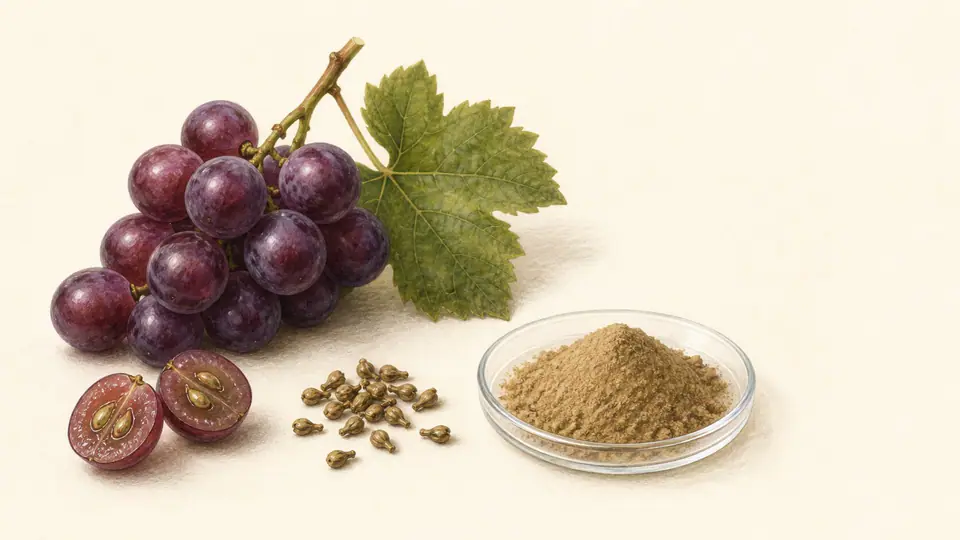
Astringent Components of Discarded Seeds Become Antioxidant Capsules
When concerned about blood pressure, blood vessels, or skin antioxidants, will taking grape seed extract be more definitively helpful than grapes or wine? In short, there is still insufficient evidence to say it is "definitive."
Grape seed extract is an ingredient with different components and exposure levels than grape pulp, juice, wine, or grape seed oil, and research results are inconsistent across different analyses. One must consider both what was concentrated and the scope of evidence based on human subjects.
What is Concentrated in Grape Seed Extract?
Grape seed extract is primarily Vitis vinifera an ingredient that concentrates polyphenols and proanthocyanidins from seeds. The parts that are usually discarded, like when chewing and spitting out seeds while eating grapes, contain components that produce an astringent taste and dark color. These components gained attention as supplement ingredients because they show antioxidant capacity in test tubes. However, test tube values do not mean they prevent aging or disease within the body. Antioxidant indices such as ORAC are merely a single chemical characteristic and do not guarantee the final effect in the human body.
Different from Grapes, Juice, and Wine
Grape seed extract should not be understood as being in the same category as grapes, grape juice, or wine. Grape pulp and juice mainly contain sugars and different polyphenol patterns, while wine contains alcohol and components modified during the fermentation process. Grape seed oil is centered on oil components, whereas grape seed extract is centered on polyphenols and proanthocyanidins. Extraction methods and standardization also vary by product. Therefore, reasoning such as "since grapes are good, grape seed extract must also be good" or "research on wine can be applied directly to grape seed extract" is not valid.
Why Expectations are Linked to Blood Pressure and Skin
Expectations for grape seed extract generally flow in two directions: one is blood pressure and vascular health, and the other is skin, wound healing, and edema. Regarding blood pressure, a 2022 meta-analysis of 19 controlled trials reported a small average decrease in diastolic blood pressure and heart rate, but systolic blood pressure and vasodilation indicators were not significant, and there was very high heterogeneity between studies. A 2016 meta-analysis also reported a decrease in blood pressure, but it involved only 810 people and stated that larger, long-term, high-dose studies are needed. In other words, a slight drop in the blood pressure monitor reading does not mean that myocardial infarction or stroke has been prevented.
Other claims, such as skin antioxidants, wound healing, and edema, have limited data on human subjects or vary in evidence by product. Showing strong antioxidant power in a test tube does not mean skin aging is reversed.
Difference Between Total Extract mg and Proanthocyanidin Standardization
When choosing a product, looking only at "total extract mg" is insufficient. You must also check whether proanthocyanidins are standardized and what the daily intake amount is. This is because the degree of concentration and the method of standardization differ by product, even under the same name of "grape seed extract." This is a prime example of how a single name can obscure the issue. So, what should you look for? A realistic starting point is to first check if the ingredient is Vitis vinifera A realistic starting point is to first check whether it is a seed extract and whether proanthocyanidin standardization and the 1 daily dose are specified.
Essential Checks When Taking with Other Medications
There is insufficient data on drug interactions for grape seed extract. If you are taking blood pressure medication, anticoagulant or antiplatelet therapy, or are awaiting surgery, you must verify the possibility of bleeding or blood pressure changes with your medical provider. For those who are pregnant, breastfeeding, or have liver or kidney disease, data on long-term use of high doses is limited. If chest pain, paralysis, slurred speech, fainting, or unstoppable bleeding occurs, you must seek emergency evaluation immediately.
Adverse Reactions and Individual Safety Signals
Generally, adverse reactions such as headache, dizziness, nausea, or itching may occur. If symptoms persist or worsen, it is advisable to stop taking the supplement and consult a medical provider. The NCCIH advises that research on various uses of grape seed extract is limited and that products should not be used as a substitute for the treatment of diseases.
The Gap Between Human Evidence and Expectations
While meta-analyses on grape seed extract exist, the results are inconsistent and vary significantly between studies. A slight decrease in diastolic blood pressure and heart rate does not prove an effect in preventing cardiovascular events. Different levels of evidence are required to bridge the gap between in vitro antioxidant levels and human effects, as well as between changes in blood pressure readings and the prevention of myocardial infarction or stroke. To date, there are not enough human studies to fill those gaps.
Differences from Similar-Looking Ingredients
Grape seed extract is clearly distinct from grape seed oil, grape pulp, grape juice, and wine. Grape seed oil is primarily a fat-based product, whereas grape seed extract is a concentrate of polyphenols and proanthocyanidins. Research on polyphenols in wine cannot be interpreted as applying to grape seed extract, nor vice versa. Each product differs in dosage, accompanying ingredients, and method of exposure.
Realistic criteria to check today
When choosing grape seed extract, look for specific criteria rather than the broad term "antioxidant." Check whether the raw material is a Vitis vinifera Check whether it is a seed extract, whether proanthocyanidins are standardized and the 1 daily dose is specified, whether you have confirmed the possibility of concurrent use with current blood pressure medications, anticoagulants, or antiplatelet agents with medical staff, whether your expectation is blood pressure improvement or skin improvement, and whether that expectation is not being extrapolated from in vitro results or small changes in blood pressure to cardiovascular or anti-aging therapeutic effects. The key to viewing this ingredient is not to interpret small numerical changes as the prevention of major diseases.
References
- NCCIH: Grape seed extract usefulness and safety.
- Grape seed extract, vascular function and blood pressure: systematic review and meta-analysis.
- Grape seed extract and blood pressure: meta-analysis of randomized trials.
This text explains the origin of the raw materials, the scope of research, and precautions before consumption. As this cannot replace individual diagnosis or treatment, please consult a medical professional if you are taking medication or if symptoms persist. If sudden and severe symptoms such as difficulty breathing or decreased consciousness occur after consumption, seek help from 119 or the emergency room.

Medical Staff Review
Director Choi Yeon-seung
Chief Director of Baekrokdam Korean Medicine ClinicGrape Seed Extract Dictionary Entry, reviewed the safety of expressions and the scope of verification before administration.
Review scope: Ingredient origin, human studies, concomitant medications, safety of intake · Last reviewed 2026-08-17
- Graduated from Kyung Hee University College of Korean Medicine
- Providing Korean medicine treatment since 2010
- Consultations for Gongjindan, Gyeongokgo, Nokyong (Deer Antler) restorative medicine, and customized restorative herbal medicine