Can bitter roots from the desert soil relieve joint pain?
When your joints or back hurt, can you use Devil's Claw instead of painkillers? To answer briefly, it is not an ingredient that can be swapped so simply. While the name sounds sharp, the part we actually need to examine is the root hidden underground. Everything changes depending on which species the root comes from, how it was harvested, and which type of pain it targets.
It is precisely this gap that must be distinguished.
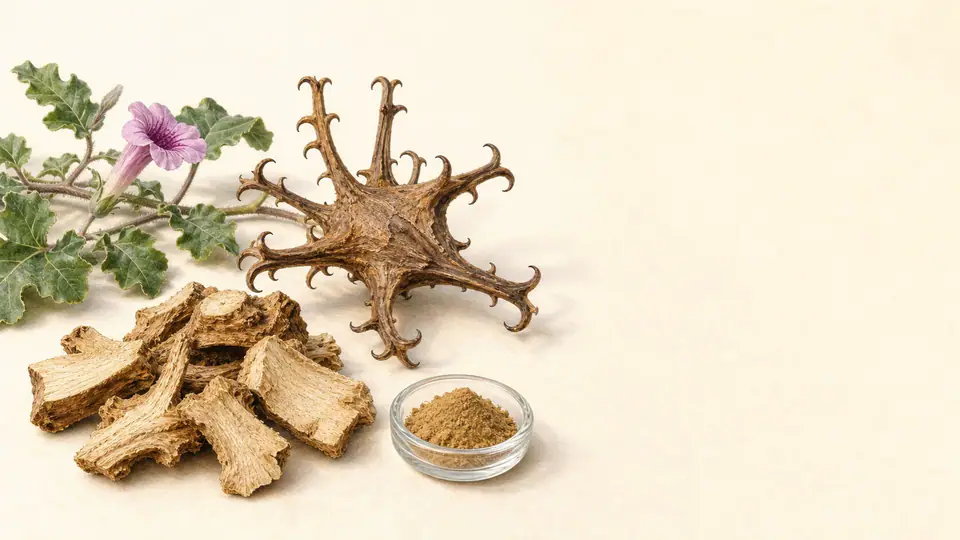
The name comes from the hooked fruit, but the medicinal part is the root
The name Devil's Claw comes from its fruit. Kew Harpagophytum procumbensdescribes it as a perennial plant with tuberous roots native to southern Africa, noting that the common name derives from the hooked fruit. However, the medicinal ingredient reviewed in the European Medicines Agency (EMA) monograph is not the fruit. H. procumbens or H. zeyheriThe target is the tuberous 2nd root.
People are drawn to the sharp image of 'Devil's Claw,' but the part expected to provide pain relief is actually the root underground. If you miss this simple distinction, that the name belongs to the fruit while the medicinal use belongs to the root, it can lead to confusion when choosing a product.
What exactly has the EMA recognized?
The EMA monograph covers this root and its powder, aqueous extract, and ethanol extract. It views the scope of use for this ingredient as mild joint pain, abdominal bloating, and temporary loss of appetite, classifying it as traditional use based on over 30 years of experience rather than clinically established efficacy.
In other words, the claim that Devil's Claw reduces joint pain remains in the realm of traditional experience and is not a treatment firmly proven by modern medicine. Even if some studies showed signals, they are still insufficient to move those signals out of the category of traditional use.
Pain signals were observed in studies, but
A 2015 Cochrane review on low back pain found that certain Devil's Claw preparations might reduce pain more than a placebo. However, the quality of evidence was moderate or low, and it is difficult to specify which preparation, at what dose, reduces pain for which person. The EMA also evaluated that a firm conclusion could not be reached because many clinical studies were uncontrolled or had differing designs.
Then what should you look for? When looking at research results, it is dangerous to assume that all products will act the same under the broad name of 'Devil's Claw.' There is no basis for applying results from a specific extract to a different powder or the root of a different species.
Root tea, powder, extracts, and standardized products are not the same
Root tea, powder, aqueous or ethanol extracts, and harpagoside-standardized products are not the same preparations. Even for the root of the same plant, the types and concentrations of components vary depending on how it was processed.
| Category | What is the difference? |
|---|---|
| Hooked fruit vs. 2nd root | The source of the name and the actual medicinal part are different |
| H. procumbens vs. H. zeyheri | Although the EMA covers both, they cannot be considered the same species |
| Root powder vs. specific standardized extracts | Differences in processing methods and whether harpagoside content is indicated |
| Traditional use for mild joint pain vs. prescribed analgesic and anti-inflammatory treatment | The range of expected outcomes is completely different |
This table summarizes four common points of confusion when choosing Devil's Claw. If the product label only says 'Devil's Claw,' we still know nothing about it.
Do not start use arbitrarily if taking prescription medications
Due to potential interactions with anticoagulants, antiplatelet agents, diabetes medications, and blood pressure or heart medications, it is safer not to start use arbitrarily while taking prescription drugs. Additionally, if you have gastric or duodenal ulcers, gallstones, biliary tract disease, or heart disease, please consult a medical professional first, and discontinue use if gastrointestinal symptoms worsen.
The fact that this ingredient is a plant does not mean it is safe. In particular, for those already taking medication or with chronic diseases, it can be dangerous to start use based solely on the name 'natural ingredient.'
What symptoms should prompt you to stop?
Common gastrointestinal and neurological symptoms such as diarrhea, nausea, vomiting, abdominal pain, headache, and dizziness have been reported. Hypersensitivity reactions such as rash, hives, and facial swelling may also occur. The EMA's practical criteria for discontinuation are as follows:
- Seek evaluation if joint pain worsens during use or persists beyond 4 weeks.
- Seek evaluation if digestive discomfort persists beyond 2 weeks.
- Seek immediate evaluation for facial swelling, difficulty breathing, or new onset of paralysis or urinary dysfunction.
Masking pain with supplements for an extended period may lead to missing the underlying problem.
Insufficient safety data for pregnancy, lactation, and adolescents
There is insufficient safety data for medicinal use during pregnancy, lactation, and for those under 18 years of age. This does not mean it is 'dangerous,' but rather that it is 'unknown.' We cannot recommend intake when the safety is unknown. Those in these groups must decide after consulting with a medical professional.
Realistic criteria to check today
Before choosing or taking Devil's Claw, check the following questions:
- H. procumbens·H. zeyheri Which species is it, and is it from the root?
- What is the extraction method, the harpagoside labeling, and the 1 daily dose?
- What is the location and duration of the pain, and are there warning signs such as swollen and hot joints, trauma, muscle weakness, sensory loss, or urinary dysfunction?
- Do you have gastric ulcers, gallstones, heart disease, or diabetes, or are you taking anticoagulants, NSAIDs, or diabetes medications?
These questions serve as criteria for selecting a product and as a way to check your own health status.
Final Judgment
Rather than focusing on the name 'Devil's Claw,' verify the species, the part of the root used, the extract type, and the target pain. Do not use supplements to mask joint pain lasting more than 4 weeks or neurological warning signs, and do not arbitrarily replace prescribed painkillers. Devil's Claw is simply a traditional ingredient derived from bitter roots in desert soil; it is not a miracle fruit that can treat all types of joint and back pain.
References
- Kew Plants of the World Online: Harpagophytum procumbens.
- EMA: Harpagophyti radix herbal medicinal product.
- Cochrane review: herbal medicine including devil's claw for low back pain.
- Devil's claw for osteoarthritis: efficacy and safety review.
- Harpagophytum for osteoarthritis and low back pain: systematic review.
This text explains the origin of the raw materials, the scope of research, and precautions before consumption. As this cannot replace individual diagnosis or treatment, please consult a medical professional if you are taking medication or if symptoms persist. If sudden and severe symptoms such as difficulty breathing or decreased consciousness occur after consumption, seek help from 119 or the emergency room.

Medical Staff Review
Director Choi Yeon-seung
Chief Director of Baekrokdam Korean Medicine ClinicDevil's Claw Glossary Entry, reviewed the safety of expressions and the scope of verification before administration.
Review scope: Ingredient origin, human studies, concomitant medications, safety of intake · Last reviewed 2026-08-17
- Graduated from Kyung Hee University College of Korean Medicine
- Providing Korean medicine treatment since 2010
- Consultations for Gongjindan, Gyeongokgo, Nokyong (Deer Antler) restorative medicine, and customized restorative herbal medicine