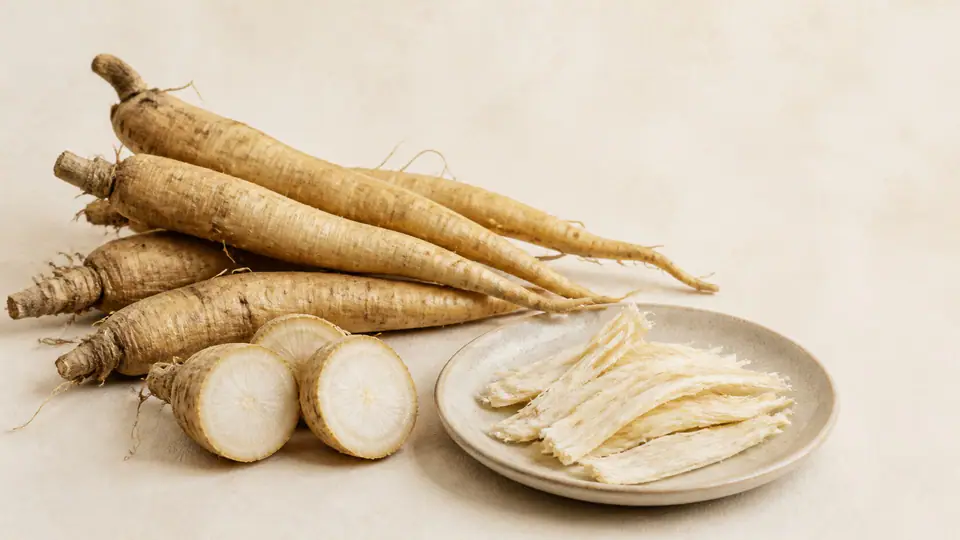
The root called 'meat of the mountains': what changes when concentrated
If I drink Deodeok juice or concentrate for a cough or bronchial health, is it more effective than eating it grilled? In short, because it cannot be converted to an equivalent amount of Deodeok, it cannot be simply said that more concentration is better.
Rather, the sugar in juices, the seasoning in grilled versions, and the marker components of extracts each create different criteria. How should we evaluate what kind of plant Deodeok is, why expectations for bronchial and immune health are attached to it, and whether those expectations extend to humans?
Deodeok is a distinct plant, separate from Doraji and Dangsam
Deodeok is a plant of the Campanulaceae family Codonopsis lanceolataIt is a wild mountain vegetable and cultivated crop where the root is consumed. It is a plant with a different scientific name from Doraji (Platycodon grandiflorus) of the same family and Dangsam (Codonopsis pilosula) of the same genus. The National Species Information System also classifies Deodeok Codonopsis lanceolataas a cultivated plant whose root is eaten, stating it is a separate species from Doraji.
Because plants with similar names and appearances are easily mixed, and there are medicinal plants in the same family and genus, the species identification of the raw material must be verified first. If a research paper or product label only says 'Deodeok,' you must first check exactly Codonopsis lanceolatawhich species it is. Misidentifying the species can lead to incorrect conclusions regarding components and safety.
The detection of saponins does not necessarily mean a cough will improve
The detection of triterpenoid saponins and various components in Deodeok roots, and the identification of biosynthetic genes, only demonstrate the presence of these components. The fact that saponins exist does not prove the treatment of bronchial symptoms. Literature regarding anti-inflammatory, immune, and respiratory effects is centered on cell and animal studies, and there are insufficient high-quality randomized trials proving the improvement of cough or phlegm in humans.
In other words, there is a gap between the presence of a component and the efficacy felt by a person that requires separate clinical trials. Research on saponin biosynthesis pathways and component content helps in understanding varieties and processing methods, but it does not determine a safe and effective dose for humans.
Raw roots, grilled, juice, powder, and extracts are not all the same Deodeok
Deodeok is used in various forms, such as raw roots, grilled, seasoned, tea, juice, powder, and standardized extracts, and these differ in components and intake amounts. Seasoned grilled Deodeok, sugar-containing juice, and test extracts with adjusted solids and marker components cannot be converted to the same amount of Deodeok.
Grilled Deodeok is a food eaten as a side dish. Juice may contain sugar during the concentration process, and powders or extracts may be formulations where specific components are concentrated or standardized. Therefore, simple comparisons such as "I eat a lot of Deodeok, so the effect will be greater" are not valid. Every time the form changes, the types and amounts of components consumed, as well as the accompanying sugar, sodium, and additives, also change.
A single blood pressure study does not represent the effect of Deodeok juice or grilled Deodeok
A small study testing a specific Deodeok extract, a 6-week double-blind trial on adults with prehypertension, showed signals in some blood pressure and vascular markers. However, this does not imply the effect of side dishes or juices. That trial did not study bronchial symptoms, nor is it evidence to replace hypertension medication. The purpose and results must not be misinterpreted.
The lesson from this study is rather this: signals observed in a specific extract do not apply directly to general foods, and evidence regarding the bronchi or cough is a separate issue.
What overlaps when used with blood pressure or diabetes medication
If you are taking blood pressure medication, you must consider the possibility of overlapping dizziness due to the blood pressure signals of certain extracts. It is important to inform your medical staff about the product and not to reduce your medication arbitrarily. Since there is no evidence that Deodeok products can replace medication, they should not be used as a basis for stopping or reducing existing prescriptions.
Deodeok juice containing sugar should be viewed by the same standards as general side dishes for diabetes and weight management, and sweet and salty grilled Deodeok should be viewed by the same standards for sodium and sugar intake. Just because a juice is a health food does not mean sugar intake disappears, and just because grilled Deodeok is a natural food does not mean sodium is ignored.
Different standards for concentrated products regarding pregnancy, breastfeeding, and allergies
Experience eating it as food should not be extended to the long-term safety of highly concentrated juices, powders, or extracts. Data on concentrated products during pregnancy and breastfeeding are insufficient. If you have allergies to plants in the Campanulaceae family or root foods, you should monitor for mouth itching, hives, or respiratory symptoms.
The critical point here is the reasoning that "it is safe because I have eaten it since long ago." Concentrated products, which differ in amount and form from those eaten as side dishes, require different safety evaluations. Those with allergic tendencies or who are pregnant or breastfeeding should approach these more cautiously.
Do not rely solely on Deodeok if a cough persists
Shortness of breath, high fever, blood-tinged sputum, chest pain, or a cough lasting more than 3 weeks should not be managed with Deodeok products; you must receive a medical evaluation for the cause. This is because such symptoms may be other diseases beyond simple bronchial irritation. Deodeok products do not treat the cause and should not be used to mask symptoms.
What to check first when choosing Deodeok, Doraji, and Dangsam
First, you must identify exactly which plant it is among Deodeok, Doraji, and Dangsam, and which form it is in among raw root, side dish, tea, juice, powder, or extract. Next, consider what you expect, cough, sputum, immunity, or blood pressure, and whether there is a duration of symptoms and a diagnosis of the cause. Finally, check if you are taking blood pressure or diabetes medication, if you are pregnant, breastfeeding, or have allergies, and the amount of sugar in the juice or sodium in the grilled seasoning.
These questions are not simple checklists, but tools to narrow the gap between expectation and evidence. The name of the raw material alone is not sufficient.
What to look for before the label "wild vegetables good for the bronchi"
Rather than the label "wild vegetables good for the bronchi," you must verify the exact species, whether it is a food or concentrated formulation, and the cause of the symptoms. You must first look at the gap between saponin/animal experiments and human cough/immunity results, as well as sugar, sodium, and drug interactions. Deodeok is still a root plant with taste and aroma, but within products created by concentration technology, it must be judged by different standards.
References
- National Species Information System: Deodeok Codonopsis lanceolata.
- Rural Development Administration: Food Use and Characteristics of Deodeok.
- Rural Development Administration: Deodeok Genome and Saponin Biosynthesis Pathway.
- Codonopsis lanceolata extract in prehypertensive adults: randomized trial.
- Codonopsis lanceolata phytochemistry and pharmacology: review.
This text explains the origin of the raw materials, the scope of research, and precautions before consumption. As this cannot replace individual diagnosis or treatment, please consult a medical professional if you are taking medication or if symptoms persist. If sudden and severe symptoms such as difficulty breathing or decreased consciousness occur after consumption, seek help from 119 or the emergency room.

Medical Staff Review
Director Choi Yeon-seung
Chief Director of Baekrokdam Korean Medicine ClinicDeodeok Dictionary Entry, reviewed the safety of expressions and the scope of verification before administration.
Review scope: Ingredient origin, human studies, concomitant medications, safety of intake · Last reviewed 2026-08-17
- Graduated from Kyung Hee University College of Korean Medicine
- Providing Korean medicine treatment since 2010
- Consultations for Gongjindan, Gyeongokgo, Nokyong (Deer Antler) restorative medicine, and customized restorative herbal medicine