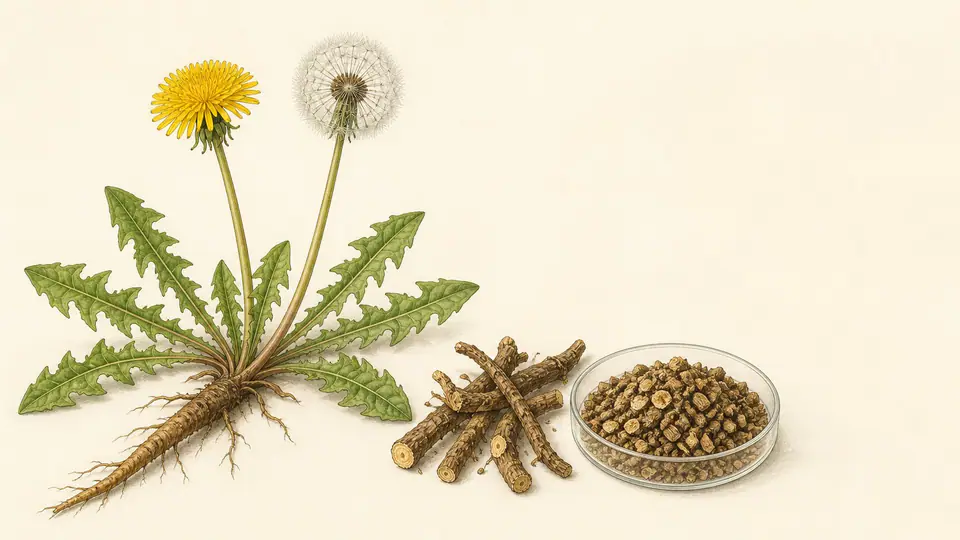
From yellow roadside flowers to liver detox juice
Is it okay to drink dandelion root tea or juice for liver detoxification or edema? Is it okay to dig up dandelions from the roadside?
Simply put, enjoying dandelion tea or juice as a traditional food is a different matter from using concentrated products to treat a disease. I cannot recommend arbitrarily digging up and eating dandelions from roadsides or parks. This is because a single name encompasses various plants, parts, and uses.
Dandelions are not a single species
The name 'dandelion' does not refer to just one plant. Dandelions native to Korea include Taraxacum platycarpumwhich are used as namul (seasoned vegetables) from their young leaves. White dandelions, mountain dandelions, and the naturalized species known as Western dandelions Taraxacum officinale lineages are all mixed together. Kew treats T. officinaleas a complex taxonomic group intertwined with hundreds of microspecies, and recognizes native species in Korea and Japan T. platycarpumas separate species. Data from the Rural Development Administration also distinguishes the commonly seen naturalized Western dandelion T. officinalefrom native dandelions based on the shape of the involucre below the flower, explaining that their names should not be mixed.
In other words, the data on roots and leaves found in traditional European herbal literature refers to specific T. officinale raw materials. It is not accurate to apply that directly to all plants of the dandelion genus in Korea. Then, what should we look at? After the species name, you must look at the part of the plant and its form.
Leaves, roots, whole plant, and extracts are different stories
There are many ways to consume dandelions. Young leaf namul, flowers, root tea, roasted roots, the whole plant, and leaf or root extracts all involve different parts and forms. Roots contain a relatively high amount of inulin, which can ferment in the gut, but the dosage of one cup of dandelion root tea is not the same as that of a standardized inulin supplement.
Tea brewed as food and concentrated products with standardized doses differ in dosage and application. Just because something has been consumed traditionally does not mean you can expect the same safety and effect when consuming it in a concentrated manner. This difference becomes important especially when taking juices or capsules expecting liver detoxification or edema treatment.
How convincing is the claim of liver detoxification?
It is common to hear that dandelions are good for the liver. However, the NCCIH states that there is no convincing scientific evidence that dandelions help with any health condition, and human studies are very limited. The EMA's documentation on dandelion root summarizes its traditional use for mild digestive symptoms, temporary loss of appetite, and increased urine volume; this does not mean that its efficacy in treating liver disease has been clinically proven.
Claims regarding liver protection, anti-inflammatory effects, and anti-cancer properties are mostly limited to cell, animal, or component studies. This is not evidence that dandelion tea or juice treats fatty liver, hepatitis, or cancer. There is a significant gap between the research stage and actual human treatment.
To what extent have the effects on edema and diuresis been verified?
There is a human study examining the potential diuretic effect of dandelion leaves. However, it was a single-day, open-label, uncontrolled pilot study involving only 17 people, and it only observed changes in the frequency of urination. It did not prove the treatment of edema-related diseases or long-term safety. Therefore, if you have edema, it is a priority to first identify the cause.
Why are roadside dandelions dangerous?
Dandelions from roadsides, parks, or farmland may be misidentified by species and may have been exposed to herbicides, pesticides, exhaust fumes, or animal waste. It is not recommended to arbitrarily collect these and concentrate them into juices or teas. While clean cultivated products and roadside collections may be called by the same name, they are entirely different raw materials.
You must first verify whether the product consists of leaves or root tea grown for consumption or wild-harvested samples, as well as the exact species and which part, leaves, roots, or the whole plant, is being used.
Concurrent medications and existing conditions are important
Medicinal dandelion root products require caution in certain situations. They should not be used arbitrarily by those with biliary issues such as bile duct obstruction, cholangitis, liver disease, or gallstones, or those with heart or kidney disease where medical staff have restricted fluid intake. Since theoretical possibilities of interactions with diuretics, diabetes medications, anticoagulants, and antiplatelet agents have been raised, it is advisable to inform your medical provider if you are using concentrated products while taking multiple medications.
If you have an allergy to Asteraceae plants, be cautious of itching, hives, oral swelling, or respiratory symptoms after skin contact or ingestion. Safety for medicinal concentrated products has not been established for pregnancy, breastfeeding, or children under 12 years of age. If jaundice, severe abdominal pain, hematuria, fever, or difficulty breathing occurs, you must receive a prompt medical evaluation.
What expectations did you have when starting?
When choosing dandelion, it is best to first reflect on what you are trying to resolve. It is important to determine whether you are trying to address liver enzyme levels, edema, indigestion, or urination, and whether you have received a diagnosis for the cause. While dandelions have been traditionally used for indigestion, temporary loss of appetite, and increased urine volume, this does not equate to liver detoxification or the treatment of edema.
In other words, the feeling that dandelions are a healthy plant and the evidence that they treat a specific disease are two different matters.
Criteria to Check Today
When selecting dandelion, check the following rather than the label 'detox herb': the exact species, the part used, the cultivation and collection environment, the amount of food versus concentrate, the gap between traditional use and human clinical evidence, and your biliary/kidney/fluid status and current medications. The relaxation of a cup of tea and the expectation of treating a disease may share a name, but they carry different weights.
References
- Korea Forest Service National Species Knowledge Information System: Dandelion.
- Rural Development Administration: Distinguishing between Western Dandelions and Native Dandelions.
- Kew Plants of the World Online: Taraxacum platycarpum.
- NCCIH: Dandelion usefulness and safety.
- EMA: Dandelion root herbal monograph.
- Dandelion leaf extract and urine output: one-day pilot study.
This text explains the origin of the raw materials, the scope of research, and precautions before consumption. As this cannot replace individual diagnosis or treatment, please consult a medical professional if you are taking medication or if symptoms persist. If sudden and severe symptoms such as difficulty breathing or decreased consciousness occur after consumption, seek help from 119 or the emergency room.

Medical Staff Review
Director Choi Yeon-seung
Chief Director of Baekrokdam Korean Medicine ClinicDandelion Dictionary Entry, reviewed the safety of expressions and the scope of verification before administration.
Review scope: Ingredient origin, human studies, concomitant medications, safety of intake · Last reviewed 2026-08-17
- Graduated from Kyung Hee University College of Korean Medicine
- Providing Korean medicine treatment since 2010
- Consultations for Gongjindan, Gyeongokgo, Nokyong (Deer Antler) restorative medicine, and customized restorative herbal medicine