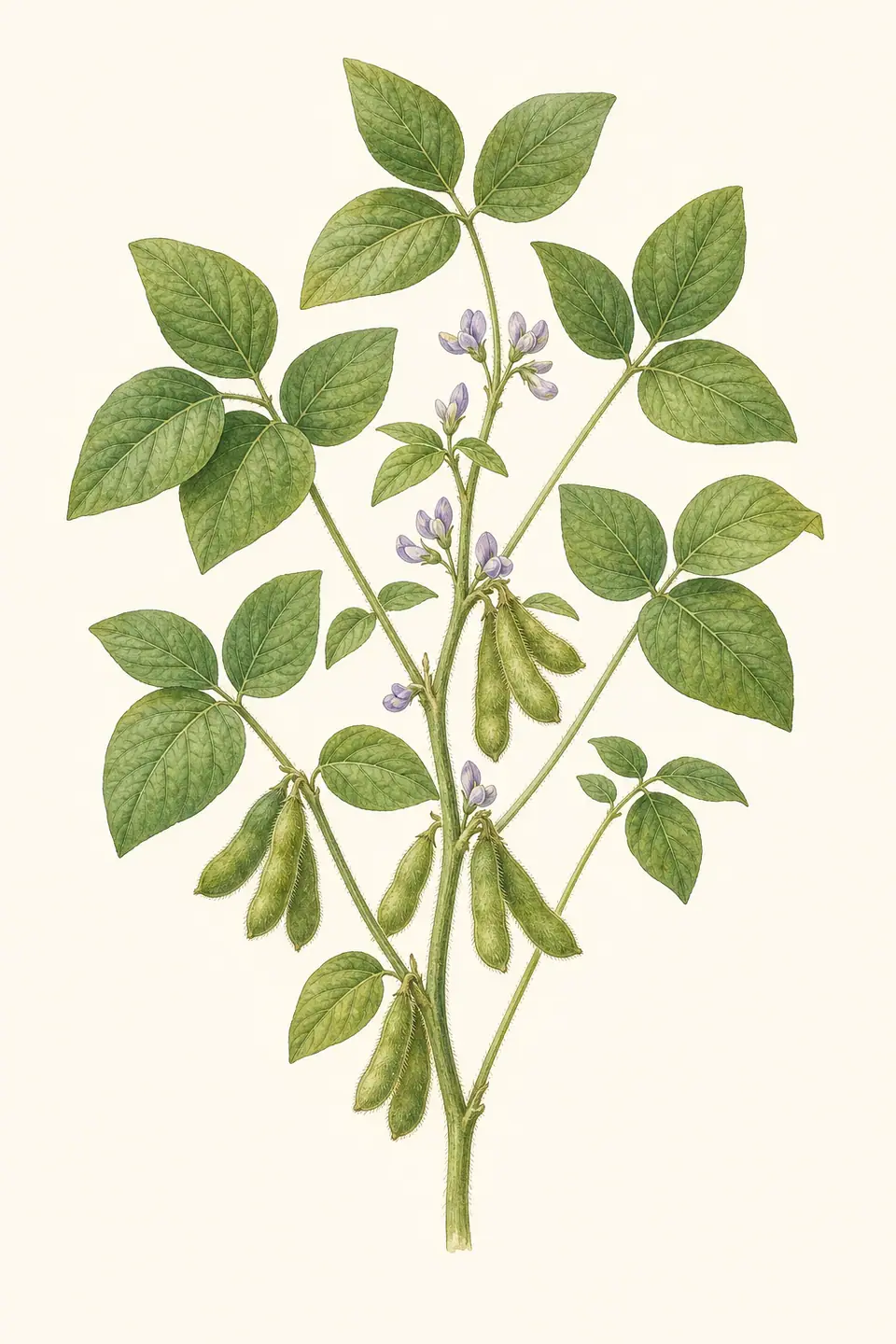
Yusuk: Relieving stuffiness from a closed jar
The 《Myeongui Byeollok》 first recorded this medicinal material, stating it is used for “headache and fever/chills from cold damage, toxic miasma, irritability and chest fullness, shortness of breath from deficiency-fatigue, and cold pain in both legs.” Its name is ‘Shi’. In the 《Shiming·Shiyinshi》 by Liu Xi of the Han Dynasty, the following explanation remains: “豉,嗜也,五味調和須之而成,乃可甘嗜.” This means the name originates from the taste of soybeans, which are loved as a seasoning. However, when the same soybeans are placed in a closed vessel and fermented with the juice of mulberry leaves (Sangyeop) and sweet wormwood (Cheongho), the food becomes medicine. This is why it is called ‘Yusuk’; ‘Yu’ means a closed and dark place, and ‘Suk’ means soybeans. The name captures the process of soybeans transforming on their own in the darkness.
It is easy to view this material as simply ‘fermented soybeans’ or ‘raw ingredients for soybean paste and soy sauce.’ However, the 《Shanghan Lun》 refers to it as ‘Xiangshi’ and makes it a pillar of its prescriptions, and the Chongshi-tang of the 《Zhouhou Beiji Fang》 treats the early stages of wind-cold common cold using only green onions and this material. The 《Bencao Gangmu》 called it “Danshi,” and it was in the 《Bencao Yuanshi》 that the modern official name “Damdusi” was established. ‘Dam’ means that the version with low salt content is used for medicinal purposes. In other words, this is not a simple food, but a Korean herbal medicine whose properties are defined toward ‘relieving stuffiness’ through the transformation of fermentation.
The core of this transformation lies in addressing ‘stagnant heat’ (ulyeol) and ‘irritability’ (beonjo). The Jizachi-tang of the 《Shanghan Lun》 is used for chest stuffiness (ao-nu) and deficiency-irritability (heobeon) that prevents sleep, even after sweating, vomiting, or purging treatments. In this prescription, Damdusi pairs with Gardenia (Jija) to release the stagnant heat of the chest and diaphragm and eliminate irritability. The Gwa-che-san of the 《Uifanggo》 states that “Damdusi is decayed and thus overcomes dryness,” explaining that soybeans that have undergone decay and fermentation possess properties that overcome dry and stuffy conditions.
However, this power to ‘relieve stuffiness’ does not act in the same direction for everyone. The 《Bencao Jingshu》 clearly lists contraindications, stating, “Whenever cold damage enters the Yin meridians or directly hits the Three Yin, it should not be used,” and those with a weak stomach who experience frequent nausea should be cautious. Additionally, those with soybean allergies must avoid it. Therefore, how much, for whom, and with which prescription it is used is critical, and that is exactly what this page covers.
Summary at a Glance
Damdusi is a Korean herbal medicine derived from fermented soybeans, while simultaneously retaining the identity of the soybeans familiar to our dining tables. The table below summarizes everything from its core identity to its properties, efficacy, and precautions at a glance.
| Category | Content |
|---|---|
| Origin | Hanja Name 淡豆豉, Scientific Name Glycine max (L.) Merr. A processed medicinal material made by fermenting and drying mature seeds of soybeans (mainly large soybeans, black varieties) with the juice of mulberry leaves (Sangyeop), sweet wormwood (Cheongho), etc. |
| Properties and Meridian Tropism | Bitter (苦), Acrid (辛), Cold (寒) or Cool (涼); Lung Meridian, Stomach Meridian |
| Representative Aliases | 豉·豆豉(名醫別錄), 香豉(傷寒論), 淡豉(本草綱目), 大豆豉, 淡豆豉(本草原始) |
| Efficacy Recorded in Literature | Releasing the exterior (haepyo), eliminating irritability (jebeon), dispersing stagnation (seonul), regulating the center (jojung), 《Myeongui Byeollok》 records its use for headache and fever/chills from cold damage, toxic miasma, irritability and chest fullness, shortness of breath from deficiency-fatigue, and cold pain in both legs |
| Key Preparation Characteristics | Soybeans are soaked in water and steamed, covered with mulberry leaf and sweet wormwood residue to ferment until a yellow coating (hwang-ui) forms, and then dried |
| Combination & Precautions | Used as a core component in traditional prescriptions such as Jizachi-tang, which releases stagnant heat in the chest when combined with Gardenia (Jija); contraindicated for Yin meridian diseases, direct hit to the Three Yin, and stomach deficiency (wi-heo). Since its action differs from tonic medicines for supplementing Yang or Yin, self-combination is not recommended |
Is this medicinal herb right for me?
Because Damdusi is a fermented soybean, one must consider both the constitutional reaction to soybeans and the characteristics of fermented foods. Please review based on the following three criteria.
- Generally suitable cases: Use under the prescription of a Korean medicine doctor if there is mild fever, headache, or sore throat in the early stages of an external contraction, or if chest stuffiness, irritability, and insomnia need to be resolved by releasing stagnant heat. Using small amounts as food is generally less problematic.
- Cases requiring caution: Those who experience frequent nausea due to a weak stomach, those with a history of soybean allergies, or those who must monitor salt intake due to hypertension or kidney disease must consult a Korean medicine doctor. Guidance from medical staff is also required when using for pregnant or breastfeeding women or young children.
- Cases to avoid: Theoretically, it should be avoided if cold damage has entered deep into the Yin meridians, if there is a direct hit to the Three Yin, or if you are taking MAOI-class antidepressants. This is due to concerns regarding interactions with tyramine, which can be contained in fermented foods.
Practical Q&A
As Damdusi is both a fermented soybean and a Korean herbal medicine, there are frequent questions in clinical practice ranging from “Why is a prescription needed if it's used as food?” to “What should I do if I have a soybean allergy?” Based on the facts confirmed below, I will explain the points to consider alongside your consultation.
I have a soybean allergy; should I also avoid Damdusi?
Yes, if you have a soybean allergy, the principle is to avoid Damdusi as well. This is because Damdusi is a processed medicinal material made by fermenting and drying the mature seeds of soybeans (Glycine max). While some allergen proteins may be denatured during the fermentation process, there is insufficient clinical evidence to guarantee this. If you have had an allergic reaction in the past, please be sure to mention it before taking the medicine.
My stomach is weak and I often feel nauseous; is it okay to take?
Both traditional records and modern medical information sites recommend cautious use for those who experience frequent nausea due to stomach deficiency (wi-heo). Damdusi has a bitter taste and cold or cool properties, which may cause indigestion, nausea, or abdominal bloating in people with weak stomachs. For those with this constitution, it is necessary to adjust whether it is included in the prescription and the dosage used.
Can I boil and drink Chongchi-tang at home during the early stages of an external contraction (cold/flu)?
Chongchi-tang is a simple prescription from the 《Zhouhou Beiji Fang》, consisting of scallion white and fermented soybean (Damdusi) decocted in water. However, even in the early stages of an external contraction, the appropriate prescription varies depending on whether it is a Wind-Cold or Wind-Heat pattern and the individual's constitution. Eungyo-san is for Wind-Heat colds, while Chongchi-tang is for the early stages of Wind-Cold colds. We recommend consulting a doctor of Korean medicine for the initial symptoms rather than self-diagnosing.
What is the 'chest tightness and restlessness' mentioned in Jizachi-tang?
Jizachi-tang is a prescription from the 《Shanghan Lun》 used for 'empty restlessness' (Heobeon), a state of insomnia, chest tightness, and distress (O-hok), that remains after sweating, vomiting, or the use of purgatives. Fermented soybean is paired with Gardenia (Chija) to release stagnant heat from the chest and diaphragm and eliminate restlessness. This is a concept of pattern identification (Byeonjeung) that differs from simple stress, so the application of the prescription must be determined by a doctor of Korean medicine.
I am currently taking restorative herbal medicine; can I use fermented soybean-based prescriptions if I catch an external cold?
Fermented soybean is a heat-clearing and dispersing medicinal herb with effects that release the exterior, resolve stagnation, and eliminate restlessness, which differs in direction from the tonifying action of restorative medicine. If an external contraction or stagnant heat symptoms occur, a doctor of Korean medicine may consider a fermented soybean-based prescription after pausing the restorative medicine. However, self-combining it with restorative medicine is not recommended, and since it depends on the pattern identification, a consultation is essential.
Can it be used during pregnancy?
While there is a record of 'stabilizing pregnancy' (Antae-eung) in the 《Hoeyak Uigyeong》, this is merely a traditional record under specific symptoms and combinations and cannot be expanded as modern clinical evidence. Data from the NCCIH regarding soy also indicates that safety data for pregnancy and lactation are limited. It must be used under the guidance of medical staff when used during pregnancy, lactation, or for infants.
Relationship with Other Medicinal Herbs (Yakdae/Pairing)
Fermented soybean is not used alone. Its characteristics of releasing the exterior (Haepyo, releasing external pathogenic factors) and eliminating restlessness (Jebeon, removing chest irritability) become more distinct when paired with other herbs; this is traditionally called 'Yakdae' (medicinal pairs). In particular, because fermented soybean is used to release the exterior while simultaneously resolving stagnant heat (Seonul, clearing blocked energy) inside, it is assembled into various roles such as inducing sweating, clearing heat, inducing vomiting, or resolving stagnation depending on the properties of the paired herbs.
We introduce the representative combinations and prescriptions identified below.
- Jizachi-tang A prescription recorded in the 《Shanghan Lun》. By combining fermented soybean (Hyangdusi) and Gardenia (Chija), it has been traditionally used to treat empty restlessness (Heobeon), chest distress (O-hok), and difficulty falling asleep that remain after sweating or the use of emetics/purgatives.
- Chongchi-tang A prescription found in the 《Zhouhou Beiji Fang》. By adding scallion white (Chongbaek) to fermented soybean (Damdusi), it is traditionally used for chills, fever, absence of sweat, headache, and nasal congestion in the early stages of Wind-Cold colds. The acrid-warm sweating effect of scallion white and the exterior-releasing/stagnation-resolving effect of fermented soybean complement each other.
- Eungyo-san A prescription found in the 《Wenbing Tiaobian》. Along with Honeysuckle, Forsythia, Mint, and Burdock seed, fermented soybean and bamboo leaf are added; it has been traditionally used to treat fever, slight chills, headache, and sore throat in the early stages of Wind-Heat colds or warm diseases.
- Gwache-san An emetic prescription recorded in the 《Shanghan Lun》 and 《Uifanggo》. By combining Gourd seed (Gwache), Red Adzuki bean, and fermented soybean, it is used to treat abdominal fullness, vomiting, and dry nose accompanying jaundice. The 《Uifanggo》 explains that fermented soybean 'decays to overcome dryness'.
As such, fermented soybean is used in various directions such as inducing sweating, clearing heat, resolving stagnation, or as an emetic depending on the intent of the prescription, but all combinations follow pattern identification (Byeonjeung). It is not suitable for those with Yin-channel diseases, direct attack of the three Yin, or frequent nausea due to stomach deficiency, so it is safer to consult a doctor of Korean medicine than to self-administer without a prescription.
In what form is it consumed?
Although fermented soybean is a fermented soy product, simply boiling it to drink or adding it to food does not produce medicinal effects. Traditionally, decoction (Jeontang), where it is boiled in water, is most common, and its characteristics change significantly depending on the dosage and combination. We summarize each form based on the facts confirmed below.
- Possible as tea: Not common. Traditional records of it in a standalone tea form have not been confirmed. For the purpose of releasing the exterior (Haepyo) or eliminating restlessness (Jebeon), the principle is to consume it as part of a decoction.
- Possible as food: Fermented soybean is a processed fermented soy product and has traditionally been used as a seasoning or food ingredient. However, medicinal fermented soybean is managed for medical use, and you must distinguish that the dosage and purpose of food-grade and medicinal-grade products differ.
- Decoction required: The most common and appropriate method of administration. Based on a decoction dose of 5–15g, representative prescriptions such as Jizachi-tang, Chongchi-tang, and Eungyo-san are all boiled in water for consumption.
- Self-administration not recommended: As a Korean herbal medicine ingredient, pattern identification (Byeonjeung) is required, and contraindications exist such as Yin-channel diseases, direct attack of the three Yin, and stomach deficiency. Long-term self-administration is not recommended.
In summary, fermented soybean is Decoction is required; self-administration is not recommendedThis is a medicinal herb. While small amounts may be used as food, it is safe to follow a Korean medicine doctor's prescription for medicinal purposes.
Interactions and Safety During Use
Since Damdusi is fermented soybean, soy allergies, the characteristics of fermented foods, and contraindications as a Korean herbal medicine must be considered. Below are the confirmed interactions and precautions.
- Soy Allergy: Damdusi is made from soybeans. Those with soy allergies should avoid it. If skin rash, itching, or difficulty breathing occurs after administration, stop use immediately and seek medical evaluation.
- Wei-Xu (Stomach Deficiency) Constitution: Those with a weak stomach and frequent nausea should be cautious. Please stop use if nausea, vomiting, abdominal bloating, or diarrhea persists after administration.
- Yin-channel Disease / San-yin Direct Hit: According to the Ben Cao Jing Shu, Damdusi is not suitable for cases where cold damage has entered the Yin channel or directly hit the three Yin channels.
- High-Sodium Products: Some fermented soybean products may be high in salt. Those with hypertension or kidney disease should be cautious of headaches, edema, and increased blood pressure.
- Theoretical Tyramine Concerns: Some fermented soybean products may contain tyramine; therefore, consultation is necessary if you are taking MAOI-class antidepressants. However, direct clinical research on Damdusi itself has not been confirmed.
- Pregnancy and Breastfeeding: There is a lack of direct clinical trial evidence. Please consult a medical professional when using this for infants, toddlers, or during pregnancy and breastfeeding.
While Damdusi comes from soybeans familiar to our diet, professional judgment based on pattern identification and constitution is required for medicinal use. If abnormal symptoms appear during administration, or if you have questions about combining it with current medications or restorative herbal medicine, please visit Baekrokdam Korean medicine clinic for a consultation.
If you experience these symptoms
If these symptoms appear
Since Damdusi is a Korean herbal medicine made from fermented soybeans, the signals appearing after administration can be divided into three main categories. First are soy allergic reactions; second are indigestion signals common in those with weak gastrointestinal tracts; and third are reactions theoretically concerning due to the nature of fermented foods. These signals may be warnings related to dosage or constitution, so rather than adjusting it yourself, you should prioritize stopping administration and notifying your attending Korean medicine doctor or medical institution.
- Skin and Respiratory Reactions: Skin rash, itching, difficulty breathing, possible soy allergy; stop administration immediately
- Digestive Symptoms: Nausea, vomiting, abdominal bloating, diarrhea, caution is required especially for those with a Wei-Xu (Stomach Deficiency) constitution
- Blood Pressure and Kidney-related Signals: Headache, edema, increased blood pressure, suspected if a high-sodium product was consumed
- Symptoms Specific to Fermented Foods: Headache, dizziness, caution is required regarding theoretical tyramine sensitivity
- Constitutional Changes After Long-term Use: Dry mouth and throat, alternating constipation and diarrhea, or patterns of Sang-hwa (excess internal heat) or Han-sang (cold damage)
If any of the above symptoms persist or worsen, please stop taking the medicine and visit a nearby Korean medicine clinic or general medical institution for a consultation. In cases of rapid progression, such as difficulty breathing or systemic rashes, please visit an emergency medical institution (emergency room).
Differences from other restorative medicines
Damdusi does not fall under the category of restorative herbal medicine (Boyak). In fact, its nature is closer to the opposite of restorative medicine; distinguishing this point first will help you more accurately understand the purpose of the prescription during your consultation. While restorative medicine focuses on supplementing energy, Yin-blood (Eum-hyeol), or Yang-energy (Yang-gi), Damdusi is a heat-clearing and dispersing medicinal herb used to release external pathogenic factors (Hae-pyo), vent stagnant heat in the chest (Seon-ul), and eliminate restlessness (Jeo-beon). Although no direct literary evidence has been confirmed regarding specific interactions between Damdusi and restorative medicines such as Gongjindan, Gyeongokgo, or Bojungikgi-tang, the fact that their directions of action differ is an important criterion for clinical judgment.
For example, if external contraction (Oe-gam) or stagnant heat (Ul-yeol) occurs while taking restorative medicine, a Korean medicine doctor may temporarily suspend the restorative medicine and consider a prescription containing Damdusi. However, this is a decision based on pattern identification (Byeon-jeung), and it is not recommended to use restorative medicine and Damdusi together based on your own judgment. In particular, the "Ben Cao Jing Shu" specifies that Damdusi is contraindicated or should be used with caution in cases where cold damage has entered the Yin meridians, directly hit the Three Yin, or for those with frequent nausea due to stomach deficiency (Wi-heo). Therefore, you must consult a Korean medicine doctor regarding the concurrent use of restorative medicine.
References
- Evidence material 1 regarding Damdusi: koreantk.com evidence materials.
- Evidence material 2 regarding Damdusi: GBIF plant classification data.
- Evidence material 3 regarding Damdusi: nccih.nih.gov evidence material.
- Evidence material 4 regarding Damdusi: GBIF plant classification data.
- Evidence material 5 regarding Damdusi: GBIF plant classification data.
- Evidence material 6 regarding Damdusi: PubMed academic paper.
- Evidence material 7 regarding Damdusi: PubMed academic paper.
- Evidence material 8 regarding Damdusi: NCBI original academic data.
If you would like to check if this medicinal herb is right for you or which prescription it should be used with, please leave a medical inquiry. For those who find it difficult to visit the clinic, non-face-to-face consultations are available; we will provide guidance after first reviewing your current condition and current medications.

Medical Staff Review
Director Choi Yeon-seung
Chief Director of Baekrokdam Korean Medicine ClinicDamdusi Dictionary Entry, reviewed the safety of expressions and the scope of verification before administration.
Review Scope: Clinical Accuracy, Pharmacology, Contraindications, Combinations, QA · Last Reviewed 2026-08-16
- Graduated from Kyung Hee University College of Korean Medicine
- Providing Korean medicine treatment since 2010
- Consultations for Gongjindan, Gyeongokgo, Nokyong (Deer Antler) restorative medicine, and customized restorative herbal medicine