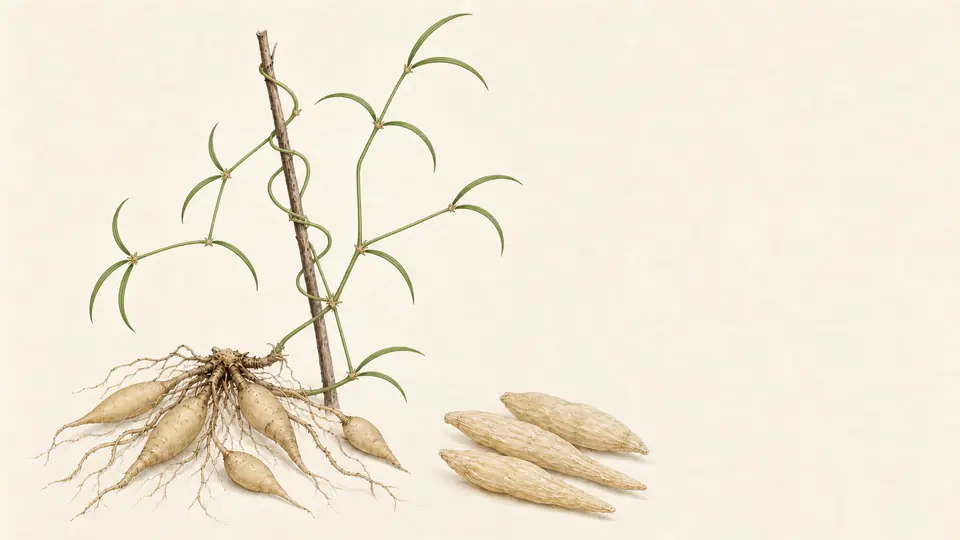
Storage roots of a coastal vine: Questions remaining after the claim of 'moistening the throat'
Can I drink Asparagus cochinchinensis as a tea for a long time when I have a cough or a dry throat? In short, there is insufficient data on long-term administration safety in humans to do so.
While Asparagus cochinchinensis is frequently mentioned in Korean medicine for coughs and dry throats, most modern findings are based on cells, animals, or saponin-concentrated extracts. Acknowledging this gap, what should we look at first?
What to check first when a cough persists
The cause and duration of a cough are important. Before drinking Asparagus cochinchinensis tea, you must check for signs such as high fever, difficulty breathing, chest pain, coughing up blood, or decreased consciousness, and determine how long the cough has lasted. In such cases, it is more appropriate to receive a medical evaluation and emergency assessment first rather than drinking more tea. Even if you choose Asparagus cochinchinensis, it cannot replace a professional evaluation of the cause of pneumonia or severe respiratory infections.
Which part of which plant is Asparagus cochinchinensis
Cheonmun-dong is a herbal medicine made from the dried tuber root of Asparagus cochinchinensis. The Korean Herbal Medicine Resource Research Center also lists it under the tuber root of this plant. The important point here is that the part used as the herbal material is not the young shoot. Even if they belong to the same genus, the edible young shoots, other asparagus species, whole-root water decoction, saponin concentrates, and fermented extracts cannot be regarded as the same medicinal part or preparation. This is because changing the part used or the processing method will also alter the exposed constituents.
The gap between expectations and actual evidence
A 2022 comprehensive literature review identified over 90 compounds and various pharmacological signals in Asparagus cochinchinensis. While there are interesting results regarding anti-inflammatory, anti-asthmatic, and gut health effects, most are preclinical data. Therefore, it is premature to translate signals observed in cells or animals into therapeutic effects for human coughs, pneumonia, or constipation. The distance between possibility and proof must be viewed as it is.
Differences by product form: Same name, different exposure
| Form | Characteristics |
|---|---|
| Dried tuberous root | Traditional medicinal form. Used as a water decoction |
| Edible young shoot | May be the same species, but differs from the part used for medicinal purposes |
| Saponin concentrate | Concentrates specific components. Exposure to components differs. |
| Fermented extract | Components may change depending on the processing method |
This table is simply for distinguishing forms. Choosing a particular form does not guarantee the same results as another form. In particular, concentrates or fermented extracts may create different exposure patterns compared to a water decoction of dried tubers.
When using with other medications or supplements
If you have liver or kidney disease, or are taking multiple medications, it is necessary to inform your medical staff or pharmacist of the product and dosage before starting an extract. Because there is a lack of interaction data in humans, some unpredictable elements remain when used concomitantly. It is not advisable to arbitrarily reduce or stop your existing prescription medications just because you are adding Asparagus cochinchinensis.
Individual circumstances and adverse reaction signals
There is a lack of safety data in humans for pregnancy, lactation, and children. It is advisable to avoid using concentrated products arbitrarily for long periods. If a rash, swelling of the lips or throat, difficulty breathing, or persistent vomiting occurs during intake, stop immediately and seek help from an emergency room or 119. This is not limited to Asparagus cochinchinensis, but is a general principle applied when using any new raw material.
Limitations of animal testing: Meaning of no liver or kidney toxicity
In a study where saponin concentrated extracts were administered to mice for 14 days, no distinct liver or kidney toxicity was observed within the test range. However, this does not determine the long-term safety in humans, nor does it determine the safe dosage for the entire tuber. Short-term animal tests are only reference materials and cannot serve as a guarantee for long-term intake.
Similar names, different ingredients
When understanding Asparagus cochinchinensis, you must distinguish between medicinal tubers and edible young shoots, Asparagus cochinchinensis and general asparagus, water decoctions and saponin concentrates, and anti-inflammatory signals in animals versus cough treatment in humans.
Similar names or plant genera do not mean they share the same efficacy and safety. When looking at product labels, it is necessary to develop a habit of checking the scientific name of the plant, the part used, and the type of extract.
Asparagus cochinchinensis and Baekrokdam Gyeongokgo are not the same thing
Just because Asparagus cochinchinensis and Gyeongokgo appear close to each other in a medicinal herb dictionary does not mean that Asparagus cochinchinensis is included in Baekrokdam Gyeongokgo. Baekrokdam Gyeongokgo is guided with a fixed composition of Ginseng, Poria cocos, Rehmannia glutinosa, and honeyand Asparagus cochinchinensis is not one of its constituent herbs. You should not apply formulations seen in traditional literature or other products to the ingredients of products currently on sale.
Therefore, when choosing Gyeongokgo, rather than wondering 'would it be better if Asparagus cochinchinensis were also included,' first check the actual four components of the product, sugar and allergy information, and the relationship with your current medications. The composition and intake standards for Baekrokdam products Gyeongokgo Informationand Kyung-ok-go Guidecan be checked in one place here.
Criteria to Check Today
When choosing Asparagus cochinchinensis, rather than the traditional expression of 'moistening the throat,' first check the exact plant, part, and formulation, as well as the cause, duration, and emergency signals of the cough. A more realistic starting point is to acknowledge the gap in clinical evidence in humans and distinguish whether it is a dried tuber or a saponin concentrate, and whether the cough is simple throat dryness or a signal of another disease.
References
- Korea Institute of Oriental Medicine, Herbal Medicine Resource Research Center: Asparagus cochinchinensis.
- Asparagus cochinchinensis botany, phytochemistry and pharmacology review.
- Saponin-enriched Asparagus cochinchinensis extract toxicity study in mice.
This text explains the origin of the raw materials, the scope of research, and precautions before consumption. As this cannot replace individual diagnosis or treatment, please consult a medical professional if you are taking medication or if symptoms persist. If sudden and severe symptoms such as difficulty breathing or decreased consciousness occur after consumption, seek help from 119 or the emergency room.

Medical Staff Review
Director Choi Yeon-seung
Chief Director of Baekrokdam Korean Medicine ClinicAsparagus cochinchinensis Dictionary Entry, reviewed the safety of expressions and the scope of verification before administration.
Review scope: Raw material origin, human studies, concomitant medications, intake safety, Baekrokdam Gyeongokgo fixed composition boundaries · Last reviewed 2026-08-30
- Graduated from Kyung Hee University College of Korean Medicine
- Providing Korean medicine treatment since 2010
- Consultations for Gongjindan, Gyeongokgo, Nokyong (Deer Antler) restorative medicine, and customized restorative herbal medicine