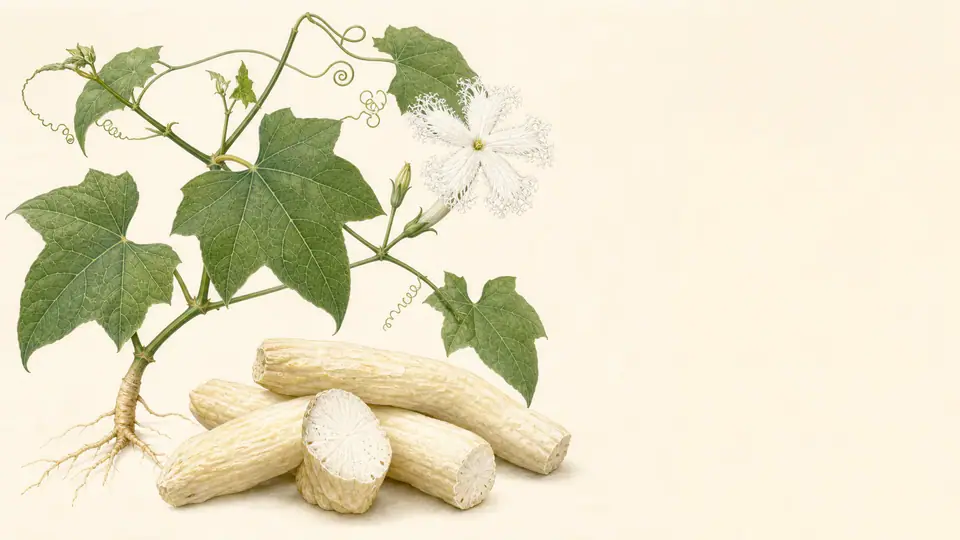
White powder from Trichosanthes root: Three faces hidden behind one name
Can I consume Cheonhwabun as a tea or powder for thirst, blood sugar, or inflammation? In short, you must first verify what that name refers to. This is because fruits, seeds, roots from the same Trichosanthes plant, and purified proteins from the root are different, yet they are often discussed as if they are the same.
This ingredient comes from the plant Trichosanthes Trichosanthes kirilowii or Trichosanthes kirilowii Trichosanthes rosthorniiDifferent parts of the same vine are distinguished by different names in the pharmacopeia, and only the root is defined as 'Cheonhwabun' in the Korean Pharmacopoeia. However, as the image of white root powder becomes mixed with the strong biological activity of the purified protein trichosanthin, the boundary between traditional decoctions and modern laboratory components often becomes blurred.
Cheonhwabun is a root, not a fruit
The Ministry of Food and Drug Safety's Korean Pharmacopoeia defines Cheonhwabun as Trichosanthes kirilowii or Trichosanthes rosthorniithe root with the cortex removed. Ripe fruit is Gwallusil, seeds are Gwalluin, and a decoction of the entire root is another form of exposure; meanwhile, trichosanthin, a ribosome-inactivating protein purified from the root, is not the same raw material as these. This is why you must first check which part and what form a product actually is when searching for or purchasing 'Cheonhwabun'.
Reasons for expectation: Potential for blood sugar and inflammation
A 2025 comprehensive literature review summarizes the various components and pharmacological potential of Cheonhwabun root. While anti-diabetic, anti-inflammatory, anti-cancer, and anti-viral potentials are mentioned, a significant portion of the data is at the component, cell, or animal level. Gaps in clinical, pharmacokinetic, quality, and toxicity research are also presented. In other words, it has not yet been confirmed how consistently traditional root decoctions or powders improve blood sugar or inflammation in humans. The existence of potential does not mean the effect has been proven.
Differences in product form: Teas/powders vs. purified proteins
Trichosanthin is T. kirilowii a ribosome-inactivating protein isolated from the root. It was used in the past for pregnancy termination, and its repeated clinical use was limited due to its antigenicity and short half-life. In mouse developmental toxicity studies, purified trichosanthin showed harmful signals for fetal survival and development. This serves as the basis for why it should be specifically avoided if there is a possibility of pregnancy. There is a difference in exposure levels between traditional raw materials consumed as tea or powder and proteins purified in a laboratory. However, if product labels or descriptions do not distinguish between the two and simply use the term 'Cheonhwabun', consumers may mistakenly perceive it as a safe wellness ingredient.
Seed research does not substitute for root safety
The existence of animal safety studies on Trichosanthes seeds does not automatically guarantee the safety of Cheonhwabun root or trichosanthin. Even within the same plant, the composition of components differs if the part is different. Viewing the root, fruit, seed, and purified protein as different raw materials is the first step in understanding this ingredient.
What should be checked when taking it with medication?
If you are taking diabetes medication, you must not reduce or replace your medication with Cheonhwabun products. When using concentrated products or extracts, it is necessary to inform your medical provider or pharmacist if you have liver or kidney disease or are taking other medications. If you experience thirst, polyuria, unexplained weight loss, vomiting, or changes in consciousness, it is better to prioritize an evaluation of blood sugar and metabolic status rather than trying a product first. Since these symptoms can be signals of diabetes or other metabolic issues, it is more practical to verify your condition before choosing an ingredient.
Exercise particular caution if there is a possibility of pregnancy
Do not use Trichosanthes kirilowii (Cheonhwabun) or tricosanthin products arbitrarily if you are pregnant, have a possibility of pregnancy, or are planning a pregnancy. The developmental toxicity signals of tricosanthin and its past use for pregnancy termination are key reasons why this ingredient cannot be treated lightly as a simple wellness component. Similarly, if you are breastfeeding, you must consult with medical staff.
Hypersensitivity reactions are emergencies
If reactions such as a rash, swelling of the face or neck, difficulty breathing, or fainting occur, stop use immediately and seek help from 119 or an emergency room. This is not limited to Trichosanthes kirilowii but is a general principle applied when starting any new plant-based ingredient.
The Gap Between Human Evidence and Expectations
The fact that blood glucose or inflammation-related signals were observed in preclinical studies does not directly translate to the treatment of diabetes or routine inflammation management in humans. The gaps in clinical data, pharmacokinetics, quality, and toxicity pointed out by a 2025 comprehensive literature review have not yet been filled. What then should be observed? The stage of research and the actual form of the product must be viewed together. Possibilities derived from cells or animals are merely interesting starting points and are not a basis for the decision to ingest.
Similar names, different ingredients
The root of Trichosanthes kirilowii is distinct from the fruit (Gwallusil) and seeds (Gwalluin). Root decoctions and purified tricosanthin also represent different types of exposure. Research on the roots of Trichosanthes and the edibility of seeds also fall into different categories. These distinctions are not merely academic classifications; they determine exactly which components are ingested and in what quantity.
Criteria to Check Today
Rather than relying on names like 'white root powder,' verify the part and species listed in the Ministry of Food and Drug Safety (MFDS) Pharmacopoeia and the actual formulation. The strong biological activity and pregnancy risks of tricosanthin cannot be substituted by the efficacy of traditional decoctions, nor can they replace blood glucose treatment. Before choosing a product, check whether it is a raw root, powder, decoction, or concentrated extract; whether it is the fruit, seed, or purified tricosanthin; whether you have been tested for thirst, polyuria, weight loss, or abnormal blood glucose; whether you are taking diabetes medication; whether there is a possibility of pregnancy, pregnancy preparation, or breastfeeding; and whether you have allergies, liver/kidney disease, or other medications. The story of this ingredient ultimately begins with distinguishing the three different faces hidden behind the name.
References
- Ministry of Food and Drug Safety Korean Pharmacopoeia: Cheonhwabun (Gwallugeun).
- Trichosanthis Radix botany, pharmacology, quality and toxicology review.
- Trichosanthin pharmacology, antigenicity and clinical limitations review.
- Developmental toxicity of trichosanthin in mice.
This text explains the origin of the raw materials, the scope of research, and precautions before consumption. As this cannot replace individual diagnosis or treatment, please consult a medical professional if you are taking medication or if symptoms persist. If sudden and severe symptoms such as difficulty breathing or decreased consciousness occur after consumption, seek help from 119 or the emergency room.

Medical Staff Review
Director Choi Yeon-seung
Chief Director of Baekrokdam Korean Medicine ClinicCheonhwabun Dictionary Entry, reviewed the safety of expressions and the scope of verification before administration.
Review scope: Ingredient origin, human studies, concomitant medications, safety of intake · Last reviewed 2026-08-17
- Graduated from Kyung Hee University College of Korean Medicine
- Providing Korean medicine treatment since 2010
- Consultations for Gongjindan, Gyeongokgo, Nokyong (Deer Antler) restorative medicine, and customized restorative herbal medicine