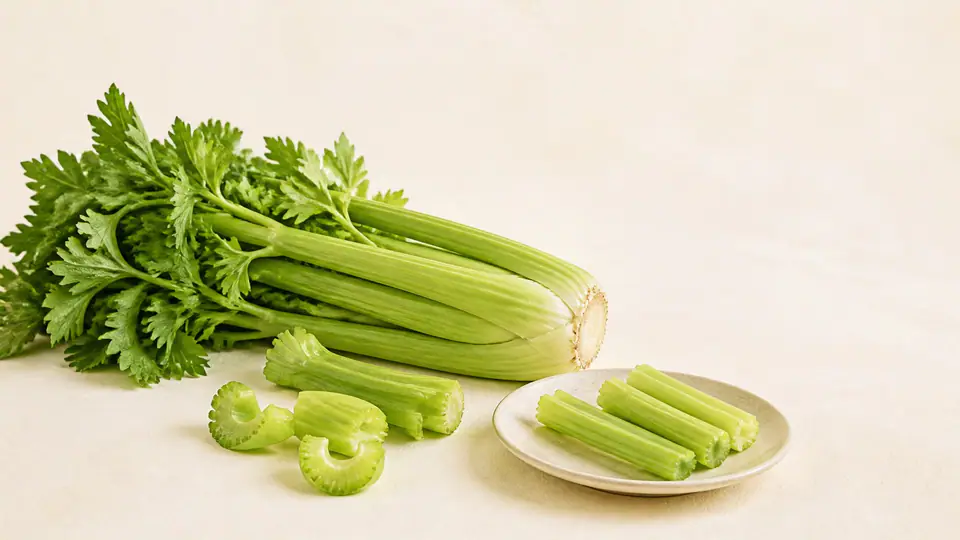
From soup aromatics to capsules
Is it okay to consume celery juice or seed extracts daily for blood pressure or swelling? It is advisable to consult a professional before daily consumption or intake. This is because celery consumed as a vegetable, seed extracts, and juices differ in the parts of the plant used and their concentrations; furthermore, research on blood pressure primarily focused on quantified seed extracts. Additionally, a decrease in blood pressure readings does not prove the prevention of myocardial infarction or stroke.
Kew classifies celery as a member of the Apiaceae family, Apium graveolensa plant that has been used for both food and medicinal purposes. The crunchy petioles we commonly know are the parts eaten as vegetables, while the seeds in the form of small fruits are used as separate preparations. Seed extracts and celery juice differ in the plant part used and the concentration. One cannot expect the same effects simply because they come from the same plant.
What kind of plant is celery?
Kew classifies it Apium graveolensas a member of the Apiaceae family used for food and medicinal purposes. Celery is used in various forms, including the petioles eaten as vegetables, leaves, seeds (referred to as small fruits), seed extracts, and celery juice. While these all come from the same plant, the parts used and their concentrations differ. A plate of petioles and one pill of seed extract are different products under the same name.
Why the expectation: Seed extract research
Most discussions regarding blood pressure and celery begin with seed extracts. In a 2022 crossover trial of 52 participants, a 24-hour reduction in blood pressure was reported when 1.34 g/day of seed extract was used for 4 weeks. However, this was a single small-scale trial. A 2025 meta-analysis of 10 trials involving 511 participants showed signals regarding blood pressure, fasting blood glucose, and triglycerides, but noted that most results were heterogeneous and samples were limited, requiring long-term verification.
Research on celery seed extracts cannot be applied to the effects of petioles or juice, nor does a reduction in blood pressure directly prove the prevention of myocardial infarction or stroke.
Vegetables, Juice, and Seed Extracts: Same Plant, Different Products
The crunchy petioles and the strong-scented seed preparations of celery come from the same plant, but they do not contain the same amount of active components. Since blood pressure research primarily used quantified seed extracts, the results cannot be transferred to general vegetables or juice.
In other words, eating petioles in a salad daily is a different choice from taking seed extract capsules. Juice is also a water-rich food; while there may be expectations for a diuretic effect, this is in a different context from seed extract research. Blurring the difference between a plate of vegetables, a glass of juice, and a single capsule may lead to expectations that diverge from reality.
What happens when taken with other medications
If you are taking blood pressure medication or diuretics, you must monitor for the possibility of dizziness or hypotension when combined with concentrated preparations like celery seed extract. It is important not to reduce medication dosages arbitrarily. For those who are pregnant, breastfeeding, or have kidney disease, the safety of seed concentrates is not sufficiently established.
What should you look for? First, check if you are taking any medications, especially blood pressure medication, diuretics, or anticoagulants. You must be even more cautious if you have kidney disease or hypotension.
Allergies: Vegetables are not harmless for everyone
In Europe, celery is a major allergen subject to mandatory labeling. Celery allergies can cause anything from hives and oral itching to dyspnea and anaphylaxis. If you have had allergies to carrots, mugwort, or birch pollen, it is safer to check for the possibility of cross-reactivity with a healthcare provider.
If dyspnea, facial swelling, fainting, or severe dizziness occurs, you must seek immediate emergency evaluation. Just because a vegetable is familiar does not mean it produces the same reaction in everyone.
The Gap Between Research Evidence and Daily Choices
Both a single small-scale trial from 2022 and a meta-analysis from 2025 focus on short-term results centered on seed extracts. Due to heterogeneity and limited sample sizes, long-term effects have not yet been confirmed. In other words, the existence of studies showing changes in blood pressure levels is not evidence that it can replace hypertension treatment.
The possibility of food allergies and digestive discomfort must also be considered. While research opens up possibilities, individual choices must be judged based on those possibilities in the context of one's current health status and concurrent medication use.
How to View Differences from Similar Ingredients
The first step is to distinguish between celery stalks and seed preparations. Vegetables, juices, and concentrated extracts have different concentrations, and a change in blood pressure levels is not the same as the prevention of cardiovascular disease. Food allergies and digestive discomfort should be treated as separate issues.
This distinction is useful not only for celery but also when looking at other plant-based ingredients. It is necessary to develop a habit of distinguishing whether it is the raw material or an extract, which part of the plant was used, and what results the research showed.
Criteria to Check Today
Rather than relying on the familiarity of it being a vegetable, first check the part used, the concentration, allergies, and current medications. The key is not to extrapolate the short-term numerical changes of seed extracts to general celery or as a replacement for medication. It is advisable to check whether you are using stalks, juice, seed powder, or standardized extracts; how much you consume per day; whether you have current medications or medical conditions; and whether you have experienced celery-related allergies.
References
- Kew: Apium graveolens.
- EFSA: Food allergens.
- Celery seed extract and hypertension randomized trial.
- Celery cardiometabolic outcomes meta-analysis.
This text explains the origin of the raw materials, the scope of research, and precautions before consumption. As this cannot replace individual diagnosis or treatment, please consult a medical professional if you are taking medication or if symptoms persist. If sudden and severe symptoms such as difficulty breathing or decreased consciousness occur after consumption, seek help from 119 or the emergency room.

Medical Staff Review
Director Choi Yeon-seung
Chief Director of Baekrokdam Korean Medicine ClinicCelery Dictionary Entries, reviewed the safety of expressions and the scope of verification before administration.
Review scope: Ingredient origin, human studies, concomitant medications, safety of intake · Last reviewed 2026-08-17
- Graduated from Kyung Hee University College of Korean Medicine
- Providing Korean medicine treatment since 2010
- Consultations for Gongjindan, Gyeongokgo, Nokyong (Deer Antler) restorative medicine, and customized restorative herbal medicine