Can I take black cohosh instead of hormone therapy for hot flashes?
Can I take black cohosh instead of hormone therapy for hot flashes? In short, some preparations may be helpful, but the evidence is not strong enough to conclude that it is a definitive substitute for hormone therapy. Furthermore, because the plant part used, extraction solvent, and standardization methods vary by commercial product, it is difficult to apply research results directly to all products.
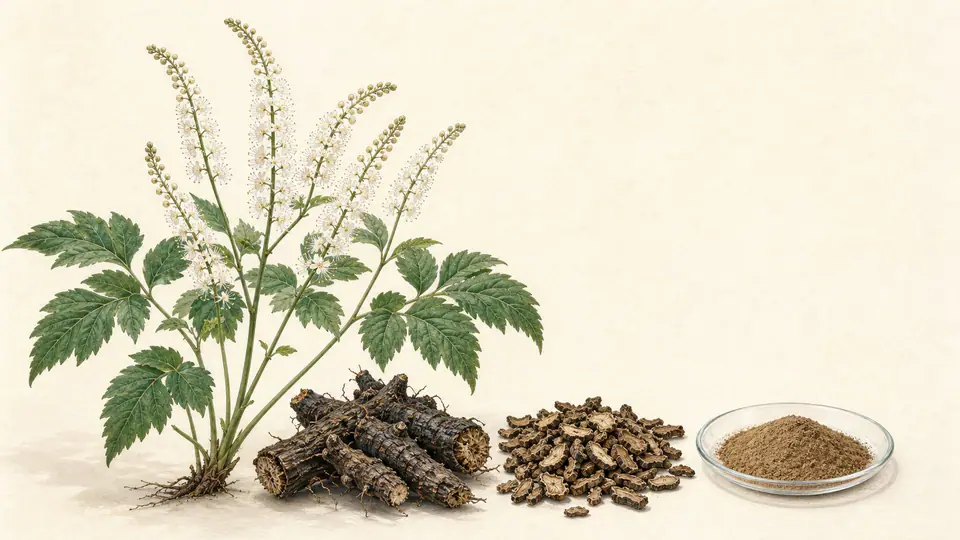
This ingredient comes from a plant of the Ranunculaceae family native to North America, Actaea racemosaspecifically from its roots and rhizomes. Old scientific names Cimicifuga racemosaare still seen. While the name may sound like one thing, powders, extracts using various solvents, specific standardized preparations, and complex formulations mixed with other herbs each have different component profiles and clinical evidence.
Background of the Question: Exploring Options for Menopausal Symptoms
Menopausal hot flashes are symptoms experienced by many women in their daily lives. While hormone therapy is known as an effective option, some seek other paths due to personal medical history or concerns. Black cohosh is frequently mentioned in this gap. A 2023 meta-analysis introduced by the NCCIH, which combined 22 studies, concluded that preparations containing black cohosh showed potential for improvement in overall menopausal symptoms and hot flashes. However, it did not confirm effectiveness for anxiety and depression. Therefore, while there are expectations for hot flashes based on some studies, it is not an ingredient that covers mood symptoms.
There is one more important distinction here. This meta-analysis included not only single black cohosh extracts but also complex preparations that used other active ingredients. Therefore, the effect of a specific product cannot be viewed as the same as the effect of black cohosh alone. What the research showed was the potential for 'certain preparations containing black cohosh,' not a guarantee for all black cohosh products.
Identity of the Ingredient: The Plant Behind the Name 'Black Root'
Black cohosh is Actaea racemosaan ingredient that uses the roots and rhizomes of a plant. It is native to North America and belongs to the Ranunculaceae family. As the scientific name changed, Cimicifuga racemosathe old name is also used, so regardless of which scientific name is written on the label, it may refer to the same plant. However, 'blue cohosh,' which has a similar name, is a completely different plant. Since these two are not the same ingredient, they cannot be used interchangeably.
Because of the image of being a plant-based ingredient, it is easy to get the impression that it is natural and safe. However, it is a fundamental property of ingredients that components vary greatly depending on the plant species, the part used, and the processing method. Black cohosh is no exception.
Reasons for Expectation: Between European Medicines and Global Supplements
Expectations for black cohosh are largely divided into two paths. One is traditional medicine used in specific extract forms in Europe, and the other is supplements sold in various forms worldwide. The EMA has assessed that specific ethanol or isopropanol dry extracts can be used for menopausal symptoms. This applies to specific dry extracts made with designated solvents for the scope of menopausal symptoms in adult women; it does not mean that all commercial supplements are certified at the same level.
US NIH data explains that because the chemical composition and extracts differ by product, it is difficult to generalize research results to all products. It also points out that long-term safety information is limited. In other words, preparations recognized under specific conditions in Europe and general supplements hold different statuses under the same ingredient name.
Differences in Product Form: Powders, Extracts, and Combination Products Are Not the Same
Black cohosh products cannot be compared simply by the name 'black cohosh.' Root powders, extracts made with different solvents, standardized preparations tailored to specific components, and combination products containing other herbs all fall into the same category. However, their ingredients and clinical evidence are not the same.
| Category | Characteristics |
|---|---|
| Root and rhizome powder | Form of the raw plant material; high possibility of ingredient variation |
| Specific solvent extract | Extracted using ethanol, isopropanol, etc.; ingredient concentrations vary |
| Standardized preparation | Products uniformed based on a specific component |
| Combination preparation | Contains other herbs or ingredients besides black cohosh |
This is why it is difficult to apply research results directly to any given product. In particular, since combination preparations do not evaluate the effect of black cohosh alone, it is a misinterpretation to apply those results to a single black cohosh extract.
Concurrent Use and Medical History: Medications and Conditions to Review Together
When considering black cohosh, you must first check your current medications and past medical history. In particular, if you have a history of hormone-sensitive diseases such as breast or uterine cancer, or if you are receiving treatment with tamoxifen or aromatase inhibitors, you must consult your oncology team first. While it is not certain that this raw material directly replaces hormonal action or interferes with treatment effects, the general rule is not to start use without caution in hormone-sensitive conditions.
Caution is also required for those with liver disease or abnormal liver function. This is because rare cases of severe liver damage have been reported after product use. However, a causal relationship proving the raw material itself was the cause has not been established, and possibilities such as the inclusion of misidentified plants or undeclared ingredients have also been raised. This is an important context in safety discussions.
Individual Circumstances and Safety Signals: When to Stop and See a Doctor
While using black cohosh, if symptoms suggestive of liver abnormality appear, such as dark urine, jaundice, severe fatigue, or pain in the upper right abdomen, you must stop use immediately and seek medical evaluation. This is a standard for action regardless of the raw material.
Since safety has not been established during pregnancy or breastfeeding, it is advisable not to use it. In particular, it must not be used for the purpose of inducing labor, and products confused with blue cohosh should be avoided. If postmenopausal bleeding, very heavy bleeding, chest pain, shortness of breath, or new neurological symptoms occur, you must have the cause evaluated immediately rather than masking the symptoms with a supplement.
The EMA recommends consulting a professional if symptoms persist or worsen, and advises not to exceed 6 months of use without medical supervision. This is a practical guideline against long-term self-administration of the raw material.
Between Evidence and Expectation: What Research Shows and What It Does Not
A 2023 meta-analysis of 22 studies showed that black cohosh-containing preparations may help with overall menopausal symptoms and hot flashes. However, no improvement was seen for anxiety or depression. This means that this raw material is not a universal solution for all menopausal symptoms.
Furthermore, because the products included in the studies mixed single preparations and combination preparations, it is difficult to isolate the effect of each product. While the number and consistency of studies suggest possibilities for some symptoms, they are not direct proof for individual products. Therefore, it is more accurate to say 'possibilities were seen in some studies' rather than concluding that 'it is effective.'
Similar Names, Different Materials: Black Cohosh and Blue Cohosh
Black cohosh and blue cohosh are entirely different plants that simply share the word 'cohosh' in their names. Black cohosh Actaea racemosais a material that uses the roots and rhizomes, whereas blue cohosh is a different plant. When checking labels, you must verify both the scientific name and the part of the plant used. If you choose based simply on the name 'cohosh,' you may purchase a completely different material.
Criteria for Today: What to Check First
If you are considering black cohosh, it is advisable to check the following three things first. First, Actaea racemosacheck if the scientific name is specified, if the root or rhizome is used, if there is information on the extraction solvent and standardization, and whether it is a single-ingredient or a combination product. Second, check which symptoms among hot flashes, sweating, sleep, or mood are persisting and for how long, and whether there are warning signs such as vaginal bleeding or weight loss. Third, check for a history of liver disease or hormone-sensitive conditions such as breast or uterine cancer, and whether you are taking medications such as tamoxifen or aromatase inhibitors.
Rather than relying on a single sentence calling it a hormone replacement, a realistic judgment criterion for this ingredient is to first verify the exact species, part used, extraction method, and target symptoms, as well as liver and hormone-sensitive medical history, and to not delay the evaluation of self-use exceeding 6 months or unexplained bleeding.
References
- NCCIH: Black Cohosh.
- NIH ODS: Black Cohosh fact sheet for health professionals.
- EMA: Cimicifugae rhizoma herbal medicinal product.
- Black cohosh extracts for menopausal symptoms: updated meta-analysis.
- Cochrane review of black cohosh for menopausal symptoms.
This text explains the origin of the raw materials, the scope of research, and precautions before consumption. As this cannot replace individual diagnosis or treatment, please consult a medical professional if you are taking medication or if symptoms persist. If sudden and severe symptoms such as difficulty breathing or decreased consciousness occur after consumption, seek help from 119 or the emergency room.

Medical Staff Review
Director Choi Yeon-seung
Chief Director of Baekrokdam Korean Medicine ClinicBlack Cohosh Dictionary Entry, reviewed the safety of expressions and the scope of verification before administration.
Review scope: Ingredient origin, human studies, concomitant medications, safety of intake · Last reviewed 2026-08-17
- Graduated from Kyung Hee University College of Korean Medicine
- Providing Korean medicine treatment since 2010
- Consultations for Gongjindan, Gyeongokgo, Nokyong (Deer Antler) restorative medicine, and customized restorative herbal medicine