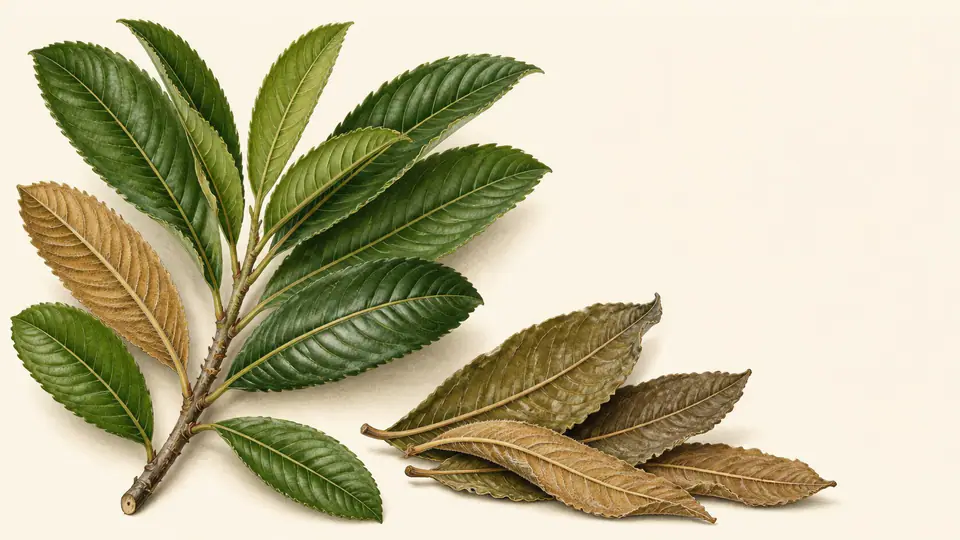
Putting the leaves of an early summer fruit tree into a cup of tea
Is it okay to drink loquat leaf tea for a long time because it is said to be good for coughs or blood sugar? In short, the familiarity of a cup of leaf tea is not enough to confirm the safety of long-term consumption.
The image of the sweet fruit of the loquat tree is easily confused with the safety of leaf concentrates, and the evidence for therapeutic effects in humans lags far behind cell and animal studies. Therefore, this gap must be distinguished.
Loquat leaf is the leaf, not the fruit
Loquat leaf is the leaf Eriobotrya japonicaof the loquat tree. The Korean Pharmacopoeia defines loquat leaf as the leaf of this tree and describes it as having dense yellow cilia on the back of the leaf. While everyone thinks of yellow, sweet fruit when they think of loquat, the loquat leaf mentioned in the pharmacopoeia is not that fruit. Sweet loquat fruit and seeds, the fuzz on the back of the leaf, leaf tea, powder, concentrated extracts, and isolated components such as ursolic acid and triterpenes are not the same raw materials or exposures. In other words, just because you have eaten loquat fruit, can you conclude that concentrated loquat leaf extracts are equally safe? No, you cannot.
Why the fuzz on the back of the leaf is important
The coarse fuzz of the raw leaf should not be inhaled or swallowed directly. The reason the pharmacopoeia describes the yellow cilia is that while this fuzz is an important identifying characteristic of the raw material, it is also a coarse irritant. Instead of using raw leaves or powders of unknown origin, you should choose products that have undergone processing and have a verified single dose. When choosing loquat leaf tea, you must first distinguish whether it is a medicinal herb with the fuzz removed from the back of the leaf, or if it is a powder or concentrated extract. What should you look for? The part of the plant used, the single dose, and whether the fuzz has been removed, as indicated on the product.
Where do the expectations for cough and blood sugar relief come from?
The reason expectations for anti-diabetic, anti-inflammatory, and antitussive effects are attached to loquat leaf is that various components such as triterpenes and flavonoids have been reported in the leaves. A 2022 comprehensive review summarized 164 components and several activities in the leaves. However, this review simultaneously points out gaps in bioavailability, pharmacokinetics, and clinical validation. Data supporting the anti-diabetic, anti-inflammatory, and antitussive expectations for the leaves are mostly based on cell and animal models, not evidence confirming the effects of general tea in humans. In other words, just because there are many components and potential is seen in animals does not mean that leaf tea drunk daily by humans acts as a cough or blood sugar medication.
Tea, powder, and concentrated extracts are not the same raw materials
Common forms of loquat leaf you may encounter include leaf tea, powder, concentrated extracts, and capsules. Although they all fall under the name of loquat leaf, the exposure amount and composition differ. In a 13-week repeated dose study in rats, no distinct toxicity was observed for a specific extract, but this is not data for long-term human consumption. Acute and subacute tests of triterpene acid concentrates are also mouse data and differ in dose and composition from whole leaf tea. Therefore, regardless of the formulation you choose, intuitions such as "it's leaf tea, so it must be mild" or "it's a concentrate, so the effect must be strong" do not apply. What is important is the single dose and duration of use indicated on the product, and whether it is the whole leaf or a concentrated component.
| Category | Points to Check |
|---|---|
| Leaf tea | Whether vellus hair was removed, dosage per administration, duration of intake |
| Powder / Concentrated extract | Concentration ratio compared to raw material, listed ingredients, amount per administration |
| Capsule | Whether it is leaf powder or extract, daily intake amount |
When using with blood glucose or cough medications
If you are taking blood glucose medication, it is advisable not to use loquat leaf concentrates based on blood glucose research in animals. Just because potential blood glucose effects were seen in animal studies does not mean we know what will happen when combined with blood glucose medication in humans. If you are taking such medication, it is necessary to show your blood glucose records and the product to your medical provider. If a cough lasts for more than 3 weeks, or if you have a high fever, shortness of breath, chest pain, blood-tinged sputum, or weight loss, prompt medical evaluation takes priority over drinking tea. There is no evidence that loquat leaf tea can replace cough medication.
Extra caution is required for pregnancy, lactation, children, and those with liver or kidney disease
There is insufficient data on the long-term or high-concentration safety and drug interactions of loquat leaf for pregnancy, lactation, children, and liver or kidney disease. This does not mean it is "dangerous," but rather that it has "not been confirmed." Caution should be exercised when taking high-concentration products for a long period in an unconfirmed state. For those prone to allergies, you should also check which parts of the plant are included and whether other leaf teas are mixed in.
The Gap Between Human Evidence and Expectations
A characteristic of loquat leaf research is that cellular and animal studies are far ahead of human clinical trials. The 164 components and various activities summarized in a 2022 comprehensive review are an interesting starting point. However, gaps in bioavailability, pharmacokinetics, and clinical validation are explicitly noted. Therefore, claims that it is "good for coughs" or "good for blood glucose" should be heard as possibilities, not as statements of therapeutic effect.
Similar names, different ingredients
When choosing loquat leaf, the following comparisons are commonly mixed up:
One must distinguish between loquat leaves and loquat fruits/seeds, between leaves with the fuzz removed and raw leaves, between leaf tea and concentrated extracts, and between whole leaves and isolated triterpene components.
This distinction is not a simple classification. This is because the image of loquat fruits and seeds can make the safety of leaf products seem supported, and the mild image of leaf tea can easily mask the potency of concentrated extracts. When selecting a product, first verify whether it is loquat tree leaves, or a product mixed with fruits, seeds, or other leaf teas.
Criteria to Check Today
There are three practical points to check when choosing or taking loquat leaf. First, whether it is loquat tree leaves, or a product mixed with fruits, seeds, or other leaf teas. Second, whether it is a medicinal herb or tea with the fuzz on the back removed, or a powder/concentrated extract, and what the daily intake amount and duration are. Third, whether you are taking cough or blood glucose medication, or if you have allergies, are pregnant, lactating, or have liver or kidney disease. The final criterion for using this ingredient is to verify the plant part (leaves), fuzz removal, formulation, and intake amount rather than relying on the familiarity of the fruit tree, and to avoid extending preclinical results as a basis for replacing cough or blood glucose medications.
References
- Ministry of Food and Drug Safety Korean Pharmacopoeia: Loquat Leaf.
- Eriobotrya japonica leaves: traditional uses, chemistry and toxicity review.
- Thirteen-week toxicity study of loquat leaf extract in rats.
- Loquat leaf aqueous extract: composition, antidiabetic effect and toxicity.
- Loquat leaf triterpene acids toxicity study in mice.
This text explains the origin of the raw materials, the scope of research, and precautions before consumption. As this cannot replace individual diagnosis or treatment, please consult a medical professional if you are taking medication or if symptoms persist. If sudden and severe symptoms such as difficulty breathing or decreased consciousness occur after consumption, seek help from 119 or the emergency room.

Medical Staff Review
Director Choi Yeon-seung
Chief Director of Baekrokdam Korean Medicine ClinicLoquat Leaf Dictionary Entry, reviewed the safety of expressions and the scope of verification before administration.
Review scope: Ingredient origin, human studies, concomitant medications, safety of intake · Last reviewed 2026-08-17
- Graduated from Kyung Hee University College of Korean Medicine
- Providing Korean medicine treatment since 2010
- Consultations for Gongjindan, Gyeongokgo, Nokyong (Deer Antler) restorative medicine, and customized restorative herbal medicine