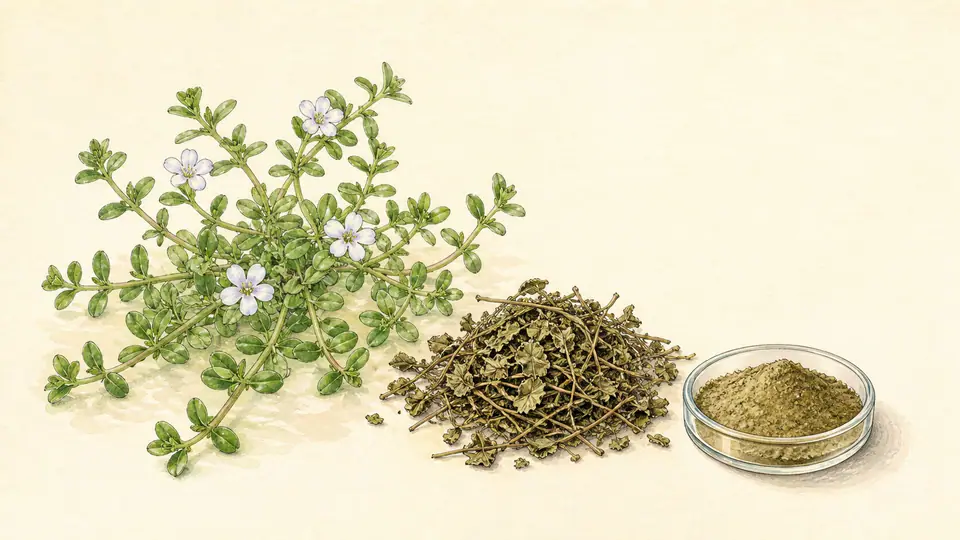
A Plant That Crawled by the Water, Now Named for Memory
If my memory and concentration are declining, will taking Bacopa help with studying or dementia prevention?
In short, while some signals were seen in partial recall tests of healthy adults after 12 weeks, there is insufficient evidence in human subjects to view it as an immediate boost in concentration or an effective dementia prevention tool. Behind this name lies a scientific name; therefore, even with the same label, the preparations can be entirely different.
Why This Question Is Frequently Asked
Bacopa has been passed down in Ayurveda as 'Brahmi,' a plant associated with memory. In modern times, it frequently appears as an ingredient in nootropics, supplements known to support cognitive function. It is an ingredient that easily attracts the attention of students, adults who feel their memory is not what it used to be, or families concerned about mild cognitive impairment or Alzheimer's disease. However, there is a gap between the traditional name and modern expectations, where product forms, study subjects, and the strength of evidence all vary. So, what is the actual reality of this ingredient?
What Bacopa Is: Scientific Name Over Common Name
The Kew Plant Database classifies Bacopa as Bacopa monnieria recognized species that is widely distributed in tropical and subtropical regions and grows in wetlands. In Korea, it is called Bacopa, Brahmi, or Water Hyssop. This ingredient is a herb made from the leaves and aerial parts of a wetland plant in the Plantaginaceae family. The important point here is that the name 'Brahmi' Bacopa monnieriis used not only for this plant but also for Centella asiatica, Centella asiaticais also used. You cannot know which plant was used or which part of the plant was used just by looking at the traditional name on the front of the product. Therefore, the scientific name Bacopa monnierito identify the ingredient.
Why Expectations Exist: Partial Recall Tests After 12 Weeks
Early studies on Bacopa in healthy adults typically used a specific extract for 12 weeks. This means it is difficult to view it as a product that increases concentration immediately, like caffeine. A review of 6 trials using three types of extracts at 300–450 mg per day showed signals of improvement in some free recall tests. However, evidence was lacking in other cognitive domains such as language, reasoning, and processing speed. In other words, there were only faint signals in some memory-related tests, and it cannot be concluded that overall cognitive function improved.
How Much Should Recent Research Lower Our Expectations?
A 2022 review of Alzheimer's disease and mild cognitive impairment examined 5 studies, all of which had a high risk of bias and very low certainty of evidence. They failed to establish a definitive difference compared to placebo or donepezil. In a 2025 randomized trial of 101 people, 300 mg/day was used for 12 weeks, but cognitive performance did not improve more than the placebo. Rather, there were more self-reported adverse reactions such as gastrointestinal discomfort and headaches. These results make it difficult to see Bacopa as significantly improving memory or concentration. Then, how should one read the product labels?
Differences in Product Form: Powder, Extract, and Standardization
Not all Bacopa products use the same raw materials. Dried herb powder, extracts with different extraction ratios, extracts standardized for bacosides, and complex formulations containing various Ayurvedic herbs are each different preparations. The studies used specific extracts, some of which were standardized for a component called bacosides. Therefore, even if commercial products contain the same number of mg, if the extraction ratio or standardization differs, you are taking something different from what was used in the research. Thus, when looking at a product, rather than simply seeing 'Bacopa 300 mg', Bacopa monnieriyou must verify whether it is a powder of the leaves/aerial parts or an extract, the daily mg dosage, and the bacoside standardization.
| Category | Points to Check |
|---|---|
| Plant Identity | Whether the scientific name is Bacopa monnierior not |
| Part/Form | Whether it is leaf/aerial part powder or an extract |
| Concentration/Standardization | Daily mg, whether it is standardized for bacosides |
Concurrent Use and Individual Circumstances: Who Should Be Prioritized
Bacopa can generally cause discomfort in people with sensitive stomachs. Since abdominal pain, nausea, diarrhea, gas, dry mouth, headache, dizziness, insomnia, or drowsiness may occur, it is advisable to set discontinuation criteria in advance if you have a sensitive stomach. Due to potential cholinergic effects, a prior review is necessary for those with bradycardia, gastrointestinal or urinary tract obstruction, ulcers, asthma, or those using cholinergic or anticholinergic medications. Additionally, while in vitro and animal data have raised the possibility of affecting thyroid hormones or drug-metabolizing enzymes, this has not been confirmed in humans. If you are taking thyroid medication or drugs where the therapeutic concentration is critical, it is appropriate to check with a pharmacist or medical professional.
Pregnancy, Lactation, Pediatrics, and New Memory Decline
There is insufficient safety data on single standardized extracts for pregnant women, lactating women, and children. One more important point: new memory decline or functional decline must be evaluated first. You should not delay dementia or mild cognitive impairment evaluations and prescriptions while starting Bacopa. While NIH LiverTox assessed that Bacopa is not linked to clinical liver injury, this does not mean that long-term safety studies in humans are sufficient.
Similar Name, Different Material: The Brahmi Trap
This is because the name 'Brahmi' is Bacopa monnieriand Centella asiaticaapplied to both. Centella asiatica is a plant familiar even in Korea and has a different action and safety profile. If the product label only says 'Brahmi extract', it is impossible to know which plant it is. Therefore, the habit of checking the scientific name, plant part, and standardization information rather than the traditional name is particularly important for Bacopa.
The Gap Between Healthy Adult Studies and the Treatment of Dementia/ADHD
Most studies on Bacopa have been conducted on healthy adults. If the purpose is to replace the treatment of dementia or ADHD, the evidence is far more lacking. In a 2022 review, all 5 studies targeting patients with Alzheimer's disease or mild cognitive impairment failed to reach a definitive conclusion. In other words, Bacopa is neither a material that provides immediate focus for studying or work, nor a medicine that prevents or treats dementia.
Criteria to Check Today
If you are considering Bacopa, first ask these three things: whether the scientific name is Bacopa monnierior not, whether it is leaf/aerial part powder or an extract, and what the daily mg and bacoside standardization are. Next, consider what your expectations are: whether it is for memory expectations in a healthy adult, or if you are trying to replace the treatment for new memory decline, mild cognitive impairment, dementia, or ADHD. Finally, check if you have gastrointestinal disease, bradycardia, thyroid disease, or if you use cholinergic/anticholinergic drugs, thyroid medication, or sedatives.
A realistic approach to this material is to look at the research context, such as the scientific name, extraction method, bacosides, and the requirement of several weeks, rather than the name 'nootropic', and to not delay the evaluation or prescription for new memory decline or dementia because of Bacopa.
References
- Kew Plants of the World Online: Bacopa monnieri.
- NIH LiverTox: Bacopa monnieri.
- NIH StatPearls: Bacopa monnieri precautions and interactions.
- Bacopa cognitive effects in healthy adults: systematic review.
- Bacopa for Alzheimer dementia and MCI: systematic review.
- Bacopa extract in adults with memory complaints: randomized trial.
This text explains the origin of the raw materials, the scope of research, and precautions before consumption. As this cannot replace individual diagnosis or treatment, please consult a medical professional if you are taking medication or if symptoms persist. If sudden and severe symptoms such as difficulty breathing or decreased consciousness occur after consumption, seek help from 119 or the emergency room.

Medical Staff Review
Director Choi Yeon-seung
Chief Director of Baekrokdam Korean Medicine ClinicBacopa Glossary, reviewed the safety of expressions and the scope of verification before administration.
Review scope: Ingredient origin, human studies, concomitant medications, safety of intake · Last reviewed 2026-08-17
- Graduated from Kyung Hee University College of Korean Medicine
- Providing Korean medicine treatment since 2010
- Consultations for Gongjindan, Gyeongokgo, Nokyong (Deer Antler) restorative medicine, and customized restorative herbal medicine