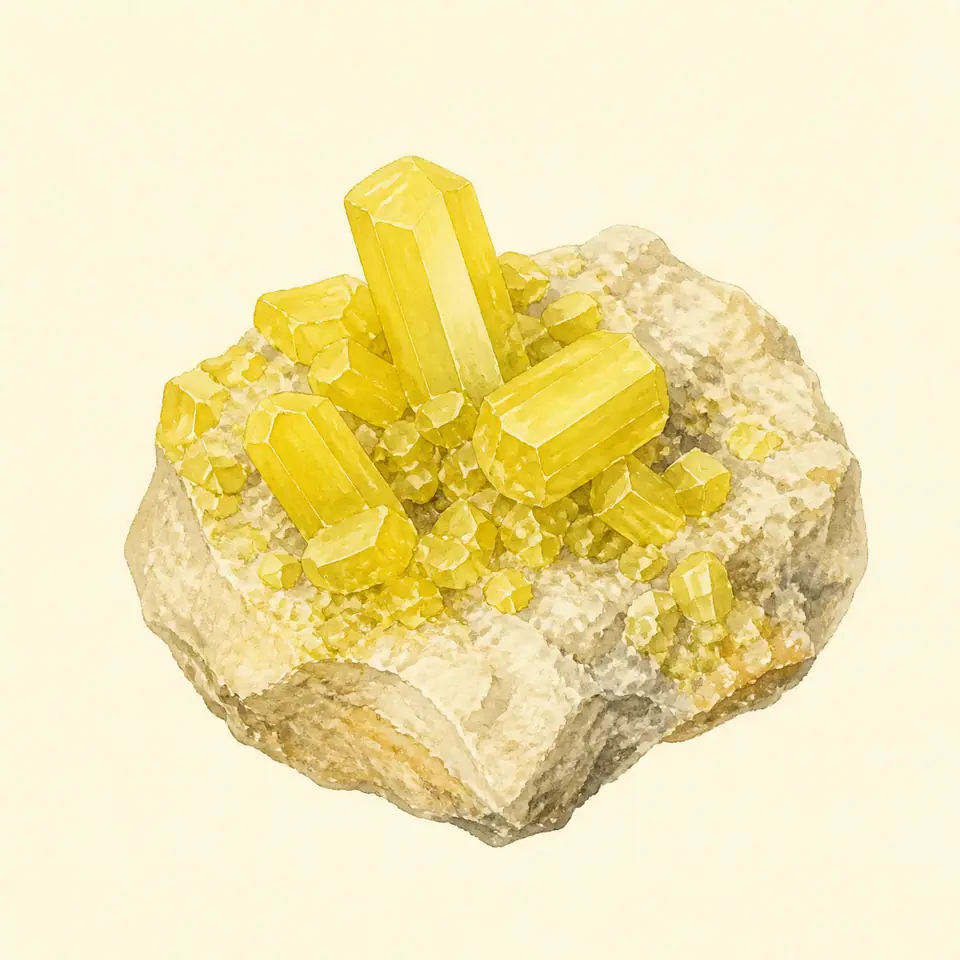
The General's Flame: A Mineral that Awakens Yang Energy
In herbal medicine, sulfur was called the 'essence of fire.' Li Shizhen, the renowned physician who compiled the Compendium of Materia Medica, introduced one of sulfur's aliases as 'The General' because its power is strong and rapid. The record in the Seongbang Cheolyong also states, 'Sulfur is the essence of fire and is also called the General.' While the name may evoke an image of a warrior on a battlefield, this mineral has actually been used in Korean medicine with two completely different faces. When applied to the skin, it becomes a 'toxin' that treats parasites and eczema; when taken internally, it becomes a restorative medicine that supplements Yang energy.
Some may first perceive it as a 'toxic medicinal herb.' Indeed, sulfur is characterized as sour and warm, and is classified as 'toxic.' However, Korean medicine has utilized this toxicity. It has been used for external treatments such as scabies and alopecia, and simultaneously as an internal restorative for conditions like cold-type constipation, impotence, cold asthma, and cold-type diarrhea caused by kidney deficiency. The same substance acts as a toxin to repel pests on the outside and as a spark to awaken Yang energy on the inside, this is the paradox of 'using toxin to remove toxin' described in herbal medicine.
However, this paradox comes with conditions. Sulfur is neither a tea nor a food, nor is it boiled as a decoction to drink. Traditionally, it was processed by boiling it with tofu to reduce toxicity before being consumed as a powder or pill, while external use was applied in the form of ointments or powders. Consumption is prohibited for those with a constitution of Yin deficiency and hyperactivity of fire or for those who are pregnant, and it has a mutually incompatible relationship with Natron, Glauber's salt, and Soda ash. Therefore, sulfur is a medicinal herb where 'who, how much, and how it is used' must be determined long before asking 'if it can be used.' We will guide you through those criteria step by step below.
Summary at a Glance
As its name suggests, sulfur is not just a simple mineral, but a medicinal herb that has simultaneously followed two paths in Korean medicine: external application and internal consumption. The following table summarizes its identity and core characteristics.
| Category | Content |
|---|---|
| Origin | Hanja Name 硫黃, Scientific Name (Unknown). A mineral medicinal herb that uses natural sulfur as a Korean herbal medicine ingredient. |
| Properties and Meridian Tropism | Sour, Warm, Toxic. Acts on the Kidney meridian and Large Intestine meridian. |
| Representative Aliases | Essence of Fire, The General. |
| Efficacy Recorded in Literature | External: Detoxification, killing parasites, treating sores. Internal: Supplementing fire and assisting Yang energy, promoting bowel movements. |
| Main Ingredients | The primary medicinal part is natural sulfur, specifically the elemental form of sulfur. |
| Combinations and Contraindications | It is not used together with Natron, Glauber's salt, or Soda ash due to mutual incompatibility. Consumption is prohibited for those with Yin deficiency and hyperactivity of fire and for pregnant women. |
Is this medicinal herb right for me?
Because sulfur is a medicinal herb that crosses the boundary between external and internal use, it is more important to determine 'if it can be used for my condition' rather than simply whether it 'has efficacy.' Traditional herbal medicine classifies sulfur as 'sour, warm, and toxic' and explains that it acts on the Kidney and Large Intestine meridians. This property provides the warm power of supplementing fire and assisting Yang energy for some, but may act as excessive fire for other constitutions.
-
Generally suitable cases: Internal prescriptions may be considered under the diagnosis of a professional Korean medicine doctor in cases where cold-type constipation repeats due to a lack of Yang energy, or when diarrhea or coldness in the heart and abdomen due to kidney deficiency is confirmed. For external use, it has been traditionally used for skin parasites or eczematous skin diseases such as scabies and alopecia.
-
Cases requiring caution: Those with a heat-type constitution, digestive diseases, or abnormalities in kidney or liver function must be especially cautious when taking it internally. Sulfur is classified as a toxic medicinal herb, and internal versions must undergo special processing such as tofu processing; therefore, it must be used only under the prescription of a professional Korean medicine doctor. As there is insufficient clinical or pharmacological evidence regarding specific interactions with modern Western medicines, consultation is required when using them concurrently.
-
Cases to avoid: Consumption is contraindicated for those with a constitution of Yin deficiency and hyperactivity of fire, a heat state accompanied by a lean body, facial flushing, night fevers, and insomnia. Consumption is also prohibited for pregnant women. Additionally, it is not used together with Natron, Glauber's salt, or Soda ash due to mutual incompatibility.
In case of overdose or improper consumption, signs of toxicity may appear, such as a hydrogen sulfide smell in the breath, vomiting, difficulty swallowing, headache, dizziness, abdominal pain, diarrhea, or in severe cases, collapse. If these symptoms occur, you must seek medical evaluation immediately.
Practical Q&A
Since sulfur is a medicinal herb that can be used both externally and internally, we have gathered the most frequently asked questions from our consultations. The answers below are general explanations based on traditional herbal medicine and prescription records and may vary depending on an individual's constitution or symptoms. Please ensure that actual use is decided through a consultation with a Korean medicine doctor.
Are the external and internal uses the same sulfur?
Yes, the material itself is the same. However, the application and form differ. External use applied to the skin is primarily for the purpose of killing parasites, detoxification, and treating sores, and is prepared as a powder, oil, or ointment. Internal use is prepared as a powder or pill after processing with tofu and is used for kidney deficiency, Yin-cold, or cold-type constipation. While external use targets a local area, internal use aims to supplement the fire of the body's overall Yang energy; thus, the approach differs even though the substance is the same.
I heard it is toxic; is internal consumption still possible?
Sulfur is traditionally classified as 'toxic.' Therefore, it must undergo professional processing (po-je) for internal consumption. A representative method is a processing technique where 200kg of tofu is added to 100kg of sulfur and heated until the tofu turns black or dark green, then washed with water and dried in the shade. This process is a traditional treatment to reduce toxicity and make it suitable for internal use. Nevertheless, internal consumption must always be done under the prescription of a Korean medicine doctor.
In which prescriptions can sulfur be found?
We introduce representative examples from traditional prescriptions where sulfur serves as a core ingredient.
- Geumyeok-dan (金液丹) A prescription recorded in the Taiping Huimin Heji Ju Fang; refined and powdered sulfur is made into pills with steamed rice cakes. It is recorded to be taken in doses of 30 to 100 pills with rice gruel on an empty stomach, and has been traditionally used for kidney deficiency, yin-cold, coldness in the heart and abdomen, and blood stasis with cold-heat in women.
- Ballyu-hwan (半硫丸) A prescription from the Taiping Huimin Heji Ju Fang; equal parts of processed sulfur and Pinellia (Banxia, processed 7 times by boiling) are mixed with ginger juice and steamed rice cakes to make pills. It is recorded that 15 to 20 pills should be taken on an empty stomach with warm wine or ginger decoction, and women should take it with vinegar decoction. It was used for coldness in the heart and abdomen, such as deficiency constipation, cold constipation, wind-induced constipation, and diarrhea in the elderly.
- Heukseok-dan (黑錫丹) A prescription listed in the Taiping Huimin Heji Ju Fang; a combination of black lead and sulfur, traditionally used for exhaustion of true essence, deficiency of yang energy, yin-toxicity, and disharmony of the Triple Burner (Sanjiao).
In addition, the Bencao Gangmu and Chengfang Qieyong list several other sulfur-containing prescriptions, such as Raebok-dan, Ikgi-dan, and Baneum-dan.
Can it be used during pregnancy or for those with a heat-prone constitution?
No. Because sulfur has acidic, warm, and toxic properties and acts on the kidney and large intestine meridians, it is contraindicated for those with Yin Deficiency and Hyperactivity of Fire (a state where yin is insufficient and heat rises excessively). It is also recorded as contraindicated for pregnant women. Special caution is required for those with a heat-prone constitution, digestive diseases, or abnormalities in kidney and liver function.
Should it not be used together with Bakcho (natron) or Mangcho (mirabilite)?
Sulfur is recorded as having a 'sang-oe' (mutual repulsion) relationship with Bakcho (natron), Mangcho (mirabilite), and Wonmyeong-bun (sodium carbonate). 'Sang-oe' refers to a combination where the medicinal effects of the ingredients may weaken each other or cause side effects. Therefore, it is a traditional principle to avoid using these ingredients together.
What signs should I look for that indicate I need to visit a hospital?
Since sulfur is a toxic medicinal ingredient, signs of toxicity may appear if taken in excessive or inappropriate amounts. If you notice a hydrogen sulfide smell in your breath, or experience vomiting, difficulty swallowing, headache, dizziness, abdominal pain, or diarrhea, stop use immediately and seek medical evaluation. In severe cases, it may lead to a state of collapse. Emergency medical care is required if accompanied by persistent vomiting, diarrhea, dehydration, or difficulty breathing.
Relationship with Other Medicinal Herbs (Yakdae/Pairing)
Sulfur is rarely used alone. The core of traditional prescriptions is to pair it with other ingredients to balance its properties, neutralize toxicity, or direct its action through specific pathways. In herbal medicine, these pairing relationships are called 'yak-dae' (medicinal pairs). For internal use, representative prescriptions have been passed down combining sulfur with Pinellia (Banxia) or black lead, and for external use, combinations with other detoxifying or insecticidal ingredients.
-
Sulfur + Pinellia (Banxia), Ballyu-hwan (半硫丸) A prescription listed in the Taiping Huimin Heji Ju Fang, using equal parts of sulfur and Pinellia. The moisture-drying property of Pinellia and the warm, laxative action of sulfur have been traditionally used for constipation accompanied by deficiency constipation, cold constipation, and coldness in the heart and abdomen in the elderly. It is recorded to be taken as 15 to 20 pills on an empty stomach with warm wine or ginger decoction, and women should take it with vinegar decoction. Taiping Huimin Heji Ju Fang, Cited in Chengfang Qieyong and Bencao Gangmu
-
Sulfur + Black Lead, Heukseok-dan (黑錫丹) A prescription also included in the Taiping Huimin Heji Ju Fang. It is structured to treat exhaustion of true essence, deficiency of yang energy, and disharmony of the Triple Burner by using black lead to support the strong warm properties of sulfur. 《太平惠民和劑局方》
-
Purely refined sulfur, Geumyeok-dan (金液丹) Strictly speaking, it is close to a single-ingredient prescription, but the process of refining and powdering sulfur and making it into pills with steamed rice cakes is a method to partially mitigate its toxicity. It was used for kidney deficiency, yin-cold, coldness in the heart and abdomen, deficiency-cold diarrhea, and blood stasis with cold-heat in women, and is recorded to be taken as 30 to 100 pills with rice gruel on an empty stomach. Taiping Huimin Heji Ju Fang, Cited in Bencao Gangmu and Chengfang Qieyong
Combination Contraindications Sulfur has a 'sang-oe' (mutual repulsion) relationship with Bakcho (natron), Mangcho (mirabilite), and Wonmyeong-bun (sodium carbonate). This is a traditional combination principle meaning they should not be used in the same prescription, or if used together, the effect may be weakened or side effects may occur. Caution is taken to avoid this combination in actual prescriptions.
In what form is it consumed?
Since sulfur is a mineral ingredient and is traditionally classified as 'toxic,' the method of consumption differs from general herbal medicines. We have summarized the common questions by form below.
- Drinking as tea This is not common. Unlike plant-based ingredients that are boiled in water to make a decoction, sulfur is a mineral processed into powder or pill form for internal use, so a tea form is not appropriate.
- Adding to food This is not common. Sulfur is a medicinal mineral, not a food, and because it is toxic, it should not be consumed personally in the form of food or supplements.
- Jeontang (decocting by boiling) This is not common. Instead of decocting, it is traditionally processed through 'Suchibeop' (a method of boiling with tofu to reduce toxicity) and then taken as a powder or pill.
- Prescription and processing by a professional Korean medicine doctor This applies. Internal sulfur must be used through the prescription and proper processing (formulation) of a professional Korean medicine doctor. Traditionally, there are records of taking 1.5~3.0g in powder or pill form after tofu processing. For external use, it may be prescribed as an ointment or powder.
Interactions and Safety During Use
Sulfur is a mineral medicinal herb classified as 'acidic, warm, and toxic.' Therefore, while its efficacy is recognized for both external and internal use, it has a dual nature where intake is restricted depending on the individual's constitution and symptoms. Below is a summary of contraindicated constitutions, pregnancy-related precautions, and interactions with other medicinal herbs as identified in traditional pharmacognosy.
-
Eumheohwawang (Yin deficiency and Fire hyperactivity) constitution, Intake prohibited When the body lacks Yin energy and, as a result, Fire rises upward, the warm properties of sulfur may aggravate the symptoms. Particular caution is needed if accompanied by facial flushing, dry mouth, night fevers, or insomnia.
-
Pregnant women, Intake prohibited Traditional pharmacognosy records that internal intake of sulfur should be avoided during pregnancy. As it is a toxic medicinal herb, it is in principle not used during pregnancy or breastfeeding.
-
Bakcho (Natron), Mangcho (Glauber's salt), Wonmyeongbun (Soda ash), Sang-oe (Mutual repulsion) Sulfur has a 'Sang-oe' relationship with these herbs. In Korean medicine, Sang-oe refers to a combination relationship where herbs may weaken each other's effects or cause side effects, so they are not used together in the same prescription.
-
Caution for heat-prone constitutions, digestive diseases, or kidney/liver dysfunction Sulfur is a medicinal herb that acts on the Large Intestine Meridian and Kidney Meridian. Therefore, if you have a constitutionally hot nature or abnormalities in gastrointestinal, liver, or kidney function, you must consult a Korean medicine doctor before intake.
Specific interactions with modern Western medicines have not been sufficiently confirmed through clinical or pharmacological evidence. If you are taking Western medicine or have a chronic disease, please inform us before the prescription. Since sulfur is a toxic medicinal herb, it is safer to use it through a Korean medicine doctor's prescription and processing rather than deciding to take it personally based on perceived efficacy.
If you experience these symptoms
If these signs appear
Sulfur is used both externally and internally, so it is important not to miss the warning signs the body sends during overdose or long-term use. The following signs are symptoms recorded in traditional pharmacognosy and modern interpretations regarding sulfur poisoning or overdose. If these symptoms appear, do not reduce the dose or stop on your own; first notify the prescribing Korean medicine doctor. If symptoms are severe or progress rapidly, you must visit an emergency medical institution.
- When a hydrogen sulfide smell is detected from the mouth A peculiar smell in the breath is a recorded sign of excessive metabolism of sulfur in the body or a sign of poisoning.
- When vomiting is repeated or diarrhea is severe Persistent digestive symptoms can lead to dehydration or electrolyte imbalance.
- Dysphagia (difficulty swallowing) Functional abnormalities near the throat or esophagus require prompt medical evaluation.
- Headache, Hyeonhun (dizziness) These are signals that the central nervous system may be affected.
- When abdominal pain worsens or abdominal diarrhea continues This may suggest long-term irritation or a toxic reaction.
- When experiencing systemic collapse (exhaustion) or a loss of energy This may indicate that toxicity has worsened, and emergency medical care is required without delay.
Even if symptoms appear mild, sulfur is a mineral medicine classified as toxic; therefore, it is safer to consult your prescribing medical staff first rather than deciding to 'wait and see.'
Differences from other restorative medicines
When taken internally, sulfur is classified as 'Bohwa-joyang' (補火助陽), an action that supplements the Yang energy (陽氣) within the body. Because of this, I often receive the question in the consultation room, "Is this also a restorative herbal medicine?" While the question is reasonable, the answer is not simple. In traditional pharmacognosy, sulfur is placed in a different category from common restorative medicines such as Ginseng, Astragalus, or Angelica gigas. This difference begins not with the direction of its efficacy, but with its identity as a 'restorative medicine that possesses toxicity.'
Traditional restorative agents such as Gongjindan or Gyeongokgo are primarily composed to slowly replenish deficiencies in Qi, Blood, and Essence over a long period. In contrast, sulfur is a potent medicinal ingredient used to treat Yang deficiency in the Kidney and Large Intestine meridians, particularly urgent cold symptoms such as deficiency-cold or cold-induced constipation. Prescriptions such as Geumyeokdan, Banryuhwan, or Heukseokdan recorded in the "Taiping Huimin Heji Jufang" all use sulfur as a core ingredient, but their purpose is closer to 'expelling deep-seated cold and reviving Yang energy' rather than being a 'restorative medicine that slowly boosts energy.'
Another major difference is the form of administration. General restorative medicinal ingredients are often boiled into decoctions or taken long-term as powders or pills. For sulfur, the traditional processing method for internal use involves boiling it with tofu to reduce toxicity, and it is used only in powder or pill form. It is not appropriate to brew it as a tea or consume it like an everyday food.
Therefore, while sulfur falls under the broad umbrella of 'restorative medicine,' it sits on the periphery. If it does not match one's constitution, particularly those with Yin deficiency and hyperactivity of Fire, heat-type constitutions, or pregnant women, it can actually be harmful. The duration and dosage of administration must also undergo the prescription and processing (po-je) of a professional Korean medicine doctor. The question of "Which restorative medicine is right for me" is ultimately one that must be judged comprehensively through a consultation with a Korean medicine doctor, considering constitution, symptoms, and currently taken medications.
References
- Sulfur-related evidence 1: koreantk.com evidence materials.
- Sulfur-related evidence 2: encykorea.aks.ac.kr reference material.
- Sulfur-related evidence 3: law.go.kr evidence.
- Sulfur-related evidence 4: Korea Institute of Korean Medicine official data.
- Sulfur-related evidence 5: Official data from the Ministry of Food and Drug Safety.
If you would like to check if this medicinal herb is right for you or which prescription it should be used with, please leave a medical inquiry. For those who find it difficult to visit the clinic, non-face-to-face consultations are available; we will provide guidance after first reviewing your current condition and current medications.

Medical Staff Review
Director Choi Yeon-seung
Chief Director of Baekrokdam Korean Medicine ClinicSulfur Dictionary Entry, reviewed the safety of expressions and the scope of verification before administration.
Review Scope: Clinical Accuracy, Pharmacology, Contraindications, Combinations, QA · Last Reviewed 2026-08-16
- Graduated from Kyung Hee University College of Korean Medicine
- Providing Korean medicine treatment since 2010
- Consultations for Gongjindan, Gyeongokgo, Nokyong (Deer Antler) restorative medicine, and customized restorative herbal medicine