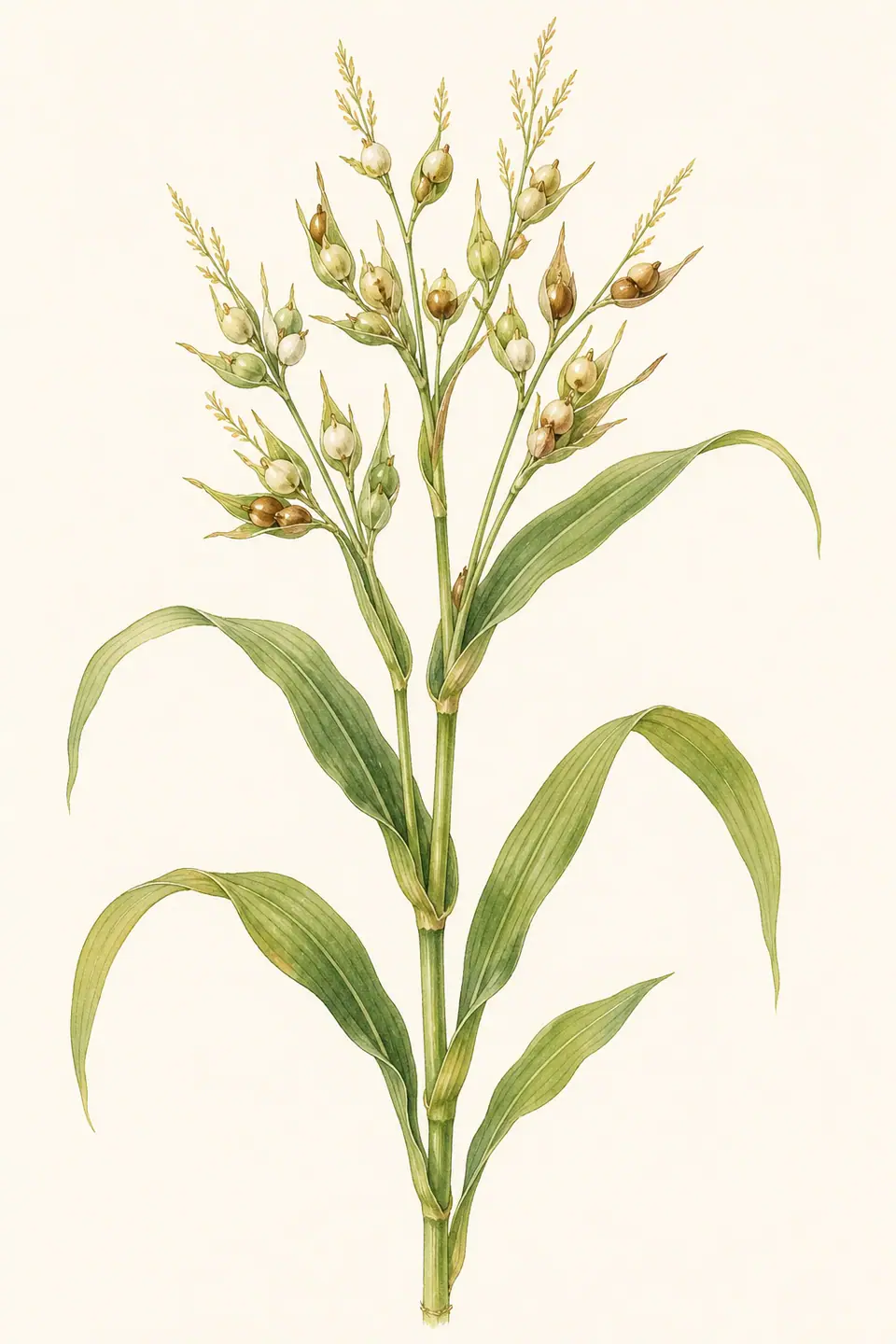
Yiyi Mingzhu (The Bright Pearl of Coix): Seeds that Clear Dampness
The 'Book of the Later Han' (Hou Hanshu, Biography of Ma Yuan) records that General Ma Yuan of the Later Han Dynasty enjoyed eating Job's tears (Coix seeds) while serving in Jiaozhi, present-day Vietnam. When he returned home, his enemies plotted against him, claiming that the Job's tears he carried on his ship were actually 'bright pearls' (Mingzhu). This anecdote became the idiom 'Yiyi Mingzhu.' The 'Compendium of Materia Medica' (Bencao Gangmu) also cites this, stating, 'Ma Yuan in Jiaozhi often ate Coix seeds, saying they could lighten the body and reduce desires to overcome the miasma.' What Ma Yuan valued was not a mere grain, it was Job's tears, known as Ui-i-in in Korean medicine, used as a medicinal herb to lighten the body and boost energy in the southern lands where damp-heat and heavy energy were prevalent.
Today, Ui-i-in is more commonly known as a 'diet tea' or as something 'good for eczema.' In fact, the 'Divine Farmer's Materia Medica' (Shennong Bencao Jing) records that 'long-term use lightens the body and benefits the Qi,' and the 'Classified Materia Medica' (Zhenglei Bencao) states it 'eliminates edema and improves appetite,' showing that its ability to lighten the body and remove excess fluid has been known for a long time. However, the core of this herb lies in managing 'dampness.' The 'Compendium of Materia Medica' explains, 'Coix seed belongs to the Earth element and is a Yangming medicine, thus it can strengthen the spleen and stomach... Earth can overcome water and remove dampness, therefore it is used for diarrhea and edema.' In other words, Ui-i-in supports the Earth energy of the spleen and stomach, using that strength to guide accumulated fluids out of the body. Thus, it has been traditionally used for symptoms involving 'dampness,' such as edema, diarrhea, joint stiffness, and skin eczema.
However, this power to 'clear dampness' is not necessarily beneficial for everyone. Records from the Traditional Knowledge Portal and the Korea Institute of Oriental Medicine warn that caution is needed for those with 'Spleen weakness and constipation' (Pi-yak-byeon-nan), people whose spleen Qi is weak and who suffer from constipation. Herbs that remove fluid can actually worsen symptoms in people who already lack body fluids or have slow intestinal motility. The 'lightening of the body' mentioned in the 'Divine Farmer's Materia Medica' occurs only when there is excessive dampness; for those who are naturally thin and deficient, it may have a different effect.
Therefore, how much, to whom, and how to use it is particularly important for this herbal material. While it can be enjoyed lightly as a tea, it is also a herbal medicine that holds meaning in prescriptions. It forms one component of Samin-tang (Sam In Tang), which clears dampness and heat, and also serves as the main ingredient in Euiibujaepaeksan (Euiibujaepaeksan), which addresses intestinal abscess. Below, we will carefully guide you through the properties of this herb, its main formulas, and precautions such as constipation and pregnancy.
Summary at a Glance
Ui-i-in is a medicinal herb recorded in long-standing literature from the 'Divine Farmer's Materia Medica' to the 'Compendium of Materia Medica.' It is the seed of Job's tears, a grain suitable for both food and medicine. The table below summarizes the core identity, properties, and key precautions of this herb.
| Category | Content |
|---|---|
| Origin | Hanja Name 薏苡仁, Scientific Name (Unknown) Job's tears (Coix lacryma-jobi var. ma-yuen) dried seed (botanical seed part) as a crude drug |
| Properties and Meridian Tropism | Sweet, bland, slightly cool; acts on the Spleen, Stomach, and Lung meridians |
| Representative Aliases | 解蠡, 薏珠子, 菩提子, 回回米, 溝子米, 六谷米, 米仁 |
| Efficacy Recorded in Literature | 《神農本草經》: “主筋急拘攣不可屈伸, 風濕痺, 下氣. 久服輕身益氣.” 《證類本草》: “利腸胃, 消水腫, 令人能食.” 《本草綱目》: “健脾益胃, 土能勝水除濕.” |
| Main Efficacy | Promotes urination and drains dampness, strengthens the spleen and stops diarrhea, relieves stiffness in joints and muscles caused by wind-dampness, and clears heat and discharges pus |
| Main Ingredients | Verification required. Please inquire during your consultation. |
| Combinations and Contraindications | A key component in prescriptions for damp-heat, wind-dampness, and abscesses, such as Sam-in-tang, Mahuang Xingren Yiyi Gancao Tang, and Ui-i-bu-ja-pae-jang-san. Contraindicated for pregnant women. Caution is advised for those with constipation due to spleen weakness, those with a cold-yin constitution, or those with depleted body fluids. When used with restorative medicines for Yang or Yin, effects may vary by constitution, requiring a diagnosis by a Korean medicine doctor. |
Is this medicinal herb right for me?
While Ui-i-in is an edible grain, its suitability as a Korean herbal medicine varies depending on the individual's constitution and symptoms. Please check the following three criteria first.
- Generally suitable casesSuitable: May be suitable for those who feel heavy and swollen, have difficulty urinating, or experience recurring eczema or itching. It is also used based on diagnosis for those with slow digestion and loose, watery stools, or those classified as having a damp-heat constitution.
- Cases requiring cautionCaution: Caution is advised for those with constipation, especially those whose intestinal motility is poor due to weak spleen Qi. Pregnant or breastfeeding women, and those with a cold or Yin-deficient constitution, should decide after consulting a specialist.
- Cases to avoidAvoid: Avoid or must consult a Korean medicine doctor in cases of acute spasms or paralysis due to cold-yin, constipation caused by depleted body fluids, or when there is a clear plan to use Western medicine but interactions have not been confirmed.
Practical Q&A
We have gathered the most frequently asked questions from actual practice. Because Ui-i-in is an edible grain, it is easy to underestimate, but its suitability as a Korean herbal medicine depends on constitution and symptoms. The following questions are organized based on what patients actually ask most often in the clinic.
Is Job's tears tea the same as the herbal medicine Ui-i-in?
Yes, they are the seeds of the same plant. However, the dosage and purpose of use differ. Job's tears tea consumed in daily life is a form of steeping or boiling small amounts; as recorded in the 'Classified Materia Medica' ('cooked as rice or made into flour'), it has long been used as an edible grain. In contrast, in Korean herbal medicine prescriptions, 9–30g is decocted and consumed (based on the Pharmaceutical Information Center), with a clear therapeutic purpose such as guiding out damp-heat or strengthening the spleen and stomach. In short, while the ingredient is the same, the quantity and application differ.
I have constipation; can I still take it?
You should be cautious if you have constipation. Data from the Traditional Knowledge Portal and the Korea Institute of Oriental Medicine advise caution for those with a 'Spleen weakness and constipation' (Pi-yak-byeon-nan) constitution, people who have constipation due to a weak spleen and stomach. Because Ui-i-in has a diuretic effect that guides fluids downward, it may worsen constipation in those who already lack lubrication in the intestines. If you have constipation, please let us know during your consultation so we can determine the appropriate formulation for your constitution.
Is it safe during pregnancy?
It is listed as contraindicated for pregnant women. Data from the Pharmaceutical Information Center also marks it as 'Forbidden for pregnant women.' If you are pregnant or may be pregnant, please stop consuming teas or Korean herbal medicines containing Ui-i-in and consult a professional first.
Can it be used topically for eczema or itching?
There are cases where Coix seed (Euianin) is included in prescriptions related to eczema or itching. The "Shennong Ben Cao Jing" records that "long-term use lightens the body and benefits Qi," and the "Jeungryu Boncho" states it "removes evil Qi from the muscles and bones," meaning it is used to guide dampness and heat out of the body and alleviate skin discomfort. However, whether it can be used topically and the appropriate dosage depend on an individual's skin condition and the overall context of the prescription. Therefore, it is advisable to consult a Korean medicine doctor rather than applying it topically on your own.
Does taking it with restorative herbal medicine reduce its effectiveness?
Direct interaction studies with restorative medicines such as Gongjindan or Gyeongokgo have not been confirmed. However, in Korean medicine, Coix seed is considered slightly cold and has a mild draining property. In those with a damp-heat constitution, using it with restorative medicine can help alleviate lingering damp-heat. Conversely, for those with Yin deficiency, Qi deficiency, or Spleen-Yang deficiency, there is a consideration that its moisture-draining effect may deplete the restorative effects of the medicine. Since the combination must be adjusted based on the deficiency, excess, coldness, and heat of your constitution, please inform us of any restorative medicines you are currently taking during your consultation so we can adjust the prescription appropriately.
How long can I take it?
Job's tears tea at a food-grade level can be consumed daily, but decoctions for therapeutic purposes or high-dose use are recommended only under the pattern identification of a Korean medicine doctor. Long-term high-dose intake may cause concerns such as damage to Spleen Qi, diarrhea, abdominal pain, or worsening constipation; therefore, the duration and dosage should be adjusted according to your individual condition. If you experience exhaustion, weakness, diarrhea, worsening constipation, menstrual irregularities, or lower abdominal pain during intake, stop immediately and seek medical evaluation.
Relationship with Other Medicinal Herbs (Yakdae/Pairing)
This medicinal herb's characteristics become more distinct when used with other herbs rather than alone. In traditional Korean medicine, such pairs are called "Yakdae" (medicinal pairs). Coix seed specifically acts as a "guide" that leads the prescription toward filtering dampness and organizing heat. Below are representative combinations recorded in actual literature.
- Samin-tang A prescription found in "Onbyeong Jobyeon." It uses Coix seed along with Amomum villosum, Apricot seed, Bamboo leaf, 通草 (Tongcho), Talcum, Pinellia ternata, and Magnolia bark. It has been traditionally used to smooth the flow of Qi and clear damp-heat. In this prescription, Coix seed plays the role of guiding dampness and supporting the spleen and stomach due to its sweet, bland, and slightly cool properties.
- Mahwang Haengin Ui-i Gamcho-tang A prescription recorded in the "Shanghan Lun," consisting of Ephedra, Apricot seed, Coix seed, and Licorice. The "Jeungryu Boncho" quotes that "Zhang Zhongjing used this for symptoms where the body is heavy and painful due to wind-dampness, which worsen toward evening." Here, Coix seed plays a supporting role in resolving wind-dampness and managing joint stiffness.
- Ui-i Buja Paejang-san A prescription found in the "Jin Gui Yao Lue." It consists of Coix seed, Aconite, and Patrinia saponaria, and has been traditionally used for intestinal abscesses. It is structured so that the cool Coix seed organizes heat and discharges pus, while the warm energy of Aconite maintains balance.
- Ui-i-in-san / Cheon-geum Ui-i-in-tang Recorded in "Jeungchi Junseung · Ryubang." Ui-i-in-san is a prescription where Coix seed is crushed into a porridge-like consistency and taken on an empty stomach to manage chronic wind-dampness and stiffness of muscles and tendons. Cheon-geum Ui-i-in-tang uses White lily turf, Coix seed, Peony root, Cinnamon bark, Jujube seed, Dried ginger, Achyranthes root, Licorice, and Aconite, and has been traditionally used for symptoms where tendons are stiff and cannot be extended.
When combining herbs, caution is required for those with severe Yin deficiency, Qi deficiency, or constipation, even when used with other herbs, due to the "moisture-draining (利濕)" property of Coix seed. Especially when used with restorative medicines, the restorative effect may be depleted by the draining action depending on the constitution, so combination under the pattern identification of a Korean medicine doctor is necessary.
In what form is it consumed?
As indicated by the fact that Yiin is the seed (種仁) of coix, it exists both as an edible grain and as a herbal medicine. Therefore, it can be consumed as a tea, added to rice or porridge, or taken as a decoction according to a prescription. However, because the appropriate uses and precautions differ depending on the form, I will explain them in four categories.
- Drinking as tea Possible. Job's tears tea is a commonly known tea for daily consumption. However, when drinking it as a diet tea, it is recommended to check if it suits your constitution.
- Eating as food Possible. The "Jeungryu Boncho" records that it is "cooked as rice or made into noodles," and the "Bencao Gangmu" states it "can be made into porridge, rice, or ground into noodles." As it has been used as an edible grain for a long time, it can be safely consumed at a general food level.
- Consumption as a decoction (煎服) Common in herbal medicine prescriptions. Both the Pharmaceutical Information Center and the Korea Traditional Knowledge Portal record a decoction dose of 9 to 30g. Since the dosage and combination vary depending on the purpose of the prescription, such as draining damp-heat or managing the spleen and stomach, it is appropriate to use it under the pattern identification of a Korean medicine doctor.
- Self-administration · High-dose professional prescriptions Not common. While Coix seed is safe as a food, there are contraindications or precautions for high-dose therapeutic use, long-term intake, or specific conditions such as pregnancy, constipation-prone constitutions, or Yin deficiency. Please determine the prescription suitable for your symptoms after consulting a Korean medicine doctor.
Interactions and Safety During Use
While Coix seed is an edible grain, there are aspects that require caution depending on the constitution and symptoms when used as herbal medicine. In particular, as it has a strong property of removing water and organizing the intestines, the body's reaction may vary depending on the form of intake, dosage, and accompanying herbs. Below are the precautions confirmed in literature and pharmaceutical information.
- Pregnant women: Traditional Korean medicine records suggest that pregnant women should avoid intake.
- People with constipation: For those who experience frequent constipation due to weak Spleen Qi (脾氣), or constipation caused by a deficiency of body fluids (津液), long-term use should be approached with caution as it may aggravate symptoms.
- Yin-Cold (陰寒) constitution or acute spasms: Due to its cool and mild diuretic properties, it may not be suitable for individuals with a cold body or those experiencing acute spasms.
- In case of overdose: Strong diuretic effects may cause diarrhea or abdominal pain, and long-term high-dose use may risk damaging the Spleen Qi.
- Interactions with Western Medicine: To date, no literature on specific interactions with Western medicines has been identified. If you are taking other medications, please inform us before receiving a prescription.
It is generally safe when consumed as food or tea, but when used for therapeutic purposes through decoction or in high doses, it must be prescribed based on a Korean medicine doctor's pattern identification (辨證). If diarrhea, abdominal pain, worsening constipation, menstrual irregularities, or lower abdominal pain occur during use, it is recommended to stop and seek medical evaluation.
If you experience these symptoms
Coix seed (Yui-in) is a medicinal herb with strong properties for removing excess water and regulating the intestines. While consuming it as tea or food is generally not an issue, you must not ignore the signals your body sends when taking it in high doses or for long periods as a Korean herbal medicine prescription. The following signals are known warnings that may appear when the diuretic and Spleen-strengthening effects of Coix seed become excessive or do not match your constitution. Rather than enduring it alone or attempting to reduce the dose yourself, it is important to first notify the Korean medicine doctor who provided the prescription.
-
When diarrhea or abdominal pain recurs Coix seed has a strong action of filtering dampness and directing water downward. If taken in excess or if unsuitable for your constitution, it may overstimulate intestinal function, leading to diarrhea or abdominal pain.
-
When constipation worsens For those with a constitution prone to constipation due to weak Spleen Qi (脾氣), referred to as 'Spleen-weakness-induced constipation' (脾弱便難) in traditional Korean medicine, Coix seed may further deplete the energy of the intestines and worsen constipation.
-
When menstrual irregularities or lower abdominal pain occur This herb is known to be contraindicated for pregnant women. If there is a possibility of pregnancy or if abnormal symptoms appear during use, stop immediately and seek medical evaluation.
-
When feeling exhaustion or extreme weakness Long-term high-dose use may damage the Spleen Qi (脾氣). If you feel increasingly exhausted and lacking in strength, stop use and a consultation is required.
-
When coughing or difficulty breathing worsens If symptoms suspected to be lung abscess (肺癰) or severe infection accompany this, do not attempt to treat it with Coix seed alone; you must seek hospital medical evaluation.
-
When urine volume increases excessively or the body becomes cold Coix seed has slightly cold and mild diuretic properties. Overuse may lead to excessive discharge of body fluids, causing the body to become cold or energy to be depleted.
Even if abnormal symptoms are mild, if they persist for several days, or if they are accompanied by severe abdominal pain, bloody stools, difficulty breathing, or decreased consciousness, it is safe to visit an emergency medical institution. Since the core of Korean herbal medicine is adjusting it to the constitution and the flow of symptoms, please consult the Korean medicine doctor who prescribed the medicine if any discomfort arises during use.
Differences from other restorative medicines
Coix seed is closer to a 'regulating' herb that clears dampness (濕) and heat (熱) rather than a restorative tonic (補藥). Its action differs from tonics like Gongjin-dan or Gyeongok-go, which supplement energy or replenish blood (血). Gongjin-dan focuses on supplementing a deficient (虛) body, and Gyeongok-go is known as a tonic for nourishing the body and blood to treat fatigue and weakness. In contrast, Coix seed is used to filter out remaining water and heat, especially damp-heat (濕熱), and to cleanse the functions of the intestines and lungs.
Therefore, for those with a damp-heat constitution, feeling heavy and swollen, or having issues with urination and bowel movements, it can serve as a supportive role in alleviating lingering damp-heat when used alongside tonics. However, for those with Qi deficiency (氣虛), Yin deficiency (陰虛), or Spleen-Yang deficiency (脾陽虛) constitutions, meaning those who are naturally weak, have a cold body, or have poor intestinal function, it may instead deplete the restorative effects of the tonic through its diuretic action. Those with constipation or who are pregnant must be especially cautious.
Therefore, the most accurate way to determine if Coix seed (Ui-i-in) is right for you and how to combine it with restorative herbal medicines such as Gongjindan or Gyeongokgo is through a pattern identification (Byeon-jeung) by a doctor of Korean medicine. Depending on your constitution and current symptoms, combining it with restorative medicine may be helpful, or it may instead make your body drier; we will review this together during your consultation.
References
- Evidence material 1 regarding Coix seed: koreantk.com evidence materials.
- Evidence material 2 regarding Coix seed: Korea Citation Index academic paper.
- Evidence material 3 regarding Coix seed: baekrokdam.com evidence material.
- Evidence material 4 regarding Coix seed: health.kr supporting data.
- Evidence material 5 regarding Coix seed: herba.kr evidence.
- Evidence material 6 regarding Coix seed: docs.waglewagle.net Evidence.
- Evidence material 7 regarding Coix seed: zhongyibaodian.com evidence material.
If you would like to check if this medicinal herb is right for you or which prescription it should be used with, please leave a medical inquiry. For those who find it difficult to visit the clinic, non-face-to-face consultations are available; we will provide guidance after first reviewing your current condition and current medications.

Medical Staff Review
Director Choi Yeon-seung
Chief Director of Baekrokdam Korean Medicine ClinicCoix seed dictionary entry, reviewed the safety of expressions and the scope of verification before administration.
Review Scope: Clinical Accuracy, Pharmacology, Contraindications, Combinations, QA · Last Reviewed 2026-08-16
- Graduated from Kyung Hee University College of Korean Medicine
- Providing Korean medicine treatment since 2010
- Consultations for Gongjindan, Gyeongokgo, Nokyong (Deer Antler) restorative medicine, and customized restorative herbal medicine