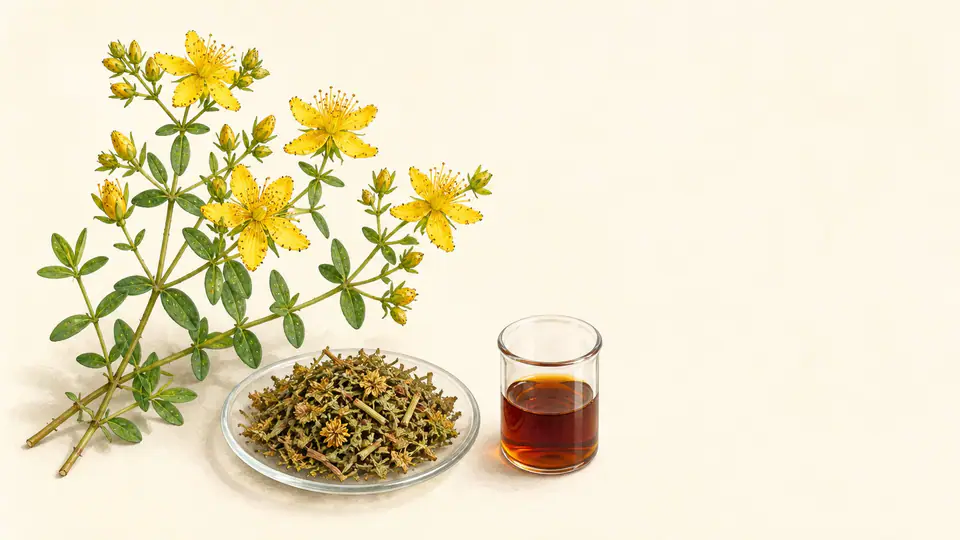
Interaction warnings hidden in the midsummer yellow flower
Can I take St. John's Wort for feelings of depression? Is it okay to take it with birth control pills or antidepressants? In short, while some studies on mild depression have shown better results than placebos, the primary criterion to check first is that it can be dangerous when used with birth control pills or antidepressants. This ingredient has strong drug interactions, as much as its reputation as a 'natural' product, and the evidence varies depending on which formulation is used.
People considering St. John's Wort usually have two simultaneous thoughts: a desire to alleviate feelings of depression and an expectation that it will be a gentler approach than prescription medication. However, as summarized by the NCCIH, this is an ingredient where results vary by study region and formulation. While some studies showed it to be more effective than a placebo and similar to standard antidepressants for mild to moderate depressive symptoms, those results cannot be applied identically to all teas, powders, tinctures, and extracts. So, what should you look for? First, you must distinguish the identity of the raw material and the product form in which it is delivered.
Identity of the material: Yellow flowers and aerial parts
St. John's Wort is a plant-based material using the aerial parts of Hypericum perforatum. In Korea, it is also called Seong-yohan-cho. The name originates from the yellow flowers that bloom around the feast of St. John in midsummer. This flower has long been used in Europe as a supplement for depression, and today it has become a material with global drug interaction warnings. This contrast is key: the impression of being a natural plant and the ability to strongly induce enzymes exist within the same substance.
Why there are expectations: Mild depression studies
The NCCIH summarizes that St. John's Wort has been more effective than a placebo and showed results similar to standard antidepressants for mild to moderate depressive symptoms in some studies. However, results vary by study region and formulation. This is simple: it does not mean it is ineffective, but rather that while signals were seen in some studies, those signals do not appear identically in all products. Therefore, rather than concluding that it "is effective," one must look at the number of studies, consistency, and the limitations of the formulations used.
Product form divides the evidence
St. John's Wort comes in various forms, such as teas, powders, tinctures, and extracts. These differ in their hypericin and hyperforin content. A difference in content means that the strength of drug metabolism induction and the clinical evidence are not the same. Research on specific standardized formulations in Europe cannot be transferred to all teas, tinctures, and online products with different compositions. While it may seem that various products under the name "St. John's Wort" share the same evidence, in reality, they do not.
| Category | Characteristics |
|---|---|
| Tea, tincture, powder | Inconsistent hypericin/hyperforin content, weak clinical evidence |
| Standardized extract | Fixed content of specific components, evidence exists in some studies |
The table only provides a condensed view of the differences in form; not all products can be explained by this table.
Concurrent medications create risks
The greatest risk of St. John's Wort lies not in its own effects, but in lowering the concentration of medications taken concurrently. This material strongly induces CYP enzymes and intestinal P-glycoprotein. Hyperforin increases the expression of enzymes and transporters in the intestines and liver, which can lower the concentration of other medications rather than its own. Consequently, the effectiveness of cyclosporine, birth control pills, warfarin, digoxin, and certain HIV, anticancer, or anticonvulsant medications may be reduced.
Additionally, using it in combination with medications that affect serotonin, such as antidepressants, may cause serious serotonin-related adverse reactions. This is divided into two types of risk: interactions that reduce drug efficacy and serotonin excess. If you are using any of the following, birth control pills, antidepressants, transplant medications, anticancer drugs, anticoagulants, anticonvulsants, or HIV treatments, you must check your medication list before starting St. John's Wort.
Individual circumstances divide safety
St. John's Wort does not pose the same risk to everyone. In cases of bipolar disorder or schizophrenia, it should not be self-administered as it may worsen manic or psychotic symptoms. During pregnancy, there are concerns regarding the risk of congenital abnormalities, and during breastfeeding, colic, drowsiness, and lethargy have been reported; therefore, it should be avoided during pregnancy and lactation.
Furthermore, even if there are signals for improving feelings of depression, it is not a tool for self-diagnosing or treating bipolar disorder, suicide risk, or severe depression. If high fever, agitation, hallucinations, rapid pulse, muscle rigidity, or thoughts of self-harm occur, you must seek emergency help immediately. You must first distinguish whether it is a mild, temporary low mood, or if there is depression, functional decline, mania, or thoughts of self-harm lasting more than 2 weeks.
The Gap Between Human Evidence and Expectations
The US FDA has not approved St. John's Wort as an over-the-counter or prescription drug for the treatment of depression. Moreover, it does not replace standard care for severe depression or suicide risk. In other words, the fact that some research signals exist for mild cases does not mean that severe depression or psychiatric emergencies can be managed at home. The differences in study subjects and product forms, as well as the presence of concurrent medications, create the gap between expectation and evidence.
Different Things Under Similar Names
Comparisons regarding St. John's Wort can be summarized into three main axes: the difference between teas/tinctures and standardized extracts; the difference between studies on mild-to-moderate depression and severe depression; the difference between interactions that reduce drug efficacy and those that cause serotonin excess; and the difference in enzyme induction recovery after starting and stopping intake. This shows that the outcome depends on the situation rather than just the raw material. Even if the name is the same, the story changes completely depending on which product is used, in what amount, and with which other medications.
Final Decision Criteria
When considering St. John's Wort, you must first check all current medications and the formulation rather than focusing on the label 'natural antidepressant.' The standard is to avoid arbitrarily adding or stopping prescription medications and to not delay evaluations for depression, mania, or risk of self-harm. You must first verify whether it is a tea, tincture, or extract, what the hypericin/hyperforin standardization and daily dose are, and whether you are taking other medications. This ingredient is something that should be discussed with medical staff rather than decided upon alone.
References
- NCCIH: St. John's Wort.
- NCCIH: Herb-drug interactions.
- Kew: Hypericum perforatum.
- NCCIH: St. John's wort and depression.
This text explains the origin of the raw materials, the scope of research, and precautions before consumption. As this cannot replace individual diagnosis or treatment, please consult a medical professional if you are taking medication or if symptoms persist. If sudden and severe symptoms such as difficulty breathing or decreased consciousness occur after consumption, seek help from 119 or the emergency room.

Medical Staff Review
Director Choi Yeon-seung
Chief Director of Baekrokdam Korean Medicine ClinicSt. John's Wort Dictionary Entry, reviewed the safety of expressions and the scope of verification before administration.
Review scope: Ingredient origin, human studies, concomitant medications, safety of intake · Last reviewed 2026-08-17
- Graduated from Kyung Hee University College of Korean Medicine
- Providing Korean medicine treatment since 2010
- Consultations for Gongjindan, Gyeongokgo, Nokyong (Deer Antler) restorative medicine, and customized restorative herbal medicine