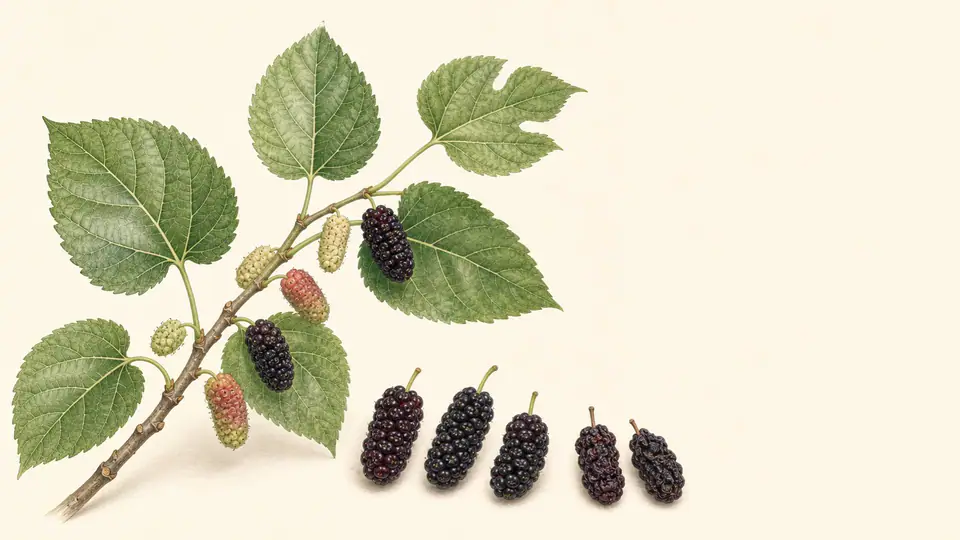
Purple fingers and the boundary of 'before fully ripening'
"Are Sangsimja and mulberries the same? Can I take a concentrate since it's said to be good for blood sugar?"
To put it simply, while the names are often used interchangeably, they have different characteristics depending on the timing of harvest and the form. Sangsimja is the fruit of the mulberry tree Morus alba Linné or other Morus closely related species of the same genus before they are fully ripe. Ripe fresh mulberries, frozen mulberries, jams, juices, mulberry leaves, mulberry twigs, mulberry root bark, and quantified fruit extracts are not the same forms of intake.
Why they share the same name, and where they diverge
Sangsimja is commonly referred to as mulberry. In domestic herbal medicine standards, Sangsimja is defined as the fruit of the mulberry tree Morus alba Linné or other Morus closely related species of the same genus before they are fully ripe. The key here is the harvest criterion of 'before fully ripening'. The fully ripe mulberries in the market that stain your fingers purple are fruits from the same tree, but the moment they become medicinal herbs, the harvest timing is shifted earlier.
Even from the same tree, the parts are further divided. Mulberry leaves, mulberry twigs, mulberry root bark, and Sangsimja are classified as different medicinal herbs. A 2024 review concluded that each part of the mulberry tree has different components and research contexts. Therefore, it is not valid to apply blood sugar research on leaves directly to Sangsimja, which is the fruit.
Where the discussion on blood sugar began
There is a reason why expectations regarding blood sugar are attached to Sangsimja and mulberries. This is because short-term trials have reported that some standardized fruit extracts lowered postprandial blood sugar responses. However, those studies were conducted under specific conditions.
In a crossover trial of 24 patients with type 2 diabetes, a specific low-dose fruit extract of 0.75 g lowered the 2-hour blood sugar response after a meal of white rice. However, this was a small-scale, acute, industry-sponsored study, and it is not the same as eating a plate of fresh mulberries, drinking a Sangsimja decoction, or the long-term treatment effect for diabetes. A trial of 84 healthy adults was also a single-meal study comparing the same standardized fruit extract with DNJ. Therefore, it cannot be applied directly to Sangsimja decoctions or jams.
In other words, the claim that it is 'good for blood sugar' is based on narrow evidence from the single-meal response of a specific extract.
Fresh fruit, jams, juices, and extracts speak different languages
Although they are all called 'mulberry', the point of comparison changes if the form is different.
| Category | Key Difference |
|---|---|
| Dried Sangsimja (unripe mulberry fruit) | Traditional usage, such as harvesting time and decoction methods based on medicinal herb standards |
| Ripe raw mulberry berries or frozen berries | Food; high sugar and moisture content |
| Jams, syrups, or juices | Processed forms with different sugar concentrations than the raw material |
| Standardized fruit extracts or capsules | Forms with quantified specific components; most research evidence is focused here |
Jams, syrups, and juices have different sugar concentrations than raw fruit. Therefore, it is necessary to check the nutrition facts first rather than consuming multiple products together. Applying the short-term test results of standardized extracts to raw fruit or jams is like using different languages for the research subject and the actual consumed product.
What changes when taken with diabetes medication?
If you are taking diabetes medication, you should not use Sangsimja or mulberry concentrates as a substitute for treatment. It is necessary to inform your medical provider about the sugar and extract content of the product. Assuming that a short-term single-meal test showing a lower blood glucose response means the medication can be replaced or that glycated hemoglobin (HbA1c) can be controlled long-term is an overinterpretation of the evidence.
Then, what should you look for? First, distinguish whether it is dried Sangsimja (unripe), ripe raw mulberry berries, frozen berries, jams, juices, or concentrated extracts. Next, check if it is being taken with diabetes medication, and verify the sugar content, DNJ standardization, and the actual intake amount of the product.
Allergies are not 'safe just because it is food'
Morus Cross-reactions between fruit allergies and pollen or other fruits have been reported. Being a food does not mean there is no risk of allergy. If you experience itching in the mouth, hives, swelling of the lips or throat, or difficulty breathing, you must stop use immediately. If difficulty breathing or systemic reactions occur, a 119 evaluation takes priority.
You should also check for any history of allergies to mulberry or birch pollen, fruits such as peaches, or experiences with difficulty swallowing or hives.
Limited data on long-term high doses for pregnancy, lactation, and children
Safety data for concentrated extracts and long-term high doses in pregnancy, lactation, and children are limited. It is important not to view the consumption of fruit and the intake of medicinal herbs or extracts as the same thing. A handful of raw berries and one pouch of concentrate may look similar in volume, but the concentration and exposure levels are different.
The gap between a single-meal response and long-term treatment
There are several steps between research evidence and daily choices. Single-meal studies on standardized fruit extracts looked at the 'post-meal blood glucose response for one meal.' This should not be expanded to mean 'long-term glycated hemoglobin control' or 'diabetes treatment effect.'
Furthermore, since those studies targeted specific products, they cannot be generalized to other forms of Sangsimja or mulberry products. The correct way to understand this ingredient is to look at the number of studies, consistency, and limitations, rather than concluding that it 'is effective.'
Summary of differences between similar-looking items
Comparisons regarding Sangsimja can be organized into four categories: unripe Sangsimja vs. ripe mulberry; fruit vs. mulberry leaves, twigs, and root bark; raw fruit, jams, and juices vs. standardized fruit extracts; and single-meal post-meal blood glucose response vs. long-term glycated hemoglobin. If these distinctions are all mixed together, only the single sentence 'mulberries are good for blood sugar' remains.
Criteria to Check Today
Rather than the impression that 'it is natural because it is a mulberry,' first check the ripeness, part of the plant, processing, sugar content, and extract standardization. Do not expand short-term single-meal tests to diabetes treatment or the effects of all mulberry products. If you are taking medication, inform your medical provider of the product form and content, and prioritize immediate discontinuation and emergency evaluation in case of adverse reactions.
References
- National Institute of Food and Drug Safety Evaluation, Sangsimja Herbal Medicine Specification Revision Data.
- Morus alba medicinal parts review.
- Mulberry fruit extract pilot trial in type 2 diabetes.
- Mulberry fruit extract and DNJ randomized trial.
- Allergic reactions to Morus plants review.
This text explains the origin of the raw materials, the scope of research, and precautions before consumption. As this cannot replace individual diagnosis or treatment, please consult a medical professional if you are taking medication or if symptoms persist. If sudden and severe symptoms such as difficulty breathing or decreased consciousness occur after consumption, seek help from 119 or the emergency room.

Medical Staff Review
Director Choi Yeon-seung
Chief Director of Baekrokdam Korean Medicine ClinicSangsimja (Unripe Mulberry Fruit) Glossary, reviewed the safety of expressions and the scope of verification before administration.
Review scope: Ingredient origin, human studies, concomitant medications, safety of intake · Last reviewed 2026-08-17
- Graduated from Kyung Hee University College of Korean Medicine
- Providing Korean medicine treatment since 2010
- Consultations for Gongjindan, Gyeongokgo, Nokyong (Deer Antler) restorative medicine, and customized restorative herbal medicine