When the Inner Bark Underground Receives a Separate Name
Can I take Sangbaekpi or mulberry extracts for coughing, edema, or blood pressure? In short, there is a lack of direct evidence in humans for the Sangbaekpi root bark itself.
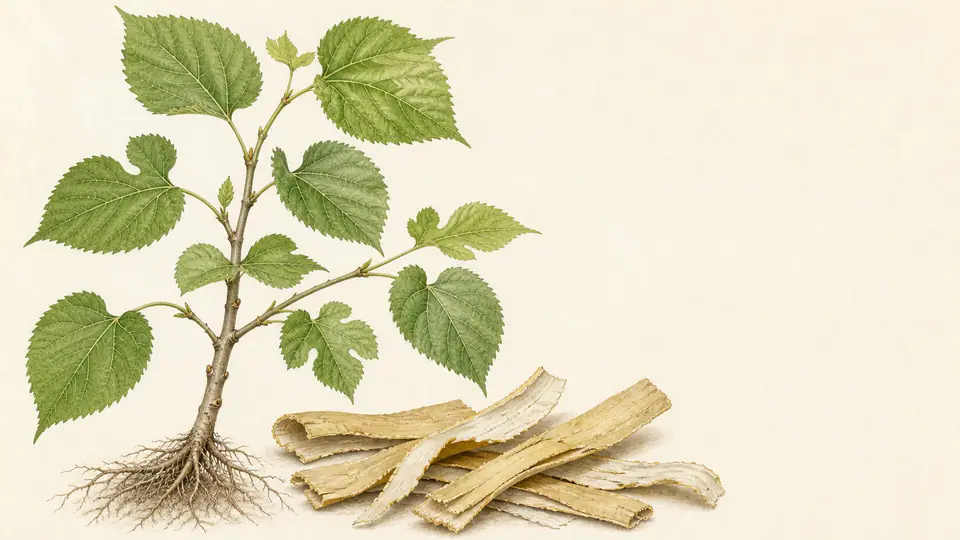
Sangbaekpi is not the entire mulberry tree, but a medicinal herb made from the dried root bark with the cork layer removed. In that case, can research on the leaves or berries be applied directly to the root bark?
Points of Confusion: One Tree, Multiple Parts
Mulberry trees usually bring to mind mulberries and mulberry leaves. Perhaps for this reason, when hearing about Sangbaekpi, it is easy to associate it with blood sugar research on leaves or the food image of the berries. However, the Standard Korean Medicine Terminology defines Sangbaekpi as Morus albathe root bark of the mulberry tree and related species in the same genus with the cork layer removed. The leaves, berries, branches, and root bark may come from the same tree, but their components and activities differ. A 2024 comprehensive literature review by part also concludes that Mori folium, ramulus, cortex, and fructus each have different components and preclinical activities. So, what should we look at? The start is distinguishing the part of the plant.
What Sangbaekpi Is: Root Bark with the Cork Layer Removed
Sangbaekpi is a medicinal herb made by removing the outer cork layer from the root bark and drying it. Mulberries, mulberry leaves, branches, stem bark, the entire root, standardized root bark extracts, and isolated sanggenons are all substances with different parts and exposure levels. This means the name Sangbaekpi is quite specific. On the other hand, because it is precise, bringing research from other parts under this name blurs the identity of the raw material.
Reasons for Expectation: Old Animal Studies and Recent Mouse Studies
There are reasons why expectations regarding coughing, edema, and blood pressure are attached to Sangbaekpi. In old pharmacological studies of root bark, antitussive, diuretic, and hypotensive effects were observed in data from mice, rats, guinea pigs, and dogs. Additionally, a mouse study on MA60, a standardized root bark extract, showed acute maximum tolerated dose and moderate anti-influenza signals. However, this does not prove the treatment of coughing or infection in humans. Signals appearing in animals and effects in humans are at different stages. The fact that the concentration of active ingredients in lung tissue was very low during repeated administration is another reason why it is difficult to transfer these expectations.
Differences in Product Form: Raw Material, Decoction, and Standardized Extract
When using Sangbaekpi, you must first check what form it is in. Raw root bark, decoctions, and standardized MA60 extracts belong to different product categories. Raw materials and decoctions are traditional medicinal forms, while MA60 is a standardized extract. Since the research subjects and product forms differ, the results of one form cannot be applied directly to another. In particular, concentrated extracts or capsule products may have different exposure levels than raw materials, so caution is required.
When taking with medications or supplements
When using Sangbaekpi products concurrently with other medications, blood pressure medications, diuretics, and diabetes medications are key. Do not arbitrarily reduce or replace these medications with Sangbaekpi; it is necessary to inform your medical provider or pharmacist before using concentrated products. There is a lack of human data regarding pregnancy, lactation, children, long-term oral administration, and drug interactions. Therefore, checking an individual's medication status first is the priority when deciding on concurrent use.
Individual circumstances and safety signals
If specific signals appear while taking Sangbaekpi, you must stop and receive a prompt medical evaluation. These include dizziness, severe diarrhea, vomiting, rash, swelling of the face or neck, and difficulty breathing. Furthermore, before attempting to manage coughing or edema with Sangbaekpi, if symptoms such as difficulty breathing, chest pain, coughing up blood, cyanosis, suddenly worsening edema, decreased urination, or fainting occur, a prompt medical evaluation takes priority over the product. This is because the symptoms themselves require medical evaluation, regardless of whether they are side effects of Sangbaekpi.
The Gap Between Human Evidence and Expectations
Human studies on blood sugar using mulberry leaves or food studies on berries do not prove the effects of Sangbaekpi on coughing, edema, or blood pressure. This is because the common name 'mulberry' groups together research on leaves, berries, branches, and root bark. Recent toxicity and anti-infection studies on standardized root bark extracts were also based on mouse data, and there is still no evidence to translate this into human treatment. Acknowledging the gap between possibility and proof is the way to properly view this material.
Differences from similar raw materials
Three comparisons are helpful when understanding Sangbaekpi.
| Comparison Target | Key Difference |
|---|---|
| Root bark Sangbaekpi vs. Mulberry leaves, berries, branches | Different parts, different components and activities |
| Root bark decoction vs. Standardized MA60 extract | Different product forms and exposure levels |
| Animal signals for cough, diuresis, and blood pressure vs. human treatment | Differences in research subjects and levels of evidence |
Clinical data on mulberry leaf blood glucose and evidence for Sangbaekpi (mulberry root bark) cannot be placed on the same level. Human research on leaves does not guarantee the efficacy of the root bark.
Final Decision Criteria
Rather than the common name 'mulberry tree,' first verify the specific part used, the extraction method, and the target symptoms. The key is not to substitute human research on leaves or berries, or animal signals from root bark, as treatment for cough, edema, or blood pressure using Sangbaekpi. Before taking it, verify whether it is the root bark, mulberry leaf, mulberry berry, or branch; whether it is the raw material, a decoction, or a standardized extract; the duration of the cough and the presence of fever, dyspnea, or chest pain; the presence of edema and sudden weight gain; and whether you are taking blood pressure medication, diuretics, or diabetes medication, or have liver, kidney, or heart disease. Sangbaekpi is one of the many faces of a single tree. Accurately identifying that face is the final criterion for judgment.
References
- Sangbaekpi entry based on the Standard Korean Medicine Terminology of the Society of Korean Medicine.
- Morus alba phytochemistry, pharmacology and clinical evidence review.
- Different medicinal parts of Morus alba: composition and pharmacology review.
- Standardized Morus alba root bark extract: mouse toxicity and efficacy study.
- Morus alba root bark pharmacology in animal models.
This text explains the origin of the raw materials, the scope of research, and precautions before consumption. As this cannot replace individual diagnosis or treatment, please consult a medical professional if you are taking medication or if symptoms persist. If sudden and severe symptoms such as difficulty breathing or decreased consciousness occur after consumption, seek help from 119 or the emergency room.

Medical Staff Review
Director Choi Yeon-seung
Chief Director of Baekrokdam Korean Medicine ClinicSangbaekpi Dictionary Entry, reviewed the safety of expressions and the scope of verification before administration.
Review scope: Ingredient origin, human studies, concomitant medications, safety of intake · Last reviewed 2026-08-17
- Graduated from Kyung Hee University College of Korean Medicine
- Providing Korean medicine treatment since 2010
- Consultations for Gongjindan, Gyeongokgo, Nokyong (Deer Antler) restorative medicine, and customized restorative herbal medicine