If you cool warm rice and then reheat it, does it really become 'weight-loss rice'?
If you cool rice and reheat it, will the increase in resistant starch be helpful enough for postprandial blood glucose and weight management? In short, while cooling and reheating do partially change the starch structure, the amount of increase is not large enough to ignore the total amount of carbohydrates in a single meal. More importantly, various types are mixed under the name 'resistant starch.' This is because starch in food, quantitative supplements, post-meal responses, and long-term indicators each follow different paths.
This term is frequently seen in recent health information. There are ongoing claims that cold rice, frozen rice, and reheated potatoes or pasta are beneficial for weight and blood glucose. However, grouping all of these under the single term 'resistant starch' leads to the error of judging the whole based on a single phenomenon. This article explores the distinctions and the gap in evidence hidden behind that name.
What happens when rice is cooled?
When cooked starch is hot, it has a structure that allows digestive enzymes to attach easily. As it cools, some of the starch recrystallizes, returning to a form that is difficult for enzymes to access. This is roughly what resistant starch RS3 looks like. However, the amount of increase varies depending on the rice variety, cooking method, cooling time, and reheating conditions. Even for the same rice, the proportion of resistant starch differs if the conditions change.
Therefore, a simple formula such as 'just cooling rice increases resistant starch and lowers blood glucose' does not hold true. Cooled starch foods require safe refrigerated storage and sufficient reheating; leaving them at room temperature for a long time to increase resistant starch is not worth the risk of food poisoning. This means you should not risk food poisoning just to eat cold rice.
Resistant starch is not a single entity
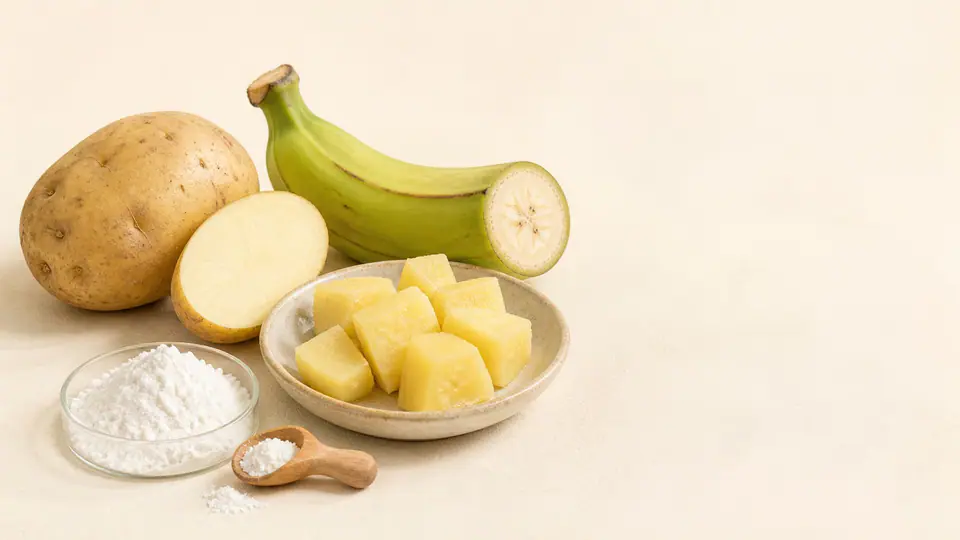
Resistant starch is a collective term for starch and its degradation products that are not digested or absorbed in the human small intestine and instead reach the large intestine. RS1 in intact plant tissues, RS2 in raw potatoes, unripe bananas, or high-amylose corn, RS3 which recrystallizes after cooking and cooling, and chemically modified RS4 all differ in how they are created and how they behave in food.
Depending on the structure and processing, they are divided from RS1 to RS4 and beyond, making it difficult to group research results from different types into one category. For example, RS1, RS2, and RS3 in food and quantitative supplements use the same name, but they are actually different materials. When applying research results, one must consider which type was consumed, in what amount, and in what form.
Under what conditions were the postprandial blood glucose claims made?
The condition regarding postprandial blood glucose recognized by the European Food Safety Authority (EFSA) is when at least 14% of the total starch in a meal is replaced with resistant starch instead of digestible starch. This is not a claim that total carbohydrates and quantity can be ignored. This means the result came from a diet composition containing a certain proportion of resistant starch, not that cooling any rice will produce the same effect.
Then, how can this condition be applied to an actual dining table? It is difficult to accurately match the total starch amount of a bowl of rice and the proportion of resistant starch within it. It should be kept in mind that laboratory conditions and home-cooked meals are different environments.
To what extent is there evidence based on human subjects?
In a 2023 meta-analysis of subjects with diabetes or prediabetes, there were signals of some acute and long-term blood glucose indicator improvements for RS1 and RS2, but these could not be generalized to RS3 through RS5 due to the number of trials per type and heterogeneity. A meta-analysis of 19 randomized trials reported small improvements in fasting blood glucose and HOMA-IR, but several other insulin-related indicators were not significant. Larger effects were observed in a subgroup receiving supplement levels exceeding 28 g per day.
The important point here is that 'small improvements' and 'non-significant indicators' coexist. Just because signals were seen in some indicators, it cannot be concluded that the overall blood glucose status changes significantly. Furthermore, the group that showed larger effects was the subgroup exceeding 28 g per day. This figure cannot be equated to a single meal of cooled rice. A distinction must be made between approaching this through food and supplementing with powders where the type and amount are specified.
What happens when it reaches the intestines?
Resistant starch that reaches the large intestine becomes a substrate for microbial fermentation. During this process, gas and abdominal bloating may occur. Changes in microbes and short-chain fatty acids do not immediately guarantee weight loss. The fact that intestinal microbes are reacting actively is a different story from weight decreasing or a disease being cured.
Consuming large amounts suddenly may cause gas, abdominal bloating, cramping, or loose stools. A realistic starting point is to increase the amount gradually while monitoring water intake and total dietary fiber. Those with irritable bowel syndrome, inflammatory bowel disease, intestinal stenosis, or a history of intestinal surgery should first coordinate symptoms and dietary restrictions with their medical team or a nutritionist.
Using Resistant Starch with Diabetes Medication
If you are taking diabetes medication, do not use resistant starch as a substitute for treatment; instead, you must monitor your actual postprandial blood glucose and symptoms of hypoglycemia. While there are research signals suggesting that resistant starch may affect blood glucose, this is not sufficient evidence to replace medication. Cooked rice, potatoes, and pasta should be cooled quickly and refrigerated, avoiding exposure to room temperature, and storage duration and reheating should follow food safety principles.
Whether you approach this through whole foods or powder products, it is necessary to develop a habit of directly monitoring your own postprandial blood glucose changes. The average values found in research may differ from your body's individual response.
What to Look for When Choosing a Product
First, distinguish whether the product is a whole food or a powder, such as high-amylose corn starch. Check if the type of resistant starch and the daily dosage in grams (g) are listed on the product. You should also consider the amount of rice, potatoes, or pasta, the side dishes eaten with them, and the methods of cooling, storage, and reheating. It is also important to note if you are using diabetes medication, have irritable bowel syndrome or abdominal bloating, and whether you are directly monitoring your postprandial blood glucose.
You must compare warm rice versus cooled and reheated rice, RS1, RS2, and RS3 in foods versus standardized supplements, single-meal postprandial blood glucose versus long-term glycemic indicators, and intestinal fermentation signals versus weight loss or disease treatment. Even if they share the same name, they are actually different things.
Final Decision Criteria
Rather than relying solely on the tip of eating cold rice, look at the variety, cooking method, storage, and actual intake amount; for powders, check the type and grams (g); and if you take blood glucose medication or have a sensitive gut, observe your reaction starting with small amounts. Resistant starch is an interesting ingredient, but without considering the total carbohydrates and amount per meal, the type, and individual responses, it will only lead to unrealistic expectations.
References
- EFSA scientific opinion on resistant starch and post-prandial glycaemic responses.
- USDA ARS: Resistant starch in cooked potatoes varies by preparation and serving temperature.
- Resistant starch types and glycaemic response in type 2 diabetes or prediabetes: systematic review.
- Effects of resistant starch on glycaemic control: systematic review and meta-analysis.
This text explains the origin of the raw materials, the scope of research, and precautions before consumption. As this cannot replace individual diagnosis or treatment, please consult a medical professional if you are taking medication or if symptoms persist. If sudden and severe symptoms such as difficulty breathing or decreased consciousness occur after consumption, seek help from 119 or the emergency room.

Medical Staff Review
Director Choi Yeon-seung
Chief Director of Baekrokdam Korean Medicine ClinicResistant Starch Glossary, reviewed the safety of expressions and the scope of verification before administration.
Review scope: Ingredient origin, human studies, concomitant medications, safety of intake · Last reviewed 2026-08-17
- Graduated from Kyung Hee University College of Korean Medicine
- Providing Korean medicine treatment since 2010
- Consultations for Gongjindan, Gyeongokgo, Nokyong (Deer Antler) restorative medicine, and customized restorative herbal medicine