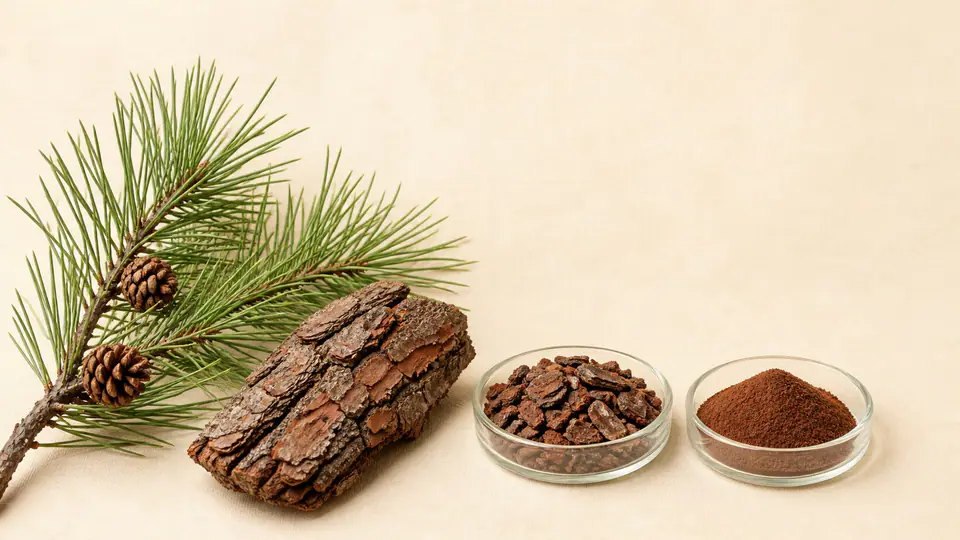
Bark that endured sea breezes: the boundaries of its name
Does taking Pycnogenol actually help with blood circulation, blood pressure, or antioxidant effects? In short, the results of human reviews to date are not as definitive as one might hope. While some studies showed small changes, there is no conclusive evidence yet to treat diseases or replace prescription medications.
Then, what should we look for? We must distinguish the gaps. Pine bark extract, Pycnogenol, and French maritime pine, these three terms are often used interchangeably, but they actually refer to different scopes. The more the names are mixed, the higher the expectations become, and the boundaries of the evidence supporting those expectations blur.
Why the names are distinguished first
Pine bark extract is a general term for raw materials consisting of polyphenol mixtures extracted from the bark of various Pinus species. Pycnogenol is a specific trademarked, standardized extract made from the bark of the French maritime pine, scientifically known as Pinus pinaster. It cannot be used interchangeably with other names such as pine bark extract, Flavangenol, or Oligopin made from different species or manufacturing methods.
The NIH LiverTox also follows this distinction. It describes pine bark as an extract from the bark of various Pinus species and distinguishes Pycnogenol as a specific preparation from French maritime pine bark. This means that the term 'pine bark' encompasses multiple species and products. Therefore, the research results of one product should not be applied directly to another.
What falls under the broad umbrella of antioxidants?
Pine bark extract is often introduced as an antioxidant supplement because it is a polyphenol mixture. However, 'antioxidant' can refer to a laboratory marker or to symptoms such as blood pressure, edema, or joint pain in humans. One should not automatically assume that markers and symptoms are linked by the same raw material.
A 2012 Cochrane review analyzed 791 people across 15 trials covering seven chronic diseases. However, due to the small number of studies and samples per disease, as well as the high risk of bias and variance in results, no definitive conclusions were reached regarding efficacy and safety for any of the diseases. In other words, while there were many attempts across various diseases, the evidence for each was thin.
Conflicting results in blood pressure research
As expectations for blood pressure are high, it is important to examine the research results. A 2019 meta-analysis of 7 randomized, double-blind, placebo-controlled trials involving 626 people found no significant improvement in systolic or diastolic blood pressure. Additionally, in a trial tracking 130 adults with high cardiovascular risk for 12 weeks, 200 mg/day of pine bark extract was not superior to placebo in terms of blood pressure, lipids, blood glucose, or inflammatory markers.
On the other hand, a 2025 meta-analysis of 27 trials reported a small average decrease in some metabolic markers. However, because the types of extracts, participants, and trial quality varied, these results should not be interpreted as a replacement for prescription treatment. Even with the same raw material, results diverge depending on the trial design and participants, and a small average change cannot be assumed to appear identically in every individual.
Differences in product form lead to differences in evidence
Pine bark extract is made by extracting and concentrating polyphenols from the bark, primarily in the form of capsules or tablets. The important part is to verify whether the commercially available product is the same as the standardized extract used in the tests. You should ask if it is Pinus pinaster or another pine species, if it is a specific brand like Pycnogenol, and what the procyanidin standardization and daily dose are.
Research is conducted under specific brands, species, and standardization conditions. However, commercial products sold under the same name 'pine bark extract' may contain different species, manufacturing methods, or concentrations. Therefore, the statement 'pine bark extract helps with blood pressure' becomes a false generalization unless the source is clearly specified.
Points to verify before using with other medications
While the possibility that pine bark extract may affect bleeding risk has been raised, the magnitude of this interaction in humans is unclear. If you are using anticoagulants or antiplatelet agents, or are facing surgery or a procedure, you should first verify with a pharmacist or medical staff given this uncertainty. You must not reduce prescription medications based solely on the hope that blood pressure or blood glucose may decrease. If you are taking such medications, a realistic approach is to monitor for signals such as dizziness or cold sweats along with changes in your levels.
Cases of taking immunosuppressants must also be considered. If the raw material has the potential to involve the immune system, it is safer to consult medical staff when using them together. The principle that supplements do not replace medication applies equally to this material.
Individual circumstances and safety signals
In short-term trials, headaches, drowsiness or insomnia, and gastrointestinal discomfort were reported. There is insufficient data on safety during long-term use or during pregnancy and breastfeeding. Those with allergies to pine materials should avoid it, and if dyspnea, generalized urticaria, or facial edema occurs, you must receive an emergency evaluation immediately.
It is also necessary to ask yourself what results you expect from taking it. You must distinguish whether you desire changes in blood pressure, edema, joints, skin, or concentration, and whether you view it as a replacement for medication or compression therapy, or as a supplementary aid. The higher the expectation, the more accurately you must verify the boundaries of the evidence.
Similar names, different ingredients
Pine bark extract and Pycnogenol are not the same raw material. You must keep these four distinctions in mind when choosing: general pine bark extract versus the trademarked ingredient Pycnogenol; Pinus pinaster versus other Pinus species; laboratory antioxidant markers versus clinical results such as blood pressure and symptoms; and standardized extracts used in trials versus commercial blended products.
The intuition that similar names imply similar efficacy is often wrong. In particular, the composition of polyphenol mixtures can vary depending on the species, cultivation environment, extraction method, and standardization criteria. Therefore, the broad term 'pine bark extract' alone is not enough to determine which product to choose.
Criteria to Check Today
If you are considering this ingredient, check these three things first. First, check if it is Pinus pinaster, another pine species, or a specific trademark like Pycnogenol. Second, distinguish whether the expected result is a laboratory antioxidant marker or a symptom such as blood pressure or edema. Third, consult a pharmacist or medical professional regarding any medications you are currently taking or any planned surgeries.
Rather than relying on the broad term 'antioxidant,' the final criterion for evaluating this ingredient is to verify the exact pine species, trademark, standardization, and target results, and to avoid mixing research from different extracts or interpreting small numerical changes as a basis for replacing prescription treatment.
References
- NIH LiverTox: Pine Bark.
- Cochrane review: Pycnogenol for chronic disorders.
- Pycnogenol and blood pressure: systematic review and meta-analysis.
- Pine bark extract and cardiovascular risk factors: randomized trial.
- Pine bark extract and cardiometabolic factors: systematic review.
This text explains the origin of the raw materials, the scope of research, and precautions before consumption. As this cannot replace individual diagnosis or treatment, please consult a medical professional if you are taking medication or if symptoms persist. If sudden and severe symptoms such as difficulty breathing or decreased consciousness occur after consumption, seek help from 119 or the emergency room.

Medical Staff Review
Director Choi Yeon-seung
Chief Director of Baekrokdam Korean Medicine ClinicPine Bark Extract Dictionary Entry, reviewed the safety of expressions and the scope of verification before administration.
Review scope: Ingredient origin, human studies, concomitant medications, safety of intake · Last reviewed 2026-08-17
- Graduated from Kyung Hee University College of Korean Medicine
- Providing Korean medicine treatment since 2010
- Consultations for Gongjindan, Gyeongokgo, Nokyong (Deer Antler) restorative medicine, and customized restorative herbal medicine