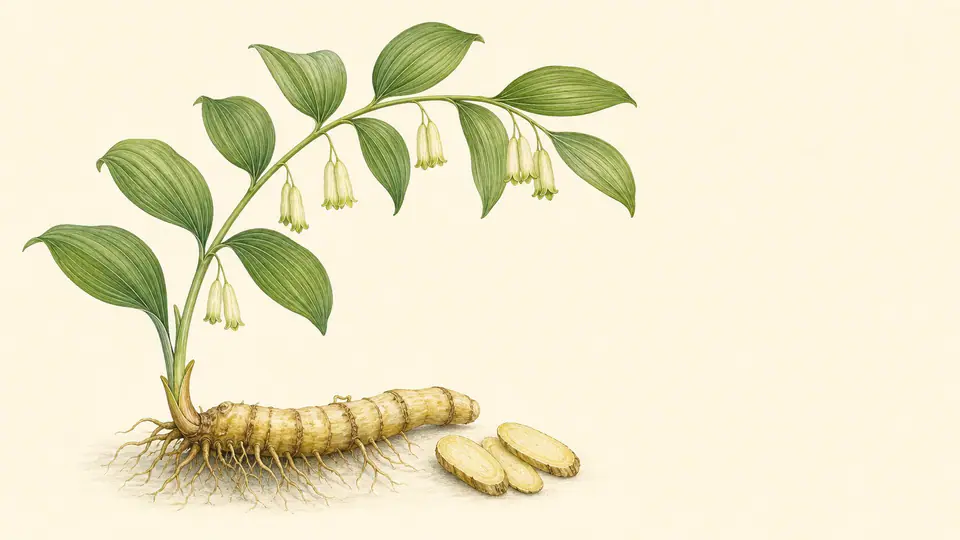
Okjuk is a rhizome connected like bamboo joints; can I drink it for a long time instead of water?
Can Okjuk be drunk for a long time instead of water, like the savory Solomon's Seal tea? To answer briefly, it is difficult to conclude that it can.
Okjuk refers to the rhizome of Polygonatum odoratum Druce var. pluriflorum Ohwi or its closely related plants. However, the plant species and processing methods may vary by commercial product, and there is a significant lack of definitive efficacy studies conducted on humans. Behind the savoriness of a cup of tea, one must verify the identity of the raw materials and the limitations of the evidence.
Where does the name Okjuk come from?
'Okjuk' appears to be a name reflecting the feeling of 'jade-like bamboo,' derived from its translucent rhizomes that are connected like bamboo joints. The standards of the National Institute of Food and Drug Safety Evaluation define Okjuk as the rhizome of Polygonatum odoratum var. pluriflorum or other closely related plants of the same genus. While standards for heavy metals, residual pesticides, sulfur dioxide, and extract content are established, these are merely criteria for managing the safety and quality of the raw materials and do not guarantee efficacy for specific diseases.
This raises the question of how Okjuk relates to Solomon's Seal tea. Solomon's Seal also frequently uses the rhizomes of plants in the Polygonatum genus. However, Okjuk, Hwangjeong, roasted Solomon's Seal tea, leaves/fruits, and polysaccharide/saponin extracts do not share the same identity, processing, or evidence. It is risky to assume they are the same raw material simply because the names are similar.
Why are there expectations regarding its effects?
Expectations for Okjuk mainly stem from components such as polysaccharides and saponins, as well as cellular and animal studies. A 2025 review of Polygonatum odoratum summarized 174 components and various biological activities. However, the focus of the research is on component analysis and cell/animal experiments, and it does not provide definitive human efficacy for general Okjuk tea.
In a study using mice on a high-fat diet, it was reported that Okjuk extract affected weight, lipid, and blood sugar indicators. However, both prevention and treatment were merely animal tests and cannot be used as evidence for treating diabetes or obesity in humans. Phenomena observed in animals cannot be automatically linked to the same results in humans.
What are the differences between the various product forms?
Okjuk, Hwangjeong, Solomon's Seal tea, and Solomon's Seal extract may all sound like the same raw material, but they are often different in reality.
| Category | Actual Meaning |
|---|---|
| Okjuk | Rhizome of P. odoratum var. pluriflorum or related species |
| Hwangjeong | Steamed rhizomes of various Polygonatum species; official origin species and processing standards differ |
| Solomon's Seal tea | Roasted rhizomes; may also contain leaves, fruits, or mixed raw materials |
| Polysaccharide and saponin extracts | Specific isolated components, different in form from decoctions of raw materials |
Decoctions of raw materials, roasted teas, steamed Hwangjeong, and concentrated extracts differ in processing methods and the plant parts used. Therefore, research results from one product cannot be applied directly to another. Research comparing cultivated Okjuk and wild Okjuk showed differences in appearance, brown rice structure, and polysaccharide content, suggesting that raw materials may not be uniform depending on the origin, cultivation method, and processing.
What should I do if I take blood sugar medication or other products?
Some animal studies related to Okjuk showed results affecting blood sugar indicators. However, these are only animal studies. If you are taking blood sugar medication or have experienced hypoglycemia, it is advisable not to add concentrated extracts based solely on animal blood sugar research. If you are concerned about changes in blood sugar, consulting medical staff should be the priority.
In particular, concentrates or extracts have different concentrations than a single cup of raw material decoction. Drinking them indefinitely instead of water or taking concentrates long-term is not recommended. You should first check the species, mixed ingredients, and the amount per serving listed on the product.
What about pregnancy, breastfeeding, children, or liver and kidney diseases?
There is insufficient data on the long-term or high-concentration safety and drug interactions of Okjuk for pregnancy, breastfeeding, children, and liver or kidney diseases. Therefore, in these situations, it is prudent not to start using concentrated products without a specific reason. Even for general tea forms, caution should be exercised when drinking them long-term or in large quantities.
When should I visit a hospital before drinking Okjuk tea?
If you have severe thirst, polyuria, or weight loss, evaluating the cause of diabetes takes priority over Okjuk tea. If you have a persistent cough, shortness of breath, or blood-streaked sputum, evaluating the respiratory cause comes first. These symptoms require the judgment of medical staff rather than choosing a tea.
The Gap Between Human Evidence and Expectations
Most research on Okjuk is limited to polysaccharide and saponin components, cell experiments, and high-fat diet mouse studies. The representative data for expectations regarding metabolism, immunity, and anti-inflammation are also centered on these preclinical studies. These are not clinical trials that have confirmed the therapeutic effect of Okjuk tea in humans.
In other words, while expectations for Okjuk began with component and animal research, it has not reached the stage of proving preventive or therapeutic effects in humans. Rather than concluding that it 'is effective,' one must consider the number of linked studies, consistency, and limitations.
Summary of differences from similar ingredients
Even within the same Polygonatum genus, Okjuk and Hwangjeong do not share research results directly because their official source species and steaming processing standards differ. Solomon's seal rhizomes are also different from its leaves and fruits. Raw material decoctions differ from roasted Solomon's seal tea or mixed teas in terms of processing and mixed ingredients. Whole rhizomes are also a different form from isolated polysaccharides and saponins.
Then what should I look for? The first step is to check the species, part used, processing method, mixed ingredients, and amount per serving written on the product label.
Realistic criteria to check today
When choosing Okjuk, check the species, rhizome, roasting, steaming, mixed ingredients, and intake amount first, rather than the impression of it being a savory tea. It is important not to use preclinical polysaccharide research as a basis for long-term consumption as a water substitute or for diabetes treatment. Those taking blood sugar medication or who have experienced hypoglycemia should consult medical staff, and long-term or high-concentration use should be avoided in pregnancy, breastfeeding, children, and liver or kidney diseases. If there is severe thirst, polyuria, weight loss, or a persistent cough, shortness of breath, or blood-streaked sputum, evaluating the cause takes priority over Okjuk tea.
References
- National Institute of Food and Drug Safety Evaluation Herbal Medicine Standards: Okjuk.
- Polygonatum genus ethnopharmacology and chemistry review.
- Polygonatum odoratum comprehensive review.
- Polygonatum odoratum extract in high-fat-diet mice.
- Cultivated and wild Polygonati Odorati quality comparison.
This text explains the origin of the raw materials, the scope of research, and precautions before consumption. As this cannot replace individual diagnosis or treatment, please consult a medical professional if you are taking medication or if symptoms persist. If sudden and severe symptoms such as difficulty breathing or decreased consciousness occur after consumption, seek help from 119 or the emergency room.

Medical Staff Review
Director Choi Yeon-seung
Chief Director of Baekrokdam Korean Medicine ClinicOkjuk Dictionary Entry, reviewed the safety of expressions and the scope of verification before administration.
Review scope: Ingredient origin, human studies, concomitant medications, safety of intake · Last reviewed 2026-08-17
- Graduated from Kyung Hee University College of Korean Medicine
- Providing Korean medicine treatment since 2010
- Consultations for Gongjindan, Gyeongokgo, Nokyong (Deer Antler) restorative medicine, and customized restorative herbal medicine