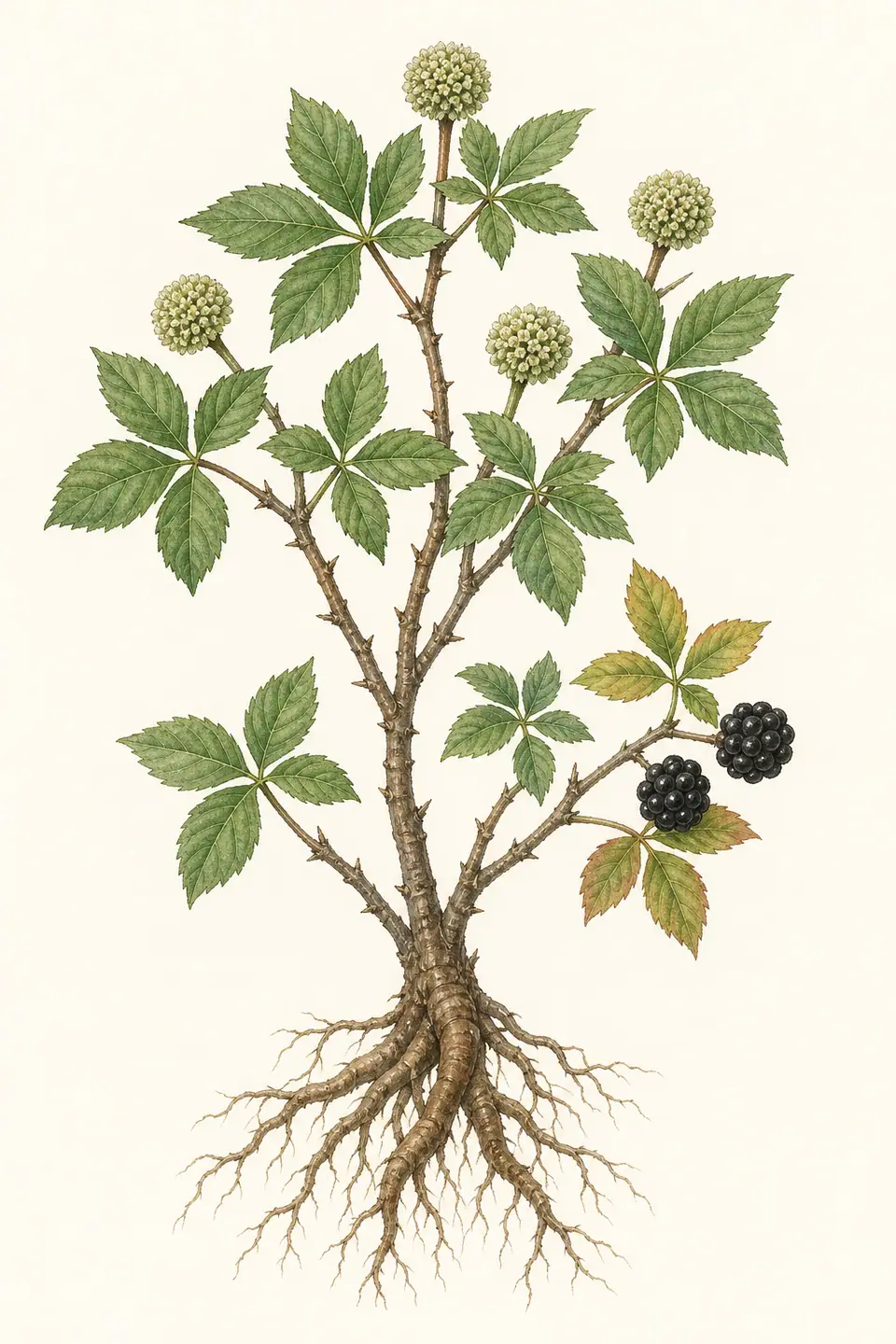
Chupungsa (追風使), the messenger that chases away wind
The 《Bencao Gangmu (Compendium of Materia Medica)》 referred to the fruit of Acanthopanax (Ogapi) as "Chupungsa (追風使)." This name, meaning a messenger that chases away 'wind' (風), is deeply connected to symptoms we commonly describe today as 'aching and numbness in the joints.' The same book also states: "Obtaining a handful of Ogapi is better than obtaining a cartload of gold and silver treasures." This is echoed in the 《Dongui Bogam》, which records that it "treats pain in the waist or spine, aching and numbness in the legs, and joint pain or limping," and can even enable a child who could not walk by 3 years of age to walk.
Due to these records, Ogalpi is often remembered as a 'tonic used when the body feels heavy and joints are uncomfortable.' However, a closer look at the verified data reveals that the core of Ogalpi is not simply a 'tonic.' Its properties are pungent (辛), bitter (苦), and warm (溫); it targets the Liver (肝) and Kidney (腎) meridians; and its effects are summarized as expelling wind-dampness (祛風濕), strengthening muscles and bones (强筋骨), and tonifying the Liver and Kidney (補肝腎). In other words, it is a medicinal herb that works to drive out external pathogenic factors known as wind-dampness, strengthen the muscles and bones damaged by them, and supplement the energy of the Liver and Kidney which serve as their foundation. This involves a more active process of bodily regulation, differing slightly from the gentle image associated with the word 'tonic.'
Because of this active nature, it is crucial to determine who should use it and how. Records from the Traditional Knowledge Portal of Korea clearly warn that "those with Yin deficiency and hyperactivity of fire (陰虛火旺者) should avoid consumption." Additionally, some research results related to lowering blood pressure have been identified, so those taking blood pressure medication may need to exercise particular caution when using it concurrently. There is currently insufficient official data available regarding pregnancy, breastfeeding, interactions with Western medicines, or specific prescription combinations. Therefore, rather than approaching Ogalpi lightly as a cup of tea or a folk remedy, it is safer to first determine the dosage, the suitable candidate, and the form of administration under the diagnosis of a Korean medicine doctor.
Summary at a Glance
This table provides a concise summary of Ogalpi, from its identity and properties to precautions, organized by item for your convenience.
| Category | Content |
|---|---|
| Origin | Hanja Name: (Unknown) / Scientific Name: Acanthopanax sessiliflorus Root bark and stem bark of Acanthopanax, a deciduous shrub of the Araliaceae family; harvested in summer or autumn and sun-dried |
| Properties and Meridian Tropism | Non-toxic, pungent and bitter, warm; acts on the Liver (肝) and Kidney (腎) |
| Representative Aliases | Chupungsa (追風使, Ogalpi berries in Bencao Gangmu) |
| Efficacy Recorded in Literature | Expels wind-dampness (祛風濕), strengthens muscles and bones (强筋骨), and tonifies the Liver and Kidney (補肝腎); Dongui Medical Center data additionally lists promoting urination and reducing edema (利水消腫) |
| Main Components and Pharmacology | Research reports on anti-cancer and immune-stimulating effects (mouse peritoneal cancer and immune cell experiments, breast cancer cell experiments); mentions of anti-allergic pharmacological actions |
| Combinations, Contraindications, and Precautions | Contraindicated for those with Yin deficiency and hyperactivity of fire (individuals with insufficient body fluids and heat-related symptoms); caution may be required when used concurrently with blood pressure medications due to research on blood pressure-lowering effects; confirmation is needed regarding pregnancy, breastfeeding, interactions with Western medicines, and cases of human side effects |
Is this medicinal herb right for me?
Ogalpi (Acanthopanax) is a medicinal herb with properties that dispel wind-dampness, strengthen the muscles and bones, and tonify the liver and kidneys. However, these properties can be helpful or burdensome depending on your body condition. Please check the following three criteria first.
- Generally suitable cases: It has been traditionally considered for those who experience stiffness in the waist or spine, aching or numbness in the legs, or a feeling of heaviness or limping in the joints. Additionally, in folk medicine, the leaves and stems have been used as tea, the roots as Ogapiju (Ogalpi liquor), and mixed into rice cakes or rice for nourishment.
- Cases requiring caution: Caution is advised if you are taking blood pressure medication or have low blood pressure. This is because a tendency toward decreased systolic blood pressure was observed in a human application test where 2g of Ogalpi fruit extract was administered daily. Furthermore, when using Ogalpi in the form of a Korean herbal medicine prescription, professional consultation is necessary regarding the combination with other herbs, dosage, and duration of intake.
- Cases to avoid: Those with a constitution of Yin deficiency and hyperactivity of fire, meaning those with insufficient body fluids and prominent heat-related symptoms, should avoid intake. If you are pregnant, breastfeeding, or taking Western medicines such as anticoagulants, antiplatelet agents, or diabetes medications, you must decide after consulting a Korean medicine doctor, as there is insufficient specific safety evidence for this herb in these cases.
Practical Q&A
We have gathered frequently asked questions about Ogalpi from the clinic. Because this is a medicinal herb where 'under what conditions and how it is used' is as important as its efficacy, we will explain based on verified facts. For your safety, the decision on whether to take it must be made after consulting a Korean medicine doctor.
"Are Ogalpi and Gasi-ogalpi the same medicinal herb?"
No. Ogalpi is a medicinal herb corresponding to the scientific name Acanthopanax sessiliflorusand Gasi-ogalpi (Acanthopanax senticosusor Eleutherococcus senticosus) are classified as separate species. The Traditional Knowledge Portal of Korea also defines them as 'Ogapi (五加皮)A / Ogalpi'; although the names are similar, they are different herbs. When choosing a prescription or health functional food, it is recommended to check the scientific name or the raw material labeling.
"What are the properties of Ogapi (Siberian ginseng)?"
Ogapi is non-toxic, has a pungent and bitter taste, and possesses warm properties, acting on the liver and kidneys. According to data from the Traditional Knowledge Portal and Dongui Medical Center, it is recorded to dispel wind-dampness, strengthen the muscles and bones, and tonify the liver and kidneys. Dongui Medical Center also mentions its role in promoting urination and reducing edema (isusojong), specifically regarding edema related to fluid metabolism.
"Can I consume Ogapi as a tea or in food on a regular basis?"
In folk medicine, it is known to use the leaves or stems as tea, mix them into rice cakes or rice, or soak the roots in alcohol to make Ogapi liquor. However, these forms are closer to general nutritional supplements. If you are seeking therapeutic effects based on Korean medicine, it is appropriate to use finely sliced raw medicinal materials in the form of a decoction prescription. Since the specific dosage and duration of intake vary depending on the individual's condition, it is recommended to decide after a consultation.
"I have high blood pressure; is it okay to take Ogapi?"
Caution is required. According to Nongsa-ro, a human application test on individuals with prehypertension who were administered 2g/day of Ogapi berry extract showed a decrease in systolic blood pressure. While this may seem positive for health function, if you are already taking blood pressure medication or are in a state sensitive to blood pressure fluctuations, you must consult a Korean medicine doctor before adding Ogapi to your regimen. As no specific studies on drug interactions for A. sessiliflorus were obtained in this search, extra caution is needed when using it concurrently with other medications.
"Can it be taken during pregnancy or breastfeeding?"
Official clinical or pharmacopeia data regarding the safety of Ogapi during pregnancy and breastfeeding were not obtained in this search. Therefore, it is difficult to recommend its use during these periods. If you believe it is necessary, please decide after thorough consultation with a Korean medicine doctor.
"Are there any body types (constitutions) that should not take Ogapi?"
Yes. According to the Traditional Knowledge Portal, those with 'Eum-heo-hwa-wang', a state where body fluids are deficient, accompanied by chest tightness, facial flushing, night fevers, or dry mouth, should avoid taking it. Because Ogapi has warm properties, it may exacerbate these symptoms in such individuals. It is important to verify your constitution and current symptoms with a Korean medicine doctor before use.
Relationship with Other Medicinal Herbs (Yakdae/Pairing)
Ogapi is a medicinal material whose properties become more distinct when used with other herbs rather than alone. In Korean medicine, such pairs are called 'Yak-dae,' and they are blended so that the effects of each herb complement or harmonize with one another. In the case of Ogapi, it has been traditionally paired with various Korean herbal medicines to maximize its properties of dispelling wind-dampness, strengthening muscles and bones, and acting on the liver and kidneys.
However, among the data confirmed so far, specific traditional prescription names, compositions, or sources that specify the scientific name Acanthopanax sessilifloruswere not obtained. While traditional prescriptions such as 'Ogapi-tang' or 'Ogapi-san' may exist, the original texts were not confirmed in this search. This part requires further verification.
Confirmed blending cases can be found in the context of modern research. In a study on a mixed extract of deer antler and Ogapi, it was reported that a ratio of deer antler:Ogapi = 1:1 showed the most superior immunomodulatory activity in terms of cell proliferation, NO production, and TNF-α and IL-6 secretion in Raw 264.7 cells.
- Deer Antler + Ogapi In an experiment mixing deer antler with 10 types of Korean herbal medicines, the deer antler-Ogapi combination showed the most superior activity in immunomodulatory indicators. After comparing ratios of 1:1, 1:2, and 2:1, the 1:1 ratio was selected as the final sample. Immunomodulatory effects of deer antler mixed extract
Regarding blending contraindications, traditional Korean medicine data specifies that those with 'Eum-heo-hwa-wang' should avoid intake. That is, if you are in a state where body fluids and 'Yin' are deficient, resulting in chest tightness, night sweats, dry mouth, or a red tongue, the warm properties of Ogapi may exacerbate the symptoms, so caution is needed. As there is insufficient data on contraindications based on specific prescription blends, please inquire during your consultation.
In what form is it consumed?
While the root bark and stem bark of Ogapi are used as medicinal materials, the forms encountered in daily life vary significantly depending on the harvested part and processing method. In folk medicine, leaves and stems are used to make tea, and roots are soaked in alcohol for Ogapi liquor. It is also used in food forms, such as being mixed into rice cakes or rice. To achieve Korean medicine therapeutic effects, it is common to use it in a finely sliced form, with impurities removed, within a decoction prescription.
- Tea (leaves, stems) In folk medicine, the leaves or stems are dried and brewed as tea.
- Food (rice cakes, rice, berries) It is consumed mixed into rice cakes or rice, or the berries are used as they are.
- Liquor (roots, Ogapi liquor) There is a folk remedy of soaking the roots in alcohol to make and drink Ogalpi-ju (Siberian ginseng liquor).
- Decoction (Korean herbal medicine prescription) When used as a herbal medicine ingredient, it is sliced and used as part of a decoction prescription. It may be included in professional prescriptions, in which case diagnosis and dosage adjustment by a Korean medicine doctor are required.
Interactions and Safety During Use
Ogalpi has been used in folk medicine and Korean medicine for a long time, but because of this, it is easy to assume that it is 'safe because it is natural.' We believe it is more honest to explain all medicinal ingredients based on their properties and evidence. The currently identified interactions and precautions are as follows.
- Contraindications in Korean Medicine: Ogalpi has properties that tonify the kidneys and liver and dispel wind-dampness, but it is not suitable for Eum-heo-hwa-wang (Yin deficiency with hyperactivity of fire) It is not suitable for this constitution. Data from the Korean Traditional Knowledge Portal also explicitly states that administration is contraindicated in this case.
- Caution when using with blood pressure medications: In a human application test where 2g of Ogalpi fruit extract was administered daily, a decreasing trend was observed, with the rate of reaching a systolic blood pressure of 120mmHg decreasing to 48%. Therefore, those currently taking blood pressure medications or those with a tendency toward hypotension should definitely consult a Korean medicine doctor.
- Pregnancy and Breastfeeding: Official clinical data for Acanthopanax sessiliflorus is currently unavailable. Those who are pregnant or breastfeeding need a consultation before intake.
- Concurrent use of Western medicines such as anticoagulants, antiplatelets, or diabetes medications: No specific evidence of interaction for Ogalpi has been confirmed at this time. However, since there is research on blood pressure-lowering effects, caution should be exercised when using it concurrently with related Western medicines.
- Hypersensitivity reactions: Anti-allergic pharmacological actions are mentioned in data from Dongui Medical Center, but specific cases of adverse effects in humans have not been confirmed. As a rule, start with a small amount when taking it for the first time and stop if any adverse reactions occur.
The form of intake, dosage, and duration vary depending on the individual's constitution, symptoms, and other medications being taken. If you wish to use Ogalpi for Korean medicine purposes, please decide after consulting a Korean medicine doctor.
If you experience these symptoms
If you experience these symptoms
Ogalpi is a warm-natured medicinal herb that dispels wind-dampness and strengthens the muscles and bones. However, these properties may actually aggravate symptoms in constitutions or states where the internal 'fire' is already weak, specifically, what Korean medicine calls Yin Deficiency with Hyperactivity of Fire (Eumheohwa-wang). The following signals are known warnings that Ogalpi may not be suitable for you. In such cases, it is safer to notify your attending Korean medicine doctor first and have your prescription adjusted rather than trying to reduce the dose or stop taking it on your own.
- Facial flushing · excessive night sweats: These are representative signals of Yin Deficiency with Hyperactivity of Fire (Eumheohwa-wang), and the warming properties of Ogalpi may unnecessarily add more heat.
- Dry mouth, burning sensation in the throat, constipation: Using warm-natured medicinal herbs when the body is deficient in moisture and yin fluids can worsen the feeling of dryness.
- Heart palpitations · difficulty falling asleep: When heat-related symptoms are prominent, Ogalpi may further disrupt stability at night.
- New onset of indigestion or abdominal discomfort, or worsening of existing symptoms after intake: The medicinal herb may not be compatible with your current constitution or other concurrent medications.
- Feeling dizziness or changes in blood pressure while taking blood pressure medications or cardiovascular-related drugs: Caution is required when used concurrently, as blood pressure-lowering effects have been observed in studies of Acanthopanax sessiliflorus fruit extract.
If these symptoms appear or if you experience sudden severe discomfort during intake, please stop taking the medicine immediately and contact your attending Korean medicine doctor or an emergency medical institution (☎ 119).
Differences from other restorative medicines
Acanthopanax sessiliflorus falls under the broad category of 'boyak' (restorative herbal medicine), but its nature differs slightly from restorative medicines that simply boost energy. Because it works to dispel wind-dampness, strengthen the muscles and bones, and tonify the liver and kidneys, it is primarily used to manage the body's structure, movement, and the underlying liver and kidney functions. In this regard, its target of supplementation differs from Gongjindan, which focuses on overall recovery of vital energy, or Gyeongokgo, which places more weight on supplementing blood and treating skin dryness.
However, there are currently no confirmed clinical data or prescription-based evidence directly comparing Acanthopanax sessiliflorus with Gongjindan or Gyeongokgo. Determining which restorative medicine is most suitable for your condition is not decided by a single symptom; it requires a comprehensive review of your constitution, existing medical conditions, and current medications. For your safety, please determine with a Korean medicine doctor during a consultation whether Acanthopanax sessiliflorus is the appropriate restorative medicine or if another type would be more suitable.
References
- Acanthopanax sessiliflorus supporting evidence 1: Korea Citation Index academic paper.
- Acanthopanax sessiliflorus supporting evidence 2: Korea Citation Index academic paper.
- Acanthopanax sessiliflorus supporting evidence 3: Korea Citation Index academic paper.
- Acanthopanax sessiliflorus supporting evidence 4: PubMed academic paper.
- Acanthopanax sessiliflorus supporting evidence 5: NCBI original academic data.
If you would like to check if this medicinal herb is right for you or which prescription it should be used with, please leave a medical inquiry. For those who find it difficult to visit the clinic, non-face-to-face consultations are available; we will provide guidance after first reviewing your current condition and current medications.

Medical Staff Review
Director Choi Yeon-seung
Chief Director of Baekrokdam Korean Medicine ClinicAcanthopanax sessiliflorus Dictionary Entry, reviewed the safety of expressions and the scope of verification before administration.
Review Scope: Clinical Accuracy, Pharmacology, Contraindications, Combinations, QA · Last Reviewed 2026-08-16
- Graduated from Kyung Hee University College of Korean Medicine
- Providing Korean medicine treatment since 2010
- Consultations for Gongjindan, Gyeongokgo, Nokyong (Deer Antler) restorative medicine, and customized restorative herbal medicine