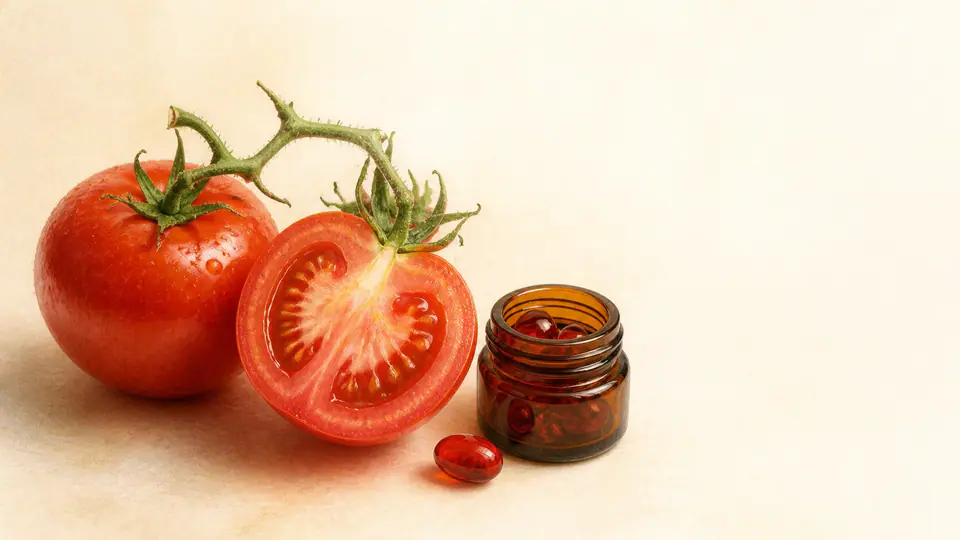
From red pigment to prostate supplements
Would taking lycopene supplements instead of tomatoes help with prostate health? In short, there is not yet sufficient evidence to suggest they are a definitive substitute for tomatoes. In fact, raw tomatoes, heated tomato sauce, tomato extracts, and single-ingredient lycopene capsules have different food structures, making it difficult to view them as the same thing.
The red color of tomatoes is created by a fat-soluble carotenoid called lycopene. Unlike beta-carotene, lycopene is not converted into vitamin A. Therefore, it is easy to create a simple equation like 'red color = antioxidant = good for the prostate,' but there are many steps between color and disease prevention.
What ingredient creates the red color of tomatoes?
Lycopene is a fat-soluble carotenoid that gives a red color to tomatoes, watermelons, guavas, and other fruits. Because of the name 'carotenoid,' it may be mistaken for a vitamin A precursor like beta-carotene, but lycopene does not convert to vitamin A in the body. It is simply a red pigment, and one should not expect it to function as vitamin A.
Although they share the common classification of 'carotenoids' and may feel like ingredients of the same family, beta-carotene and lycopene follow different pathways in the body. Therefore, when choosing lycopene, you must first confirm that it is not for 'vitamin A supplementation.'
Why is it linked to prostate health?
Observational studies have had a significant impact on lycopene becoming a representative ingredient in prostate supplements. Several studies have reported an association where groups with high dietary or blood lycopene levels had a lower risk of prostate cancer. However, this is merely an association, not a causal relationship. People who eat diets rich in lycopene may have overall different lifestyles or dietary patterns, and it is difficult to completely exclude these differences.
Looking more specifically, a reduction in progressive prostate cancer has not been confirmed. In other words, while there was a statistical association that 'prostate cancer occurs less frequently,' it did not reach the stage of proving that 'existing cancer progresses less' or that 'deaths from prostate cancer decreased.' Observational studies provide interesting clues, but translating those clues into a single capsule is a different matter.
Will PSA numbers decrease?
In an analysis of 6 randomized trials for non-metastatic prostate cancer, lycopene did not significantly lower PSA overall. PSA is a prostate-specific antigen; while cancer occurrence or progression cannot be determined by changes in this value alone, there is also insufficient evidence that supplements significantly change this number.
The National Cancer Institute (NCI) explains that because the results of human lycopene clinical trials are inconsistent, there is insufficient evidence to determine its effectiveness in preventing or treating prostate cancer. This does not mean it 'has no effect,' but rather that it is not yet clearly known; therefore, it should not replace medications currently being taken for prevention or treatment.
Will cardiovascular indicators change?
In a review of 43 intervention trials looking at cardiovascular risk factors, lycopene showed no significant difference from the control group in terms of blood pressure or lipids. Because the formulations and dosages varied greatly across studies, there are limits to interpreting the results as a whole. This reflects a similar situation for other health claims regarding lycopene. The claim that a single ingredient has distinct effects on multiple diseases simultaneously is difficult to support with studies that use varying formulations and dosages.
High absorption does not necessarily make it a medicine
There are results suggesting that heating, processing, and the presence of fats can increase lycopene absorption. Adding oil to tomato sauce may increase bioavailability compared to raw tomatoes. However, the fact that it is better absorbed cannot be equated to disease prevention effects or the superiority of supplements.
In other words, 'increased blood lycopene concentration' and 'reduced risk of prostate cancer' are different types of outcomes. The former is a pharmacokinetic result, while the latter is a clinical outcome. There is a significant gap between the two. Just because a substance is well-absorbed does not mean it will prevent the target disease.
Are raw tomatoes, sauces, extracts, and capsules the same?
No. Raw tomatoes, heated tomato sauce, tomato extracts, and single-ingredient lycopene capsules differ in their food structure, absorption amounts, and accompanying ingredients. Studies on tomato-based foods and studies on isolated lycopene supplements each have effects of other nutrients and meal substitution mixed in, making it difficult to interchange the results.
People who consume a lot of tomato sauce may have entirely different overall diets. In contrast, capsules contain concentrated lycopene without the other components found in tomatoes. Therefore, concluding that 'lycopene capsules are beneficial' based on research stating 'tomatoes are beneficial' is a leap in evidence.
Is there an overlap with other ingredients?
Prostate complex supplements may contain not only lycopene but also selenium, vitamin E, and green tea extract. Such products are not the same as studies on lycopene alone. It is necessary to verify the role of the complex ingredients and identify any overlaps. Comparing ingredient lists is essential to avoid duplicate intake.
Then, what should be checked? First, determine whether it is a raw tomato, sauce, juice, tomato extract, or a single-ingredient lycopene product. Then, clarify whether the goal is prostate cancer prevention or lowering the PSA or progression of a diagnosed cancer, whether it is intended to replace chemotherapy or prescription medication, and whether it overlaps with other ingredients in a complex supplement.
What about safety?
Tomato-based foods can be consumed as part of a regular diet. However, concentrated extracts or high-dose supplements are not viewed as the same level of exposure. In clinical trials, lycopene was generally well-tolerated, although gastrointestinal discomfort may be reported, and the benefits of long-term high-dose use for disease prevention have not been established.
In particular, lycopene must not be used to delay or replace prostate cancer screening, follow-up, surgery, radiation, or drug therapy. If you experience hematuria (blood in urine), difficulty urinating, rapid weight loss, new bone pain, or an increase in PSA, you must seek a medical evaluation rather than relying on supplements.
What is the difference between lycopene and similar ingredients?
Lycopene is distinguished from beta-carotene in that it is not a vitamin A precursor. Furthermore, raw tomatoes, heated tomato products, and isolated lycopene supplements are each different forms; and blood lycopene, PSA, prostate cancer incidence, progression, and mortality are each different indicators. The associations found in observational studies are not the same as the therapeutic effects found in randomized clinical trials.
When these distinctions become blurred, reasoning such as 'tomatoes are good, so lycopene must be good, and if lycopene is good, PSA will decrease' occurs. However, each step requires separate evidence.
Criteria to Check Today
Rather than focusing on terms like 'red antioxidants' or 'prostate ingredients,' first verify the difference between food and capsules, the actual dosage and complex ingredients, the gap between surrogate markers (such as absorption or PSA) and cancer incidence/progression, and the status of diagnosis and standard treatment. While lycopene is an interesting ingredient, current human-based evidence is insufficient to conclude that it can replace tomatoes or guarantee prostate health.
References
- NCI: Prostate cancer, nutrition and dietary supplements—lycopene.
- Lycopene and prostate cancer risk: systematic review and meta-analysis.
- Lycopene and PSA in non-metastatic prostate cancer: meta-analysis.
- Dietary and supplemental lycopene and cardiovascular risk factors.
This text explains the origin of the raw materials, the scope of research, and precautions before consumption. As this cannot replace individual diagnosis or treatment, please consult a medical professional if you are taking medication or if symptoms persist. If sudden and severe symptoms such as difficulty breathing or decreased consciousness occur after consumption, seek help from 119 or the emergency room.

Medical Staff Review
Director Choi Yeon-seung
Chief Director of Baekrokdam Korean Medicine ClinicLycopene Dictionary Entry, reviewed the safety of expressions and the scope of verification before administration.
Review scope: Ingredient origin, human studies, concomitant medications, safety of intake · Last reviewed 2026-08-17
- Graduated from Kyung Hee University College of Korean Medicine
- Providing Korean medicine treatment since 2010
- Consultations for Gongjindan, Gyeongokgo, Nokyong (Deer Antler) restorative medicine, and customized restorative herbal medicine