From a Pinch of Salt to Thyroid Supplements: The Divergence of Iodine
Is it okay to take iodine separately if I'm worried about my thyroid, or do I need supplements even if I eat seaweed often? In short, while iodine is essential for producing thyroid hormones, taking more just because it is 'good for the thyroid' can actually destabilize thyroid function. The need for supplements cannot be determined by the fact that you eat seaweed alone; you must consider the total amount from food, multivitamins, and single-ingredient products, as well as situations such as pregnancy, breastfeeding, or thyroid disease.
Iodine is a trace element. This means the amount the body needs per day is measured in micrograms. It participates directly in the synthesis of thyroid hormones and is primarily found in foods and supplements as iodides or iodates. However, under the name 'iodine,' there are actually several substances with completely different purposes and dosages. Dietary iodine, seaweed or kelp products, povidone-iodine for disinfection, and high-dose potassium iodide used only in radiation emergencies cannot be grouped together.
Where the Questions Begin: Thyroid Concerns and 'Natural' Supplementation
Interest in the thyroid often leads to iodine through two paths. One is the case of frequently eating seaweed, especially kelp or kombu, because it is 'good for the thyroid.' The other is seeking iodine supplements after feeling a decline in thyroid function or seeing test results. Both paths share the same premise: since iodine is necessary for thyroid hormones, consuming more of it will make the thyroid healthier.
This premise is only half true. Without iodine, thyroid hormones cannot be produced. However, exceeding the required amount can cause thyroid problems similar to those caused by deficiency. Hypothyroidism, hyperthyroidism, and thyroiditis can all be linked to excessive intake. This delicate structure, where deficiency and excess create similar symptoms, is the core tension of the iodine story.
What is Iodine: Raw Material for the Thyroid Hormone Factory
Iodine is a trace element required for the synthesis of thyroid hormones. The NIH ODS recommends 150 mcg per day for adults, 220 mcg for pregnancy, and 290 mcg for breastfeeding. Sufficient intake is especially emphasized during pregnancy and breastfeeding for fetal and infant development and thyroid hormone production. These amounts assume they are met through dietary iodine.
The forms commonly encountered in foods and supplements are iodides and iodates, which provide bioavailable iodine. In contrast, povidone-iodine is for skin disinfection, and potassium iodide used only in radiation emergencies is a medication used to block the thyroid's absorption of radioactive iodine according to public health authority instructions. While they have 'iodine' in their name, they have different purposes and dosages than dietary supplementation.
Why the Expectation: How a Pinch of Salt Reduced Deficiency
The history of iodine's prominence is linked to public health achievements in reducing deficiency diseases. Iodine deficiency could lead to conditions such as goiter, and policies like iodized salt were introduced to prevent this. Because of this background, iodine became established as a 'nutrient that causes problems if lacking.'
However, just because a deficiency causes problems does not mean that eating more makes you healthier. Most ingested iodine is excreted in urine, but that does not mean excessive intake is harmless. Some single-ingredient iodine supplements exceed the adult upper limit of 1,100 mcg per day. Taking such products for a long time in the name of 'thyroid health' can increase the risk of hypothyroidism, hyperthyroidism, or thyroiditis.
What Forms Do Seaweed and Supplements Take?
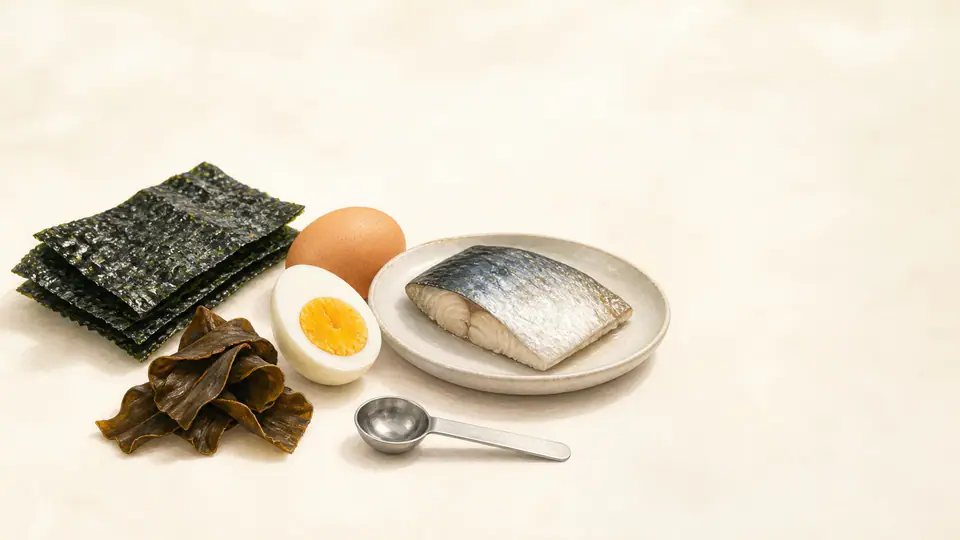
Seaweed is known to be a food rich in iodine. However, studies have shown that the iodine concentration in commercially available seaweed varies greatly, ranging from 16 to 2,984 mcg/g. This range can vary not only by species but also by origin and processing method. It is difficult to predict daily intake based solely on the name 'kombu' or the product form 'kelp capsules.'
| Category | Characteristics | Points to Check When Choosing |
|---|---|---|
| Iodized salt · General foods | Relatively stable dietary intake | Whether total daily iodine is near the recommended amount |
| Seaweed and kelp (whole food) | High fluctuation in concentration | Difficult to calculate accurately as content varies significantly by species, origin, and processing method |
| Single iodine supplement | Fixed mcg labeling | Possibility of exceeding the upper limit when combined with multivitamins or seaweed |
Then, what should people who frequently eat seaweed look for? Since adding a single iodine supplement can lead to excess, you must check the type and frequency of seaweed consumption along with the labeled amounts of other products. Conversely, if you rarely use iodized salt and limit major sources such as seaweed, dairy products, and eggs, you can review the possibility of deficiency with your medical provider.
mcg vs. mg, and Potassium Iodide for Radiation Emergencies
The most common unit confusion in iodine supplementation is between mcg and mg. 1 mg is 1,000 mcg. Dietary iodine is handled in mcg units, but potassium iodide for radiation emergencies is prescribed in mg units. This is a difference of more than a thousand times.
Potassium iodide used during radiation accidents is a medication intended to block radioactive iodine from entering the thyroid. It does not block other types of radiation, nor is it a supplement for daily thyroid health. It cannot be replaced by general iodine supplements, and general supplements cannot prepare you for radiation. It should be used only when instructed by public health authorities and according to those instructions.
Where Prescribed Medications and Supplements Meet
When considering iodine supplementation, you must look at your current medications and supplements together. People with thyroid diseases, especially those with Hashimoto's disease, Graves' disease, or nodules, may be more sensitive even to amounts that are safe for the general population. Therefore, it is important not to self-administer high doses.
Using high-dose iodine together with antithyroid drugs such as methimazole may increase the risk of hypothyroidism. You must consult your treatment team. Additionally, potassium iodide may increase the risk of hyperkalemia when used with ACE inhibitors or potassium-sparing diuretics such as spironolactone or amiloride. A low-iodine diet before radioactive iodine treatment for thyroid cancer is a medical instruction with a set duration and goal; it should not be maintained long-term as a regular diet.
In other words, there are three questions to verify: what form of iodine you are taking, whether the total daily amount including multivitamins and seaweed is in mcg or mg, and whether you have a history of treatment for hypothyroidism, hyperthyroidism, Hashimoto's disease, nodules, or thyroid cancer, or if you are taking levothyroxine or methimazole. You must inform your provider even sooner if you are pregnant, breastfeeding, taking medications that can increase potassium such as ACE inhibitors or spironolactone, or if you have a planned radioactive iodine test or treatment.
Can Individual Deficiency Be Determined?
One method for evaluating iodine status is measuring urinary iodine. This is useful for observing the iodine nutritional status of a population. However, because daily fluctuations are large, it is not a test used to diagnose an individual's deficiency on its own. It is difficult to conclude 'I am deficient' or 'I have an excess' based on a single result.
This is why thyroid tests, repeated measurements, and clinical symptoms must be viewed together. A judgment tailored to the individual is reached by comprehensively evaluating thyroid function test results, urinary iodine, and the actual foods and supplements consumed.
Safety Signals: When to Seek Help
If severe palpitations, chest pain, changes in consciousness, or difficulty breathing occur after excessive iodine intake, you must immediately seek help from medical staff, 119, or the emergency room. The same applies if there is a burning sensation in the mouth and throat or persistent vomiting after taking a large amount. These symptoms must be distinguished from routine discomfort.
The Gap Between Human Evidence and Expectations
While research on iodine shows relatively clear effects in preventing deficiency, evidence for the claim that 'eating more leads to better health' is inconsistent. Results vary depending on the number and quality of studies, the existing iodine status of the population, and the form and dose used. Therefore, it is difficult to conclude that a specific product improves thyroid function.
The gap between expectation and evidence can be summarized as follows: it is effective in preventing iodine deficiency. However, evidence that additional supplementation treats or prevents thyroid disease in people who already have sufficient levels is limited. Rather, the risks of excess are clearly reported.
Final Judgment Criteria: Sum up in mcg, and verify the situation first
The criteria for concluding the discussion on iodine are simple. Sum the total amount of all foods, seaweeds, and supplements in mcg. Then, first verify existing thyroid conditions, pregnancy or breastfeeding status, current medications, and any planned tests or treatments. These two steps take priority over the claim that iodine is 'good for the thyroid'.
If you eat seaweed frequently, check the total amount first rather than carelessly adding a single-ingredient iodine supplement. If you have a thyroid condition, do not start high-dose supplementation without consulting your medical team. Potassium iodide for radiation emergencies is not a daily supplement. By observing these three boundaries, iodine becomes a nutrient for which you can determine the necessary amount.
References
- NIH ODS: Iodine fact sheet for health professionals.
- NIH ODS: Iodine fact sheet for consumers.
- USDA, FDA and ODS database for iodine in common foods.
This text explains the origin of the raw materials, the scope of research, and precautions before consumption. As this cannot replace individual diagnosis or treatment, please consult a medical professional if you are taking medication or if symptoms persist. If sudden and severe symptoms such as difficulty breathing or decreased consciousness occur after consumption, seek help from 119 or the emergency room.

Medical Staff Review
Director Choi Yeon-seung
Chief Director of Baekrokdam Korean Medicine ClinicIodine Glossary Items, reviewed the safety of expressions and the scope of verification before administration.
Review scope: Ingredient origin, human studies, concomitant medications, safety of intake · Last reviewed 2026-08-17
- Graduated from Kyung Hee University College of Korean Medicine
- Providing Korean medicine treatment since 2010
- Consultations for Gongjindan, Gyeongokgo, Nokyong (Deer Antler) restorative medicine, and customized restorative herbal medicine