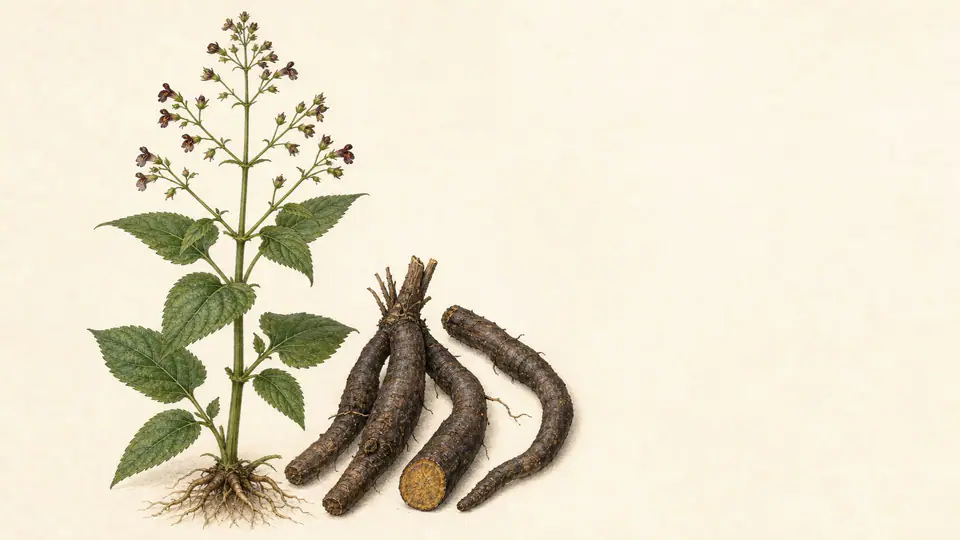
Roots with a black interior: How much should we believe the claim that it is “good for the throat”?
Can I drink Scrophularia like a tea for a long time when my throat is swollen or inflamed? In short, there is currently insufficient evidence to support such long-term use.
While Scrophularia has long been remembered in Korean medicine as a medicinal herb for treating the throat and heat, modern research suggests that we must distinguish between differences in species, processing methods, and possibilities centered on cellular and animal studies. In that case, what should be verified first between the black color and the preclinical possibilities?
The question is simple, but the ingredients are not
The name Scrophularia alone does not reveal what the actual ingredient is. The Standard Korean Medicine Terminology defines Scrophularia as Scrophularia buergeriana or Scrophularia ningpoensisthe root of the plant. What is important here is that it is not a raw root, but a medicinal herb that has been made black inside through repeated semi-drying and piling, and then completely dried. In other words, the black interior of Scrophularia is not a marker of other black-rooted plants, but a characteristic created during the processing stage. Under the same name, raw roots, aerial parts, extracts, and even isolated components like harpagoside are easily mixed, but these cannot be viewed as the same ingredient.
Where does the image of a “medicinal herb for the throat” come from?
Scrophularia is remembered as a medicinal herb for managing throat swelling, inflammation, and heat. In 2021, Scrophulariae Radix a comprehensive review and S. ningpoensis a comprehensive review summarize various components such as iridoids and phenylpropanoid glycosides, as well as preclinical activities related to anti-inflammation, nerves, bones, and immunity. However, it cannot be concluded that these results show the same effects in humans. The components and metabolic patterns of the two species cannot be seen as identical, and it is clear that raw roots, processed roots, extracts, and isolated components must be distinguished. There is a lack of high-quality standalone clinical trials and long-term safety data for Scrophularia regarding pharyngitis, laryngitis, arthritis, and memory in humans.
Teas, powders, and concentrated extracts are not the same as Scrophularia
Scrophularia available on the market comes in various forms, such as teas, powders, and concentrated extracts. However, it is difficult to view these as the same ingredient. Only the processed roots of the two species are defined as medicinal herbs, and raw roots differ from processed roots. Whole root extracts and isolated components must also be distinguished. Anti-inflammatory signals appearing in cells or animals do not directly translate to the treatment of pharyngitis in humans. Therefore, there is currently no evidence to confirm that “Scrophularia tea or concentrated extracts treat pharyngitis.”
| Category | Comparison Target |
|---|---|
| Species | S. buergeriana vs. S. ningpoensis |
| Processing | Raw root vs. medicinal herb made black through semi-drying and piling |
| Formulation | Whole root extract vs. isolated component |
| Level of Evidence | Anti-inflammatory signals in cells/animals vs. treatment of pharyngitis in humans |
What should I check when taking this with other medications or supplements?
Caution is required when using Scrophularia ningpoensis (Hyeonsam) alongside prescription medications or other concentrated supplements. This is because there is insufficient human data regarding long-term concentrated use, drug interactions, and use in children, pregnant, or breastfeeding women. It is a priority to inform your medical provider or pharmacist about the medications and products you are currently taking. Those with liver or kidney disease must also consult a professional first. As there is no evidence that Scrophularia ningpoensis can replace prescription drugs or substitute for the treatment of infections, it is important not to arbitrarily discontinue other treatments.
What symptoms should prompt me to stop use and visit a clinic?
Regardless of whether you are taking Scrophularia ningpoensis, the following throat-related signs require priority emergency evaluation. Difficulty breathing, difficulty swallowing saliva, rapid swelling of the throat, or changes in consciousness require immediate evaluation by 119 or an emergency room. If high fever, severe throat pain, lumps in the throat, or hoarseness persist, evaluation for infection or other causes should not be delayed. Additionally, if severe diarrhea, vomiting, rash, swelling of the face or neck, or difficulty breathing occurs after taking Scrophularia ningpoensis, stop use immediately and seek medical evaluation.
What is the gap between human-based evidence and expectations?
While expectations for Scrophularia ningpoensis are high, definitive evidence based on humans is limited. Most activities summarized in two systematic reviews from 2021 remain at the level of cell and animal studies. There is a lack of high-quality human clinical trials to confirm the long-term safety and efficacy of Scrophularia ningpoensis tea or concentrated extracts for treating pharyngitis. This does not mean it is "ineffective," but rather that it is "not yet at a stage where efficacy can be certain." Observed potential and proven therapeutic effect are different things.
How to avoid confusing it with other ingredients with similar names
Hyeonsam is Chinese Scrophularia (S. ningpoensis) and Korean Scrophularia (S. buergeriana). However, the two species cannot be considered identical in terms of components and metabolic patterns. It must also be distinguished from other black-rooted plants, raw roots, aerial parts, extracts, or isolated components that are similar in name or appearance to Scrophularia ningpoensis. When choosing a product, S. buergerianawhether or not S. ningpoensisthe starting point is to verify the species, whether it is a processed root, and whether it is a tea, powder, or concentrated extract.
Realistic criteria to check today
When choosing Scrophularia ningpoensis, first check the origin species, processing method, and formulation. If you have throat pain, check for the duration as well as high fever, difficulty breathing, difficulty swallowing saliva, voice changes, or lumps in the throat. You must also inform your medical provider or pharmacist about pregnancy, breastfeeding, pediatric status, liver/kidney disease, current medications, and the use of other concentrated supplements. The wise way to approach Scrophularia ningpoensis is to prioritize verifying the origin species, processing, formulation, and the cause of throat symptoms over the general image of it being a "black root" or "throat medicine," and to avoid treating preclinical potential as evidence for long-term tea consumption or infection treatment.
References
- Scrophularia ningpoensis entry based on the Standard Korean Medicine Terminology of the Society of Korean Medicine.
- Scrophulariae Radix biological activities and applications review.
- Scrophularia ningpoensis phytochemistry, pharmacology and pharmacokinetics review.
This text explains the origin of the raw materials, the scope of research, and precautions before consumption. As this cannot replace individual diagnosis or treatment, please consult a medical professional if you are taking medication or if symptoms persist. If sudden and severe symptoms such as difficulty breathing or decreased consciousness occur after consumption, seek help from 119 or the emergency room.

Medical Staff Review
Director Choi Yeon-seung
Chief Director of Baekrokdam Korean Medicine ClinicScrophularia ningpoensis Dictionary Entry, reviewed the safety of expressions and the scope of verification before administration.
Review scope: Ingredient origin, human studies, concomitant medications, safety of intake · Last reviewed 2026-08-17
- Graduated from Kyung Hee University College of Korean Medicine
- Providing Korean medicine treatment since 2010
- Consultations for Gongjindan, Gyeongokgo, Nokyong (Deer Antler) restorative medicine, and customized restorative herbal medicine