The herb tigers are said to lick: How much can we trust it now?
If Centella asiatica is good for scars or skin regeneration, would taking it in capsules help with memory or blood circulation? In short, no. Research results from applying Centella asiatica to the skin are not evidence that oral capsules improve memory or systemic circulation. Even if they share the same name, topical products and oral products follow different paths.
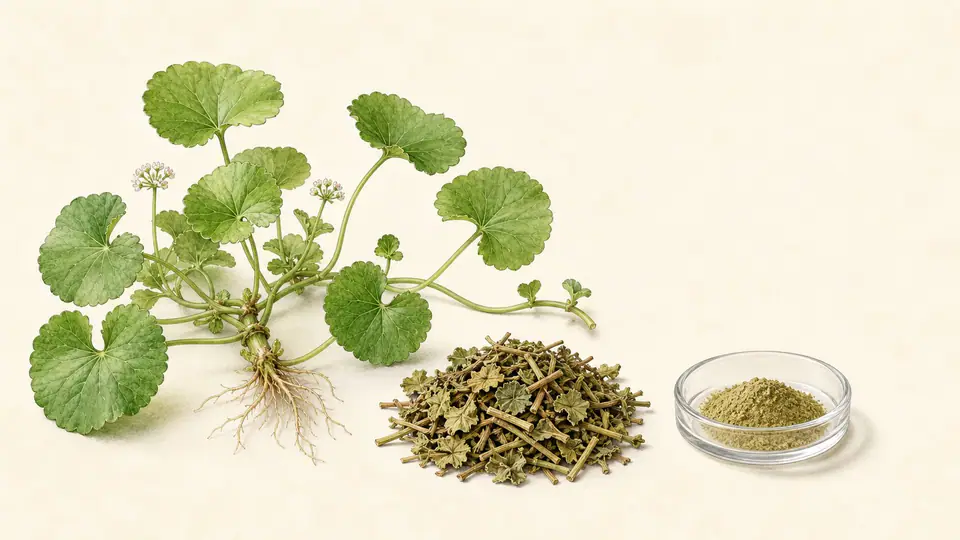
Centella asiatica is a perennial creeping plant of the Apiaceae family. Some may be more familiar with the name Centella asiatica, while others may have heard of it as Gotu Kola. The Kew plant database classifies this plant as a creeping perennial that roots at the nodes, recording both its food and medicinal uses. The first image of this plant is how it crawls along the ground, rooting at every node. This is where a single small leaf began to diverge into skin ointments, teas, powders, and capsules.
The face of Cica cream and other faces
The most familiar form of Centella asiatica to the public is likely the 'Centella' or 'Cica' ingredients in cosmetics. The name referring to the herb tigers lick to heal wounds, as well as the image of skin soothing and regeneration, came from this path. However, edible leaves, teas/powders, oral extracts, and cosmetics or external wound products containing Centella ingredients differ in their route of administration and ingredient exposure. Therefore, they cannot be grouped under a single piece of evidence. First, remember that research on topical application does not prove the efficacy of oral products.
Oral Centella asiatica is a different product
Even among oral products, formulations vary, such as leaf powder, water-soluble extracts, and triterpene standardized fractions. Research dosages cannot be converted based on the product name alone. Therefore, when hearing that 'Centella asiatica is good for leg edema' or 'helps with memory,' one must examine which form of Centella asiatica was used, in what amount, and in which study.
Leg Swelling and Veins: Signals Exist, but Not Confirmed
Literature reviewing 8 studies on chronic venous insufficiency reported signals of improvement in microcirculation, leg edema, and some symptoms. However, it was evaluated that cautious interpretation is necessary because reports are insufficient and the risk of bias is unclear. In other words, while there is a possibility that the feeling of heaviness and swelling in the legs may decrease, it is still far from being accepted as a treatment for the disease. If you experience sudden swelling and pain in one leg or shortness of breath, do not wait and see with Centella asiatica, but seek a medical evaluation. These may be emergency signals that must be distinguished from thrombosis or heart failure-induced edema.
Memory and Dementia: The Path from Animals and Cells to Humans
A significant portion of literature on cognitive and neuroprotection consists of cell and animal studies. Human studies are few, so the effects on dementia prevention or treatment cannot be confirmed. A Phase 1 crossover trial administering a standardized water-soluble extract to adults with mild dementia was a pharmacokinetic and acute tolerability study with only 4 participants, not an efficacy trial. Just because 'Centella' is in Cica creams and memory capsules does not mean they share the same evidence. Progressive memory loss should also not be managed by waiting and seeing with Centella asiatica, but should be professionally evaluated.
Liver and Safety: Rare but Critical Signals to Stop
The US NLM LiverTox states that various traditional uses of Centella asiatica have not been proven in prospective controlled trials, and rare cases of acute liver injury accompanied by jaundice have been reported. For oral products, symptoms such as headache, dizziness, abdominal bloating, nausea, and diarrhea have been reported. Since liver injury has been reported rarely after 3 to 8 weeks of intake, if jaundice, dark urine, severe itching, or pain in the upper right abdomen occurs, stop use, seek medical evaluation, and do not resume intake arbitrarily.
Topical products may cause contact dermatitis or allergic reactions. If redness, itching, or swelling recurs, stop use.
When Using with Other Medications and Supplements
It is advisable not to use oral concentrated products arbitrarily if you have liver disease, are taking multiple supplements or medications, or are pregnant or breastfeeding. You should also check if you are using medications that cause drowsiness or other herbal supplements. Before considering Centella asiatica, first distinguish whether it is a topical product, leaf tea/powder, or an oral standardized extract. Then, consider whether you are expecting scar management, leg edema relief, anxiety reduction, or memory improvement, and whether there is an underlying cause that needs to be diagnosed first.
Similar Names, Different Criteria for Judgment
Edible leaves, oral extracts, and topical Centella preparations start from the same raw material but are different products. Chronic venous insufficiency symptoms and thrombosis or heart failure-induced edema may have similar symptoms, but their causes are different. Animal memory experiments or small-scale pharmacokinetic trials are not at the same stage as dementia treatment. In other words, the biggest pitfall of this ingredient is linking multiple expectations based solely on the fact that it contains Centella asiatica.
Criteria to Check Today
Rather than focusing on names like 'regeneration grass' or 'Cica ingredients,' first check whether it is applied topically or taken orally, the exact extract and purpose, the gap between old, small-scale symptom studies and actual disease treatment, and your liver health and current medications. What should you look for? The specific form on the product label, the number and limitations of human studies matching your intended purpose, and your own medications and medical conditions. Centella asiatica has small leaves, but the paths they diverge into are more numerous than one might think.
References
- Kew Plants of the World Online: Centella asiatica.
- NLM LiverTox: Centella asiatica.
- Centella asiatica for chronic venous insufficiency: systematic review.
- Centella asiatica and cognition: pharmacokinetic phase 1 study.
- Centella asiatica for neuroprotection and cognition: evidence review.
This text explains the origin of the raw materials, the scope of research, and precautions before consumption. As this cannot replace individual diagnosis or treatment, please consult a medical professional if you are taking medication or if symptoms persist. If sudden and severe symptoms such as difficulty breathing or decreased consciousness occur after consumption, seek help from 119 or the emergency room.

Medical Staff Review
Director Choi Yeon-seung
Chief Director of Baekrokdam Korean Medicine ClinicCentella asiatica Dictionary Entry, reviewed the safety of expressions and the scope of verification before administration.
Review scope: Ingredient origin, human studies, concomitant medications, safety of intake · Last reviewed 2026-08-17
- Graduated from Kyung Hee University College of Korean Medicine
- Providing Korean medicine treatment since 2010
- Consultations for Gongjindan, Gyeongokgo, Nokyong (Deer Antler) restorative medicine, and customized restorative herbal medicine