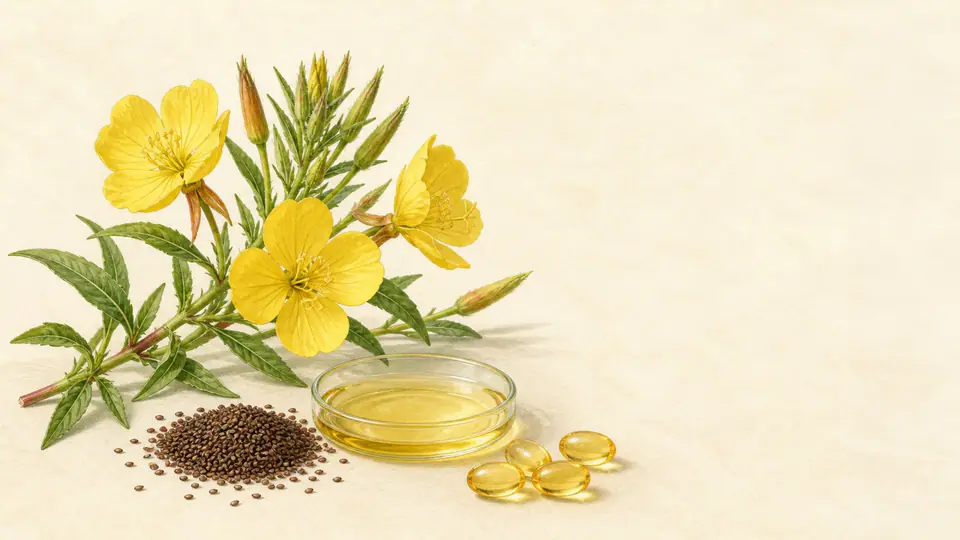
From a drop of oil to the anti-inflammatory narrative
If I take gamma-linolenic acid for atopic dermatitis, premenstrual breast pain, or joint pain, will it improve inflammation and the skin barrier?
To give a short answer, it is difficult to conclude that it might. Gamma-linolenic acid is a type of omega-6 fatty acid that can be converted into DGLA-series substances through specific metabolic pathways in the body. However, biochemical possibility does not immediately mean that human symptoms will improve. Large-scale reviews on atopic dermatitis and breast pain did not support these expectations, and signals regarding joint pain are limited to old, small-scale studies.
Then why is this ingredient still called 'anti-inflammatory omega-6'? The answer should be sought on the back of the oil bottle rather than the front, and in human studies rather than metabolic pathways.
Where the questions begin: skin, breasts, and joints
Questions about gamma-linolenic acid usually arise from three types of physical discomfort: the itching and dryness of atopic skin, the tightness and pain in the breasts before menstruation, and the stiffness and pain in joints, such as in rheumatoid arthritis. These symptoms are easily linked to inflammation. Therefore, the name 'fatty acid that reduces inflammation' is naturally appealing.
However, while the mechanism of the symptoms and the mechanism of the ingredient use the same words, they do not follow the same path. The term 'inflammation' is broad, and there is insufficient evidence to suggest that a single fatty acid can control such a wide-ranging process.
What is GLA?
Gamma-linolenic acid, abbreviated as GLA, is an omega-6 polyunsaturated fatty acid that can be synthesized in the body from linoleic acid. It is found in evening primrose oil, borage oil, and blackcurrant seed oil. While all three oils contain GLA, the actual ratio of GLA relative to the total amount of oil varies by product.
Alpha-linolenic acid (ALA) of omega-3 and GLA have similar names but are different fatty acids. While ALA belongs to the omega-3 family, GLA belongs to the omega-6 family. Because of the similar sound of 'linolenic acid,' it is easy to group them together, but the body processes them differently.
Why anti-inflammatory expectations exist
The reason GLA gained attention lies in its metabolic pathway. GLA can be converted into DGLA (dihomo-gamma-linolenic acid), which serves as a precursor to inflammation-related substances. Theoretically, there is room for it to act in a way that regulates inflammation.
However, the possibility of a biochemical pathway and the clinical effect of a single capsule are on different dimensions. We cannot assume that mechanisms shown in test tubes or animals will appear in the same pattern in humans. This is especially true for diseases with complex causes, such as atopic dermatitis or rheumatoid arthritis.
Between oil mg and actual GLA content
When looking at product labels, the total amount of oil is often written prominently, such as 1 g of evening primrose oil or 1 g of borage oil. However, the total amount of oil is not the same as the amount of GLA. Evening primrose oil tends to have a lower GLA ratio than borage oil, and blackcurrant seed oil shows yet another ratio.
In other words, even if two products list the same mg, the actual dose of GLA may differ. Therefore, when choosing an ingredient, you must look at both the type of oil and the actual GLA content within it. Comparison is impossible using only the numbers on the front.
Different questions for ingested oil vs. topical oil
Oils applied to the skin and oils taken orally have different exposure routes. When applied to the skin, it becomes a local research question related to the skin barrier; when ingested, it acts through digestion, absorption, and systemic metabolism. Even with the same ingredient, research results cannot simply be transferred. The evidence cited here primarily concerns the ingested form, namely oral products.
What does the evidence in humans show?
The National Center for Complementary and Integrative Health (NCCIH) in the US states that there is insufficient evidence to conclude that evening primrose oil is useful for any health condition. Specifically, it notes that oral products are not helpful for atopic dermatitis.
Cochrane evidence, which reviewed 27 randomized trials involving 1,596 people, also showed that oral evening primrose oil and borage oil provided no clinically significant benefit for atopic eczema. For breast pain, they are likely no better than a placebo, and evidence regarding premenstrual syndrome or menopausal symptoms is insufficient to draw a conclusion.
In rheumatoid arthritis, there were signals that GLA-containing oils improved pain, tenderness, and stiffness. However, these studies were small and old, and this is not evidence that they can replace disease-modifying antirheumatic drugs (DMARDs) or prevent joint damage.
Current Medications and Individual Circumstances
Before starting GLA-containing oils, you must first check your current medications and personal health status. You should consult a healthcare provider if you are taking anticoagulants or antiplatelet agents, have a bleeding disorder, or have an upcoming surgery.
Safety during pregnancy and breastfeeding is unclear. Results from studies using it for labor induction are also inconsistent, so it is recommended not to take it arbitrarily. When choosing borage oil, check if the product is confirmed to have pyrrolizidine alkaloids removed and has undergone quality testing; those with liver disease should not take it arbitrarily.
If you experience shortness of breath, facial swelling, abnormal bleeding, or persistent severe abdominal pain during use, stop taking it and seek medical evaluation. Evening primrose oil is generally well-tolerated for short-term use, but gastrointestinal discomfort such as abdominal pain, nausea, or loose stools may occur.
Differences from similar raw materials
To summarize the three oils commonly encountered when looking for GLA: evening primrose oil, borage oil, and blackcurrant seed oil all contain GLA, but the total oil amount, actual GLA content, raw materials, and purification quality vary by product. Please also remember that ALA is a different fatty acid, despite the similar name.
| Category | Points to Check |
|---|---|
| Oil Type | Whether it is evening primrose, borage, or blackcurrant |
| Actual GLA Content | GLA in mg, not the total oil amount |
| Purification Quality | Specifically for borage oil, whether pyrrolizidine alkaloids were removed |
| Purpose of Use | Which symptom: atopic dermatitis, breast pain, premenstrual syndrome, or joint pain |
| Concurrent use status | Use of anticoagulants/antiplatelet agents, surgery, pregnancy/breastfeeding, or liver disease |
Final Decision Criteria
Gamma-linolenic acid is not a fatty acid that increases inflammation simply because it is an omega-6, nor is it an anti-inflammatory treatment simply because it has a DGLA pathway. There is a gap between the biochemical possibilities of a single oil capsule and clinical results in humans.
When choosing raw materials, check the source oil, actual GLA content, and purpose of use rather than the label 'anti-inflammatory omega-6'. You must also consider the gap between the mechanism and human studies, personal circumstances such as pregnancy or surgery, current medications, and the purification quality of the product. Realistic criteria for checking these are provided here.
References
- NCCIH: Evening Primrose Oil.
- NCCIH: Skin conditions and complementary health approaches.
- Herbal medicinal products for rheumatoid arthritis: systematic review.
- Polyunsaturated fatty acids in inflammatory rheumatic diseases: systematic review.
This text explains the origin of the raw materials, the scope of research, and precautions before consumption. As this cannot replace individual diagnosis or treatment, please consult a medical professional if you are taking medication or if symptoms persist. If sudden and severe symptoms such as difficulty breathing or decreased consciousness occur after consumption, seek help from 119 or the emergency room.

Medical Staff Review
Director Choi Yeon-seung
Chief Director of Baekrokdam Korean Medicine ClinicGamma-Linolenic Acid Glossary Entry, reviewed the safety of expressions and the scope of verification before administration.
Review scope: Ingredient origin, human studies, concomitant medications, safety of intake · Last reviewed 2026-08-17
- Graduated from Kyung Hee University College of Korean Medicine
- Providing Korean medicine treatment since 2010
- Consultations for Gongjindan, Gyeongokgo, Nokyong (Deer Antler) restorative medicine, and customized restorative herbal medicine