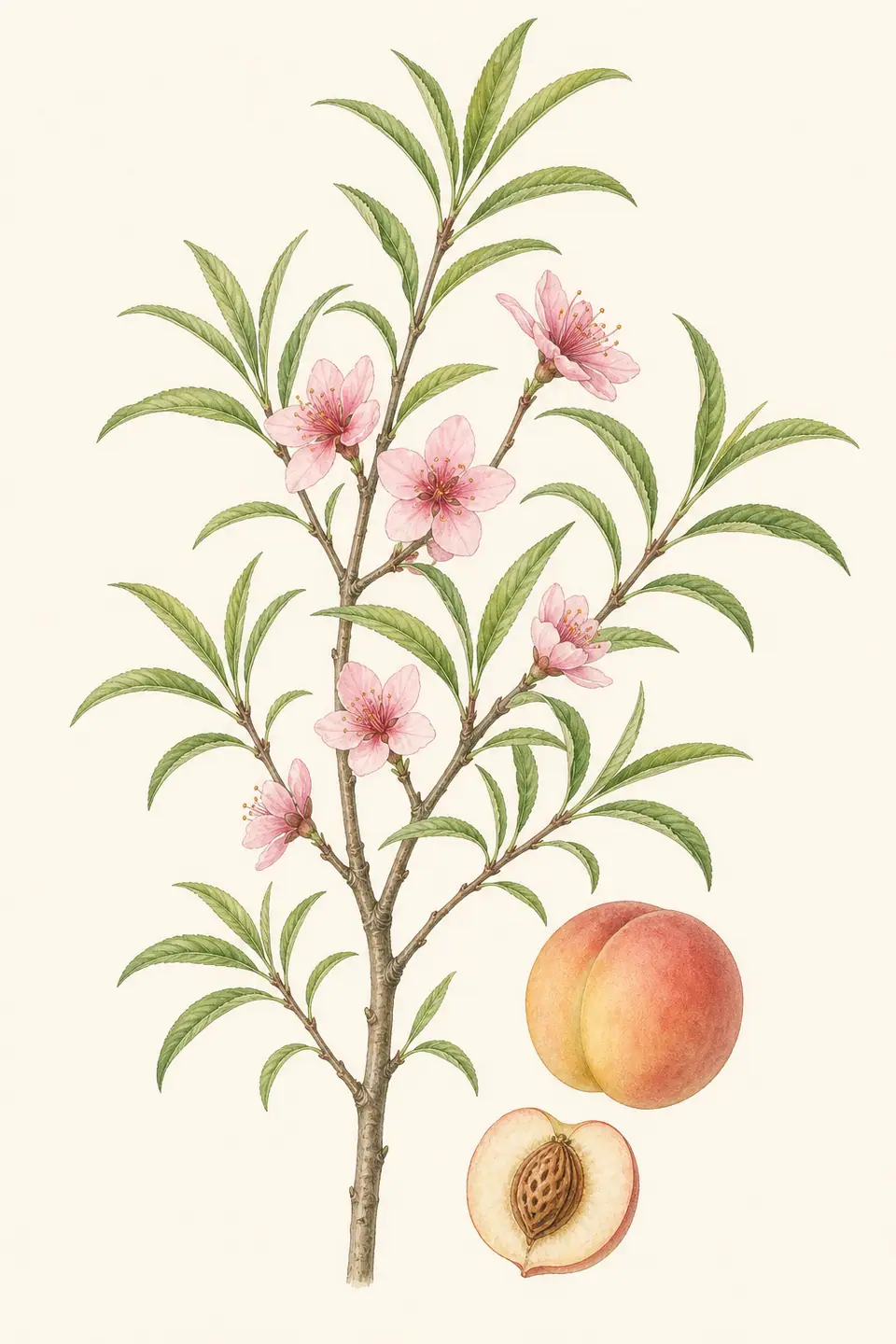
The Hidden Key of Bokmaektang: Doin (Peach Kernel)
In the classic text "Shanghanlun," there is a prescription called Bokmaektang. Its name comes from its purpose: to correct a pulse that is scattered or feels as if it might break. While Zigamcho (honey-fried licorice) is often seen as the main ingredient on the surface, Doin (peach kernel) quietly plays a vital role within. Doin refers to the peach seed, specifically Prunus persicathe dried mature seed used for medicinal purposes. Its properties are bitter and sweet with a neutral temperature, and it acts as a blood-invigorating and stasis-removing medicine that affects the Heart, Liver, and Large Intestine meridians.
Many people misunderstand the expression 'clearing the blood' as something that aggressively loosens everything or as a medicinal herb used only for women's health. However, the actual role of Doin is more sophisticated. It resolves blood stasis while moisturizing the large intestine to facilitate bowel movements and calming coughs and shortness of breath, offering a broad harmony. True to its form as a seed, it possesses the property of gently opening blocked areas in the body while ensuring the intestinal passages do not become dry.
Therefore, the amount, the patient, and the method of use become critical. For herbs with blood-invigorating effects, the approach may vary depending on the body's condition, particularly the tendency to bleed, pregnancy, breastfeeding status, and other herbs used in combination. On this page, we will guide you through the identity of Doin and the standards for using it safely.
Summary at a Glance
Doin is a blood-invigorating and stasis-removing medicine that uses peach seeds. The table below summarizes its name, origin, properties, and precautions at a glance.
| Category | Content |
|---|---|
| Origin | Hanja name: 桃仁, Scientific name: Prunus persica (L.) Batsch; uses the dried mature seed of the peach |
| Properties and Tropism | Bitter and sweet, neutral; Heart meridian, Liver meridian, Large Intestine meridian |
| Representative Alias | A blood-invigorating and stasis-removing medicine used in traditional prescriptions such as Bokmaektang |
| Efficacy recorded in literature | Invigorating blood and removing stasis, moisturizing the intestines and promoting bowel movements, relieving cough and asthma |
| Main Ingredients | Cyanogenic glycosides, phenolic glycosides, etc., have been academically reported |
| Combinations and Contraindications | As it is a blood-invigorating herb, caution is required for those with a tendency to bleed or those who are pregnant; specific drug interactions and contraindications should be confirmed during consultation |
Is this medicinal herb right for me?
Doin is a medicinal herb that helps the flow of blood and moisturizes the intestines. However, unlike the familiar image of a peach seed, it can be burdensome for those who are pregnant or have a tendency to bleed. Please review the following three criteria first.
- Generally suitable cases: It has been traditionally considered for those experiencing pain caused by blocked or stagnant blood, those who pass blood clots during menstruation, or those with hard stools and irregular bowel habits. As a herb with blood-invigorating, stasis-removing, and intestine-moisturizing properties, it may be included in a prescription tailored to such constitutions.
- Cases requiring caution: Caution is required for those who naturally have heavy menstrual flow, a tendency for blood not to clot easily, or hemorrhagic disorders. Because Doin acts to loosen the blood, it may be inappropriate for those with a bleeding tendency. Additionally, those before or after surgery or those taking anticoagulants or antiplatelet agents must consult a Korean medicine doctor.
- Cases to avoid: Pregnant women should avoid Doin. Its blood-invigorating and stasis-removing action may affect the uterus and could potentially harm the fetus. Furthermore, it is not advisable for those with frequent diarrhea, a weak gastrointestinal system, or for use prematurely when blood is not yet stagnant.
Practical Q&A
Unlike the familiar image of a peach seed, Doin is a medicinal herb in Korean medicine used to treat the blood and intestines. Consequently, there are many questions regarding pregnancy, breastfeeding, bleeding tendencies, and timing of intake. Below is a summary based on facts from frequently asked questions in the clinic. Since individual conditions vary, the final decision on whether to take it must be made through a professional consultation.
I eat peaches during pregnancy, so why can't I use Doin?
The peach flesh eaten as a fruit and Doin used as a medicinal herb are different. Doin is a herb with blood-invigorating and stasis-removing effects and is traditionally handled with caution during pregnancy. Classical texts such as "Geumgwe Yoryak" also contain contexts requiring caution when using prescriptions related to pregnancy. If you are pregnant or may be pregnant, please consult a Korean medicine doctor before deciding on a prescription containing Doin.
I have a constitution that bleeds easily; can I use Doin?
Since Doin helps the flow of blood, it may be inappropriate for those with a tendency to bleed. Particular caution is needed if you bruise easily, have heavy menstrual flow, or are taking blood-clotting medications. If you are considering Doin in this state, it is safest to first confirm its appropriateness through a consultation.
Does Doin help when I have constipation?
Doin (peach kernel) is a medicinal herb that moistens the intestines to facilitate bowel movements through its Yunjang-tongbyeon (moistening the intestines and promoting defecation) action. However, since the causes of constipation vary, such as lack of moisture, decreased intestinal motility, or medication side effects, different prescriptions may be more appropriate depending on the cause. Whether a prescription containing Doin is necessary is determined after evaluating the condition of the intestines and the patient's overall constitution.
How much Doin should be taken per day?
The general dosage of Doin in Korean herbal medicine prescriptions is traditionally often used within the range of 4 to 10g. However, this varies depending on the purpose of the prescription, the combination with other herbs, and the individual's constitution and condition. Since the specific dosage is determined by the Korean medicine doctor who creates the prescription, please do not decide the dose yourself and receive guidance through a consultation.
What should be the interval between taking Doin and meals?
The timing for taking Korean herbal medicine varies depending on the nature of the prescription and your gastrointestinal condition. Generally, taking it 30–60 minutes before or 30–60 minutes after meals is often recommended. Prescriptions containing doin (a Korean medicinal herb) may irritate the stomach, so taking the medicine after meals may be more suitable for those with a sensitive stomach. Your Korean medicine doctor will provide the exact dosage and administration instructions at the time of prescription.
What are the representative prescriptions that use Doin?
Doin is used more frequently within a prescription than alone. A representative example is Bokmaektang (Zigancho-tang) from the Sanghanron; additionally, it is combined in various prescriptions dealing with blood stasis (blood-related disorders) or intestinal dryness. Which prescription is right for you must be decided after a comprehensive review of your symptoms, constitution, and other concomitant medications.
Relationship with Other Medicinal Herbs (Yakdae/Pairing)
Doin is not used alone. In Korean medicine, most medicinal herbs only perform their role when two or more are combined, and such pairs are called 'Yakdae' (medicinal pairs). As Doin is an herb that manages the blood and intestines, its use becomes clear when combined with other blood-activating herbs, blood-tonifying herbs, or intestine-moistening herbs. Below are representative combinations found in traditional literature.
- Doin + Honghwa (Safflower) Used together in prescriptions such as Tonggyo-hwalhyeoltang found in the Uihak-gangmok. In this structure, Honghwa resolves blood stasis in the blood vessels and Doin supports this action; it has been traditionally used in prescriptions dealing with blood flow disorders in the face or head.
- Doin + Dang-gui (Angelica gigas) + Jeok-so-yak (Red Peony Root) Similar to the Tedang-wan-san series in the Sanghanron, these are combined such that Dang-gui tonifies and regulates blood, Jeok-so-yak resolves blood, and Doin removes blood stasis. This combination has been traditionally used in prescriptions dealing with blood stasis in the lower abdomen.
- Doin + Dae-hwang (Rhubarb) + Mang-cho (Glauber's salt) Used together with Doin and Suso (leech) in the Tedang-wan of the Sanghanron. In this structure, Dae-hwang and Mang-cho push heat and excess patterns downward, while Doin works to resolve blood stasis. When combined with such strong purgatives, the action becomes very sharp, so it is selected carefully according to constitution and symptoms.
Depending on the combination, the properties of Doin can range from a gentle intestine-moistening herb to a sharp blood-breaking herb (Pahyeolyak). Therefore, rather than simply noting that 'peach kernels are included' in a prescription, it is more important to see which herbs it is combined with and in what direction it is being used.
In what form is it consumed?
Since Doin is a medicinal herb that uses peach seeds, it requires professional preparation methods different from familiar food forms. In Korean medicine, the form of administration is determined to maximize the efficacy of the herb; in the case of Doin, it can be categorized as follows.
- Tea: Not common. Due to its bitter taste and specific components, Doin is rarely used in the form of a simple boiled tea.
- Food: Not common. Doin as a Korean herbal medicine, rather than the peach seed itself, is not consumed in the form of everyday food.
- Jeontang (Decoction, boiled herbal medicine): The most traditionally used form. It is boiled in water with other herbs and taken as part of a prescription.
- Professional Prescription: The most common form is a prescription determined by the Korean medicine doctor according to the patient's condition. Doin is more often used in combination with other herbs than alone.
Since the specific dosage, duration of administration, and preparation method vary depending on the individual's condition and the composition of the prescription, it is best to decide these with your Korean medicine doctor during the consultation.
Interactions and Safety During Use
While Doin may be familiar as a peach seed, in Korean medicine, it is a blood-activating and stasis-removing herb (Hwalhyeol-geo-u-yak) that helps blood flow and moistens the intestines. Due to its properties, caution is required when combined with certain physical conditions or other medications. Below are the confirmed interactions and contraindications.
- Pregnancy: Doin is traditionally classified as an herb with blood-activating (Hwalhyeol) properties. As a rule, its use should be avoided during pregnancy, and you must consult a Korean medicine doctor.
- Bleeding tendency: Those who have difficulty stopping bleeding or have a risk of bleeding, such as thrombocytopenia, should be cautious when using Doin (peach kernel).
- Breastfeeding: Sufficient safety information regarding use during breastfeeding has not been confirmed. It is advisable to decide after a consultation.
- Before and After Surgery: It is safe to stop taking the medicine and inform your medical staff before and after surgery due to the risk of bleeding and potential interactions with anesthetic drugs.
- Anticoagulants and antiplatelet agents: The risk of bleeding may increase when used in combination with medications such as warfarin or aspirin. If you are taking Western medicine, you must consult a Korean medicine doctor.
- Laxatives and Painkillers: Caution is required when using Doin with other medications that affect bowel movement or blood flow, as their effects may overlap.
Doin is a medicinal herb whose appropriate dosage and formulation vary depending on the prescription. Please ensure through a consultation with a Korean medicine doctor whether it is suitable for your condition and compatible with any medications you are currently taking.
If you experience these symptoms
If these symptoms appear
Doin is a medicinal herb that helps the flow of blood and moistens the intestines. However, these two effects can also be signals that 'excessive use may cause problems.' If the following changes occur during intake, it is important to notify your attending Korean medicine doctor first rather than reducing the dose or stopping on your own.
- Increased frequency or looseness of bowel movements: Because Doin has a property that moistens the intestines, diarrhea or changes in bowel habits may occur if taken in excessive amounts or if it does not suit your constitution.
- Increased menstrual flow or abnormal bleeding: As it is a medicinal herb with blood-activating properties, caution is necessary for those who are menstruating or have a tendency to bleed.
- New or worsening abdominal discomfort or pain: Even familiar peach kernels can put a strain on the digestive system when used for medicinal purposes.
- If you are pregnant or believe you may be pregnant: Doin is traditionally classified as a blood-activating and stasis-removing herb and, in principle, is not used during pregnancy.
If these signals appear, or if your overall physical condition deteriorates significantly after intake, stop taking the medicine immediately and contact a nearby emergency medical institution or your attending Korean medicine doctor. In particular, those who are pregnant or have bleeding disorders must consult a doctor before intake.
Differences from other restorative medicines
Because of its name as a peach kernel, Doin is easily mistaken for a 'restorative tonic' or a 'food supplement.' However, in Korean medicine, Doin is a blood-activating and stasis-removing herb (Hwalhyeol-geo-eo-yak) that helps the flow of blood, and it also possesses the characteristics of an intestine-moistening herb (Yunjang-yak). Therefore, its use differs from traditional restorative tonics such as Gongjindan or Gyeongokgo.
Gongjindan is a prescription focused on strengthening the essence of the kidneys and supplementing energy, which is far from the direction of releasing blood flow or emptying the intestines like Doin. Gyeongokgo is also a blood- and yin-supplementing prescription that nourishes the yin of the lungs and kidneys and enriches the qi and blood. In contrast, Doin is closer to releasing a state where qi and blood are blocked and helping cases where the large intestine becomes dry and stools become hard.
Therefore, rather than being a restorative tonic that 'nourishes the body,' Doin is closer to a communication-type herb used when the flow of blood and intestines is blocked. It is safe to confirm through a direct consultation whether your condition is closer to a deficiency of qi and blood, or whether the flow of blood is blocked or the intestines are dry.
References
- Evidence materials related to Doin 1: Korea Institute of Korean Medicine official data.
- Evidence materials related to Doin 2: PubMed academic paper.
- Supporting evidence for Peach Kernel 3: PubMed academic paper.
- Supporting evidence for Peach Kernel 4: PubMed academic paper.
- Supporting evidence for Peach Kernel 5: PubMed academic paper.
If you would like to check if this medicinal herb is right for you or which prescription it should be used with, please leave a medical inquiry. For those who find it difficult to visit the clinic, non-face-to-face consultations are available; we will provide guidance after first reviewing your current condition and current medications.

Medical Staff Review
Director Choi Yeon-seung
Chief Director of Baekrokdam Korean Medicine ClinicPeach Kernel Dictionary Entry, reviewed the safety of expressions and the scope of verification before administration.
Review Scope: Clinical Accuracy, Pharmacology, Contraindications, Combinations, QA · Last Reviewed 2026-08-16
- Graduated from Kyung Hee University College of Korean Medicine
- Providing Korean medicine treatment since 2010
- Consultations for Gongjindan, Gyeongokgo, Nokyong (Deer Antler) restorative medicine, and customized restorative herbal medicine