From the fragrant tears of tree bark to joint capsules
If I take Boswellia for knee arthritis, can I reduce my use of painkillers or joint injections? In short, while some small studies showed that pain and function scores improved compared to a placebo, there is not yet sufficient evidence to suggest it can replace medication or injections. This ingredient is a prime example of how a single name can lead to misunderstandings, as it encompasses incense for burning, topical products, and capsules for swallowing.
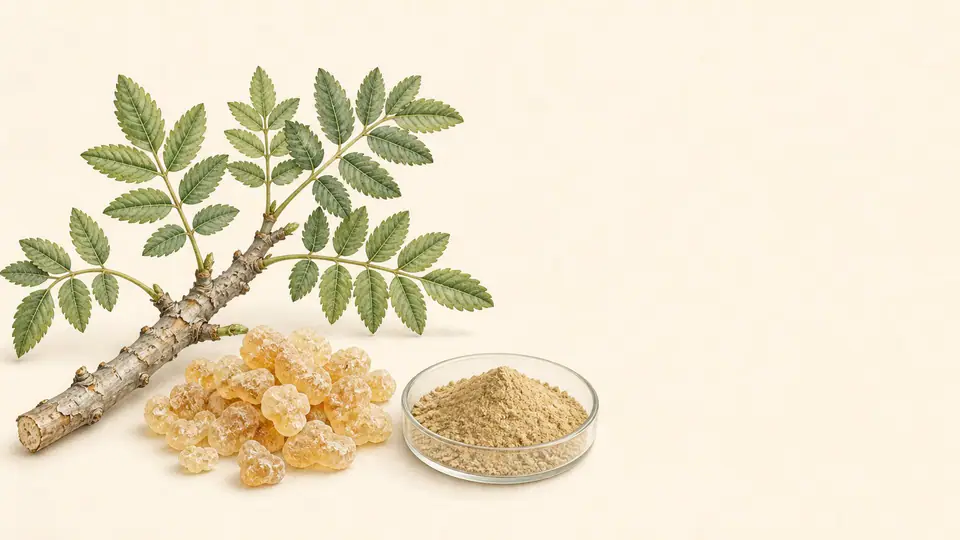
Boswellia is a raw material processed from the frankincense resin found in the Boswelliainner wood, particularly the Boswellia serrata bark of trees from India, the Middle East, and North Africa. Under the same name, raw resins, frankincense burned as incense, essential oils, topical products, and oral extracts standardized to boswellic acids or AKBA coexist. They differ in species, extraction methods, dosage, and routes of administration. Therefore, findings from one product cannot be applied to another.
Why This Question Is Frequently Asked
The NCCIH states that while oral Boswellia may potentially reduce pain and inflammation in osteoarthritis, most studies are small and of low quality, meaning there is a lack of high-quality evidence to confirm its utility for any health condition. A 2018 review on knee osteoarthritis also found that Boswellia preparations improved pain and function more than a placebo, but the overall quality of the research was low and most had fewer than 100 participants, which was insufficient for making clinical recommendations. A 2024 meta-analysis of 9 trials involving 712 people also reported improvements in pain, stiffness, and function scores, but because standardized extracts from specific brands were included in several trials, it is difficult to generalize these results to general Boswellia products.
Although the comprehensive name 'Boswellia' sounds like a single drug, the evidence actually relies on specific species, specific extracts, and specific products.
The identity of the ingredient: Species and forms must be distinguished
Frankincense is a broad term referring to the oleogum resins of several Boswellia species. Joint clinical trials primarily use specific B. serrata extracts. If the standardization rate of boswellic acid/AKBA and the extraction technology differ, the exposure of a commercial product may not be the same as the research product, even with the same mg value. Frankincense burned as incense or applied to the skin cannot share evidence with oral joint extracts because the routes of administration are different.
Therefore, it is a reasonable start to check the product label for Boswellia serrata whether it is an extract, whether boswellic acid or AKBA is indicated, and what the daily intake amount is.
Why the expectations exist: Pain scores and cartilage regeneration are different stories
Short-term improvement in pain surveys and WOMAC scores is a different outcome from the regeneration of worn-down cartilage or a reduction in the progression of arthritis and the risk of surgery. Most of the currently reviewed studies only show the former, short-term changes in symptom scores. Small studies on asthma, cancer, or intestinal diseases cannot be translated into broad anti-inflammatory therapeutic effects for commercial joint products.
In other words, the claim that Boswellia 'improves joints' may be an exaggerated expression of some results seen in pain or function surveys. Within the reviewed scope, it is difficult to find evidence that it changes cartilage structure or disease progression.
Differences in Product Form: Same Name, Different Exposure
| Category | Characteristics | Can evidence be applied? |
|---|---|---|
| B. serrata Oral extract | Primary subject of joint research | Limited to some small studies |
| Raw resin/Incense | For ritual or fragrance use | Different route than joint research |
| Essential oils · Topical products | Skin · Inhalation exposure | Irrelevant to oral extract evidence |
| Single agents · Complex formulations (Turmeric, MSM, etc.) | Varies by ingredient combination | Evidence for each complex ingredient must be viewed separately |
Standardized branded formulations are sometimes used repeatedly in research, so results for those specific products are relatively reliable, but it is difficult to generalize those results to other products.
When taking with medications or supplements
If you are taking medications such as painkillers, anticoagulants, antiplatelet agents, or asthma medications, it is necessary to inform your medical staff or pharmacist about the entire product before starting Boswellia. B. serrata In some trials, extracts were used up to 1 g per day for 6 months, but this does not imply long-term safety for all species, extracts, or complex products. Gastrointestinal discomfort, nausea, diarrhea, and skin reactions may occur, and the auxiliary ingredients and extraction solvents of each product should also be checked.
In particular, if you approach Boswellia with the intention of replacing painkillers or joint injections, that expectation exceeds the reviewed evidence.
Individual circumstances and safety signals
There is insufficient safety data for medicinal oral extracts in amounts greater than what is found in food during pregnancy or breastfeeding, so it is advisable not to use them arbitrarily. If you have swollen and hot joints, fever, sudden inability to bear weight, or deformity after trauma, you must receive a diagnosis rather than waiting and seeing with Boswellia.
Then, what should be checked first? It is important to first distinguish whether the diagnosis of knee osteoarthritis is certain, or if it is due to other causes such as acute injury, gout, or rheumatoid arthritis.
The Gap Between Human Evidence and Expectations
Research on Boswellia remains at the stage of showing 'possibility.' While the number of studies is increasing, the number of participants is small, the quality is low, and there is a tendency to rely on specific branded products. This means that rather than concluding it 'is effective,' it should be read as 'pain and function scores improved under certain conditions.'
Furthermore, improvement in symptom scores does not directly correlate with changes in joint structure or the prevention of surgery. When this gap is acknowledged, expectations for Boswellia are aligned with reality.
Differences from similar raw materials
B. serrata Oral extracts, raw resins, incense, essential oils, and topical products are different products even if they come from the same tree. The criteria for judgment also vary depending on whether it is a single extract or a complex formulation containing turmeric or MSM, and the daily intake of boswellic acids or AKBA. Pain and WOMAC function scores are separate outcome indicators from cartilage regeneration, joint structure, and surgery prevention.
Realistic criteria to check today
If you are considering Boswellia, rather than the name 'natural analgesic frankincense,' you should first look at the accurate Boswellia We first look at the species, oral formulation, standardization status, and complex ingredients. We also check the product dependency of small short-term trials, the gap between symptom scores and joint structure changes, and your current diagnosis, medications, pregnancy, and surgical status. The decision to reduce painkillers or joint injections should be made after consulting with medical staff based on this information.
References
- NCCIH: Boswellia usefulness and safety.
- Curcumin and Boswellia for knee osteoarthritis: systematic review.
- Standardized Boswellia serrata extract in osteoarthritis: meta-analysis.
- Boswellia extracts for knee osteoarthritis: systematic review.
This text explains the origin of the raw materials, the scope of research, and precautions before consumption. As this cannot replace individual diagnosis or treatment, please consult a medical professional if you are taking medication or if symptoms persist. If sudden and severe symptoms such as difficulty breathing or decreased consciousness occur after consumption, seek help from 119 or the emergency room.

Medical Staff Review
Director Choi Yeon-seung
Chief Director of Baekrokdam Korean Medicine ClinicBoswellia Dictionary Entry, reviewed the safety of expressions and the scope of verification before administration.
Review scope: Ingredient origin, human studies, concomitant medications, safety of intake · Last reviewed 2026-08-17
- Graduated from Kyung Hee University College of Korean Medicine
- Providing Korean medicine treatment since 2010
- Consultations for Gongjindan, Gyeongokgo, Nokyong (Deer Antler) restorative medicine, and customized restorative herbal medicine