Spice seeds show a different side when measured by the spoonful
Can I take nutmeg by the spoonful if it is said to be good for digestion or diarrhea? In short, it is better not to do so.
While nutmeg is a familiar spice in curries or desserts, a spoonful of powder or pure essential oil has a different safety profile than a pinch used in food. It is crucial to distinguish between these two.
Why This Question Is Repeated
Some people view nutmeg as a 'medicinal ingredient' while trying to soothe indigestion or diarrhea on their own. This is often based on the impression that it has been traditionally used for digestion and the assumption that it is safe because it is available in the kitchen. However, nutmeg as defined by the Korean Pharmacopoeia of the Ministry of Food and Drug Safety is simply the seed of Myristica fragrans Houtt. with the seed coat removed; this definition alone does not determine the appropriate dosage. The problem begins the moment 'small amounts as a spice' and 'spoonful amounts' are treated as the same.
What exactly is nutmeg?
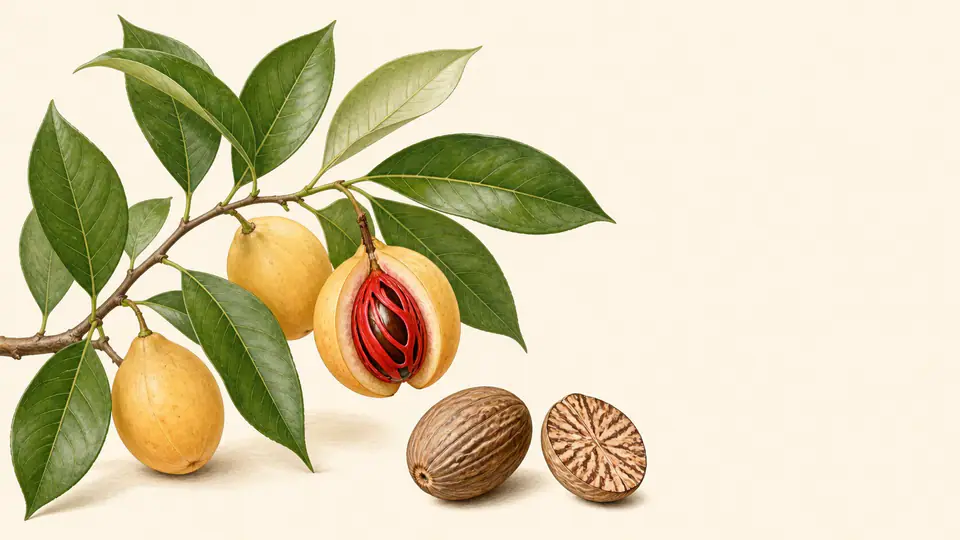
Nutmeg is not simply the name of a plant, but refers to a specific part of it. The pharmacopoeia defines it as the seed of M. fragrans with the seed coat removed. The red, net-like part wrapping the seed from the same plant is called mace, which is a different part from the nutmeg seed. Although the two are often linked because they come from the same plant, their composition and risks differ. We will revisit this point later.
Reasons for expectations and limitations of evidence
A 2025 comprehensive review summarized 328 components and preclinical activities of nutmeg. This means various components showed activity in test tubes or animal experiments. However, there is a lack of clinical translation for single components, and the review pointed out gaps in processing and quality standards, as well as toxic components such as myristicin. In other words, having many components and laboratory results does not mean the desired effect is achieved when consumed by humans. Evidence for humans is limited.
A pinch versus a spoonful, and differences in formulation
Small amounts used for flavoring food and high doses measured by the spoonful cannot be viewed with the same safety. LactMed distinguishes between food flavoring levels and high doses, explaining that high doses, such as a spoonful, can lead to anticholinergic-like toxicity. What is important here is not only the 'quantity' but also the 'formulation and purpose.' Seed powder, pure essential oil, and concentrated extracts have different compositions even if they come from the same raw material. Essential oils concentrate volatile components, while powder contains other non-volatile components. Therefore, grouping everything under the single name 'nutmeg' and assuming it is safe obscures the issue.
| Category | A pinch in food | Spoonful amounts of powder, essential oil, or concentrated extract |
|---|---|---|
| Purpose | Spice | Self-administration, hallucinogenic purposes, etc. |
| Safety Standard | Daily food level | Different potential for high-dose toxicity |
| Caution Group | General food precautions, such as allergies | Concurrent medications, accidental ingestion by children, emergency signals |
Mace is not Nutmeg
When comparing nutmeg seeds and mace arils, the first thing to understand is that while they come from the same plant, they are different parts. Cases of high-dose toxicity have also been reported for mace. Therefore, it cannot be concluded that 'nutmeg is dangerous but mace is safe.' Both are used as spices in small culinary amounts, but each carries risks at high doses. This means that beyond the simple issue of 'raw material vs. extract,' one must recognize the differences between parts within the same plant.
Concurrent Use and Accompanying Conditions Increase Risk
Data from the Illinois Poison Center over 10 years showed 32 cases of nutmeg exposure, some of which involved intentional ingestion combined with other drugs. This demonstrates that the issue is not limited to nutmeg alone, but that situations can become more complicated when combined with other central nervous system active substances. This is why high-dose nutmeg should not be used with sleeping pills, sedatives, psychiatric medications, alcohol, or psychotropic substances. Since the context of exposure differs between typical small amounts used for flavoring food and a spoonful of powder, capsules, or essential oils, you must check your concurrent medications if considering high-dose products.
Who is Consuming it and in What Condition
There is insufficient safety data for doses exceeding food flavoring for pregnant women, breastfeeding women, and children. In particular, during breastfeeding, amounts greater than those found in food should be avoided. Accidental ingestion by children must also be prevented. This is why powders or mace should not be left within reach of children and should be stored in a locked area. Additionally, it must be checked whether there are attempts to consume it for hallucinogenic purposes. Myristicin in nutmeg can cause anticholinergic toxicity patterns above a certain amount, which is far removed from simply treating indigestion.
When are there warning signs?
If severe agitation, confusion, hallucinations, rapid heart rate, vomiting, or decreased consciousness occur, you must immediately call 119 or visit an emergency room or poison control center. These symptoms are signals that can appear in high-dose nutmeg poisoning. If consumption started with the expectation that it is 'good for digestion' leads to such a state, it is no longer a matter for self-management.
Criteria to Check Today
Finally, what questions should you ask when looking at this ingredient? First, distinguish whether it is a small amount of spice in food or a spoonful of powder, a capsule, or an essential oil. Next, check if powder or mace is within reach of children, or if there are attempts to use it for hallucinogenic purposes. Then, check if sedatives, sleeping pills, psychiatric medications, alcohol, or other psychotropic substances are being used concurrently. The realistic standard for this ingredient is to avoid self-administering by the spoonful and to first verify the amount used in food, the formulation, and concurrent medications, rather than extending the familiarity of a spice to high-dose safety.
References
- Ministry of Food and Drug Safety Korean Pharmacopoeia: Nutmeg.
- Myristica fragrans comprehensive pharmacology and toxicology review.
- Nutmeg poisonings: Illinois Poison Center 10-year review.
- NIH LactMed: Nutmeg.
- Mace poisoning with reversible coma: case report.
This text explains the origin of the raw materials, the scope of research, and precautions before consumption. As this cannot replace individual diagnosis or treatment, please consult a medical professional if you are taking medication or if symptoms persist. If sudden and severe symptoms such as difficulty breathing or decreased consciousness occur after consumption, seek help from 119 or the emergency room.

Medical Staff Review
Director Choi Yeon-seung
Chief Director of Baekrokdam Korean Medicine ClinicNutmeg Dictionary Entry, reviewed the safety of expressions and the scope of verification before administration.
Review scope: Ingredient origin, human studies, concomitant medications, safety of intake · Last reviewed 2026-08-17
- Graduated from Kyung Hee University College of Korean Medicine
- Providing Korean medicine treatment since 2010
- Consultations for Gongjindan, Gyeongokgo, Nokyong (Deer Antler) restorative medicine, and customized restorative herbal medicine