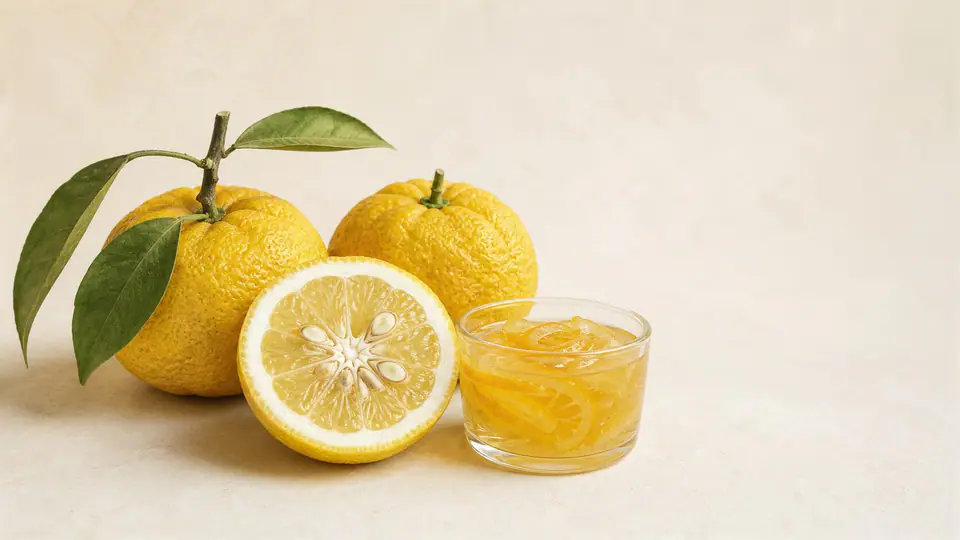
Misconceptions arising from the scent of the peel becoming a syrup
If you have cold symptoms, will drinking Yuja tea help you recover faster due to vitamin C, and can you drink it daily without worrying about sugar? In short, while warm Yuja tea can make the throat feel more comfortable, there is no human-based evidence that it eliminates cold viruses or replaces flu medications. Additionally, the impact of Yuja-cheong on blood sugar and calories depends more on the added sugar or honey and the dilution ratio than on the Yuja components themselves.
Yuja is a citrus fruit of the Rutaceae family, Citrus × junosutilizing both the strongly scented peel and the acidic juice. Fresh fruit, juice, peel powder, essential oils, and Yuja-cheong (preserved in sugar) differ in their components and intake amounts. Even under the same name, the actual exposure varies depending on the form, the amount, and what it is consumed with.
The many faces hidden behind the name 'Yuja'
Kew classifies Yuja as Citrus × junosa hybrid citrus. In the Yuja we commonly know, vitamin C, phenolic compounds, and fragrance components may be more concentrated in the peel than in the pulp. However, this varies by variety and maturity, making it difficult to view as a fixed therapeutic dose. Freshly ground fruit, squeezed juice, dried peel powder, extracted essential oils, and Yuja-cheong preserved in sugar each contain different parts and concentrations. This is where a single name can obscure the facts.
Why Yuja is perceived as a cold-fighting vitamin drink
The fact that Yuja contains vitamin C and phenolic compounds is often linked to the idea that it makes a cold heal faster. However, because these components vary by variety, maturity, and whether they are in the peel or pulp, they cannot be seen as a fixed therapeutic dose. While warm Yuja tea may make the throat feel more comfortable, there is no human-based evidence that it eliminates cold viruses or replaces flu medications. Symptom relief and infection treatment are different categories.
Why fragrance research does not equate to therapeutic effect
In a crossover trial where 20 healthy women smelled Yuja fragrance, changes in mood and saliva markers were observed. However, this was neither an ingestion study nor a disease treatment study. Changes in stress markers in a small-scale fragrance study do not mean that drinking Yuja-cheong treats colds or anxiety. If the subjects, exposure methods, and purposes of research are not distinguished, scientific observations are distorted into everyday expectations.
Actual exposure in one cup of Yuja-cheong
The impact of citron tea preserve (yuja-cheong) on blood sugar and calories depends more on the added sugar, honey, and dilution amount than on the citron itself. If you are managing diabetes or weight, do not count citron tea preserve as an unsweetened tea; instead, check the sugar content and the serving size per dose. Even if diluted, increasing the number of cups increases exposure to sugar and honey. It is difficult to categorize raw citron or citron juice in the same category as sugar- or honey-based citron tea preserve.
Precautions regarding complex products and medications
Drug interactions associated with grapefruit cannot be automatically applied to all citrus fruits. However, for concentrated peels or complex products, it is safer to show the ingredient list to a pharmacist. It is necessary to first determine whether the product is fresh fruit, unsweetened juice, sugar-preserved syrup, peel powder, or essential oil, as well as the sugar content per serving and the number of cups consumed per day. What should you look for? Priority should be given to checking the form, the sugar content, and how the ingredients in Yuja products interact with your current medications.
Personal Circumstances and Emergency Signals
If you have a citrus allergy, monitor for oral itching, hives, or swelling. Do not extrapolate the experience of eating edible Yuja-cheong to the safety of consuming highly concentrated peel extracts or essential oils. If a high fever persists, or if you experience shortness of breath, chest pain, severe dehydration, or changes in consciousness, you must seek prompt medical evaluation, including calling 119 or visiting an emergency room. This serves as the criterion to distinguish between simple cold symptoms and signals that require medical attention.
Research on Yuja versus other citrus fruits
It is important to distinguish between research on Yuja itself and research on other citrus fruits. Exposure to peel components and essential oil fragrances also differs. Even citrus fruits with similar scents and colors do not have the same component profiles, so it is crucial not to apply results from other raw materials directly to Yuja.
Criteria to Check Today
The key is to check the form (raw material, syrup, or essential oil) and sugar content rather than just the name 'Yuja,' and to avoid translating ingredient lists, test-tube studies, or fragrance research into cold treatment effects. In other words, when choosing Yuja, you must consider not just the Yuja itself, but what kind of Yuja product it is, how much sugar it contains, and what stage your current symptoms are in.
References
- Kew Plants of the World Online: Citrus × junos.
- Vitamin C, phenolics and antioxidant activity of yuzu by cultivar and maturity.
- Yuzu fragrance, mood and salivary stress marker: randomized crossover trial.
This text explains the origin of the raw materials, the scope of research, and precautions before consumption. As this cannot replace individual diagnosis or treatment, please consult a medical professional if you are taking medication or if symptoms persist. If sudden and severe symptoms such as difficulty breathing or decreased consciousness occur after consumption, seek help from 119 or the emergency room.

Medical Staff Review
Director Choi Yeon-seung
Chief Director of Baekrokdam Korean Medicine ClinicYuzu Dictionary Entry, reviewed the safety of expressions and the scope of verification before administration.
Review scope: Ingredient origin, human studies, concomitant medications, safety of intake · Last reviewed 2026-08-17
- Graduated from Kyung Hee University College of Korean Medicine
- Providing Korean medicine treatment since 2010
- Consultations for Gongjindan, Gyeongokgo, Nokyong (Deer Antler) restorative medicine, and customized restorative herbal medicine