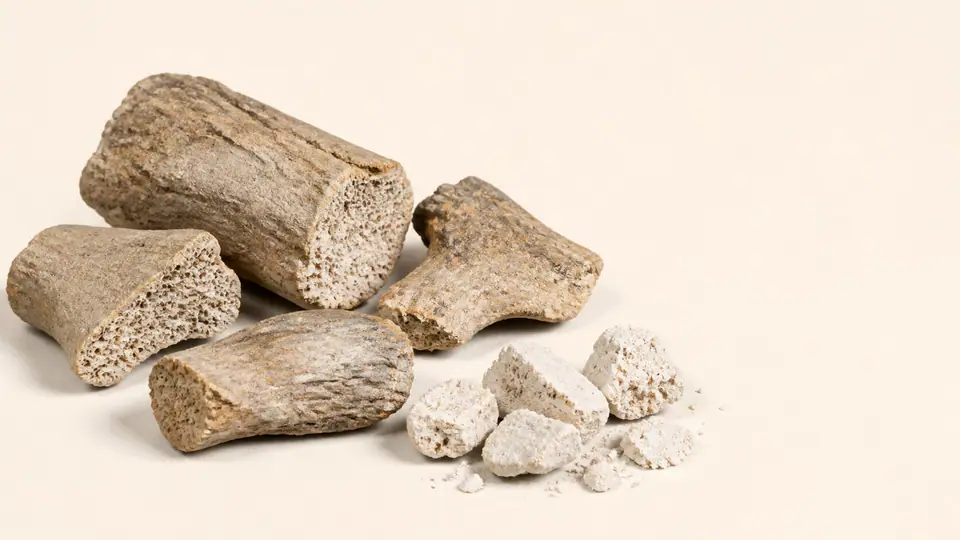
A name as hard as stone, the fossil hidden behind it
Is Yonggol, used for insomnia or anxiety, actually bone, and can it be taken like calcium? In short, despite its name, Yonggol is not a dragon's bone, but a fossilized medicinal material consisting of the mineralized skeleton of an ancient large mammal. However, it is difficult to consistently verify its origin in products, and the presence of calcium components does not mean it can be converted and taken equivalently to general calcium supplements.
This name brings to mind an imaginary animal. In Korean medicine textbooks or medicinal material lists, Yonggol is a non-plant medicinal material registered under the scientific name Fossilia Ossis Mastodi. The story begins with the fact that these stone-hard fragments are actually skeletal fossils of ancient mammals.
What the name reveals and conceals
The name Yonggol leads the listener to imagine a giant bone. However, the Yonggol actually distributed does not possess a uniform identity or quality; it can vary between bones or bone powder of modern animals, dragon teeth, raw materials versus calcined products, or fossil fragments of unknown origin. There is a gap between the singular image the name provides and the diverse forms of the actual raw material.
OASIS of the Korea Institute of Oriental Medicine lists Yonggol as Fossilia Ossis Mastodi. Traditionally, it is described as the skeletal fossil of an ancient large mammal, but it is not easy to constantly verify the original species and geological era in distributed products. The name suggests one thing, but the fact that several different things can be mixed under that name is the first boundary of this material.
Why expectations are tied to insomnia and anxiety
Chemical and pharmacological reviews of Yonggol and Moryeo summarize inorganic components and experimental activity. However, this does not clinically confirm the treatment effects for sleep or anxiety. There is a distance between the research subjects and the actual products consumed, as well as between laboratory results and the effects confirmed in humans.
The fact that inorganic components such as calcium carbonate and calcium phosphate exist does not imply a treatment effect for insomnia and anxiety, nor equivalence to calcium supplements. The presence of a component does not mean it improves specific symptoms, nor is it absorbed in the same amount as other calcium products. This is because the absorption rate of Yonggol has not been quantified. Then, what leads people to have expectations? Most of it stems from a tendency to mistake the image of the name and the mere presence of components as evidence of efficacy.
Whether it is raw material, calcined, or something else
The first question to ask when choosing Yonggol is its form. You must distinguish whether it is fossilized Yonggol, or dragon teeth, modern bone powder, calcium agents, Moryeo, or minerals of unknown origin. It also differs depending on whether it is raw material or powder, a calcined product, or a complex prescription.
The possibility of contamination for fossil or mineral raw materials varies depending on the origin and processing. Powders whose origin and heavy metal tests have not been verified should be avoided. It is particularly dangerous to directly grind and consume fossils or bone powder of unknown origin. The principle is to use only prescriptions where the origin, heavy metals, processing, and single dose are verified. Under the same name 'Yonggol', there may be materials with completely different origins and processing states.
When using with other medications or supplements
Based on the fact that Yonggol contains calcium components, the possibility of interaction with general calcium supplements can be reviewed. However, because the absorption amount of Yonggol is not quantified, it cannot be converted to an equivalent dose. Nevertheless, caution is required if you are taking other medications concurrently.
When using it with thyroid hormones, quinolone antibiotics, dolutegravir, lithium, or calcium products, it is advisable to show the product to a doctor or pharmacist. Those with kidney disease, kidney stones, hypercalcemia, or parathyroid disease should not self-administer. These conditions serve as a reminder that Yonggol is not a simple natural substance, but a raw material containing calcium components.
When medical evaluation takes priority over Yonggol
If you have been unable to sleep for several days and experience hallucinations, extreme agitation, thoughts of self-harm, or if it is accompanied by chest pain or fainting, prompt medical evaluation takes priority over researching Yonggol further. These signals are criteria for distinguishing emergency situations, not a matter of choosing raw materials.
Even if insomnia and anxiety are mild, it is safer to discuss symptoms with a professional first rather than treating Yonggol as a therapeutic alternative. In particular, mental health symptoms are often not suitable for self-treatment with a single raw material.
To what extent is there evidence based on human subjects?
Chemical and pharmacological reviews of Yonggol and Moryeo cover quality standards and preclinical data. However, there is a lack of high-quality human trials confirming the effects of single Yonggol on sleep and anxiety. This does not mean Yonggol is completely useless, but rather that the evidence reviewed so far is insufficient to conclude its efficacy for specific symptoms.
The number of studies, consistency, and limitations must be considered together. Possibilities found in a laboratory do not immediately translate into perceived effects for the user. In other words, the fact that inorganic components were detected is merely a clue to physiological action, not evidence of clinical efficacy. This is a common challenge when evaluating many traditional medicinal materials, including Yonggol, through a modern lens.
Differences from Similarly Appearing Ingredients
Yonggol is a fossilized animal skeleton. It is neither a plant nor a modern animal bone. However, it is often difficult to confirm the original animal species in a product. Yongchi should be viewed as distinct from Yonggol, and modern animal bones or bone powder do not possess the same identity or quality.
There is also a difference between raw materials and calcined products. Calcination is a processing method that can change the chemical properties compared to the raw state. Purified calcium is in a completely different product category from Yonggol. These distinctions are not merely academic curiosity; they determine the criteria for selection when actually taking the substance.
Criteria to Check Today
Rather than relying on legendary names or calcium content, it is first necessary to verify the fossil origin, processing, contamination standards, and any other medications being taken. The final criterion for judgment is to avoid self-treating insomnia or anxiety or attempting to convert the dosage into calcium supplement equivalents.
When choosing Yonggol, please verify in order: whether the origin, heavy metal levels, processing standards, and single dose are confirmed; whether you are taking other medications or have kidney or parathyroid diseases; and whether your symptoms correspond to emergency signals. The core of this ingredient is seeing how the raw material was actually produced, rather than the story told by its name.
References
- Korea Institute of Korean Medicine OASIS Medicinal Herb Encyclopedia: Yonggol.
- Non-Plant Medicinal Materials of Traditional Medicine in Northeast Asia: Yonggol.
- Chemistry and pharmacology of Os Draconis and Ostreae Concha.
- NIH ODS calcium fact sheet for health professionals.
This text explains the origin of the raw materials, the scope of research, and precautions before consumption. As this cannot replace individual diagnosis or treatment, please consult a medical professional if you are taking medication or if symptoms persist. If sudden and severe symptoms such as difficulty breathing or decreased consciousness occur after consumption, seek help from 119 or the emergency room.

Medical Staff Review
Director Choi Yeon-seung
Chief Director of Baekrokdam Korean Medicine ClinicYonggol Dictionary Entry, reviewed the safety of expressions and the scope of verification before administration.
Review scope: Ingredient origin, human studies, concomitant medications, safety of intake · Last reviewed 2026-08-17
- Graduated from Kyung Hee University College of Korean Medicine
- Providing Korean medicine treatment since 2010
- Consultations for Gongjindan, Gyeongokgo, Nokyong (Deer Antler) restorative medicine, and customized restorative herbal medicine