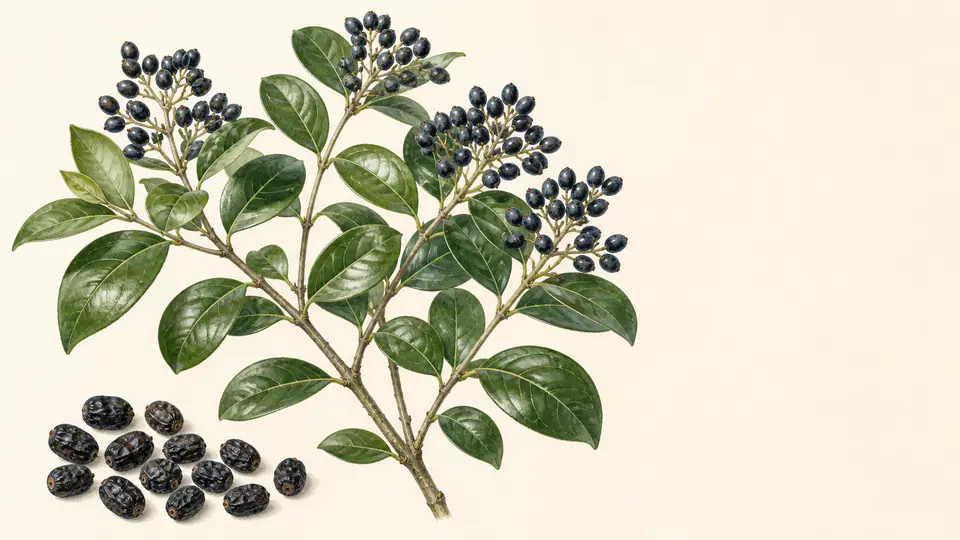
Yeojeongsil, the black fruit left by a tree that stays green even in winter
Can I take Yeojeongsil, which is said to be good for the eyes, hair, and bones, for a long time as a tea or pill? So far, there is insufficient human-based evidence to conclude the safety of long-term use. Therefore, before taking it for a long period, it is more important to verify which tree's part was used and how it was processed. So, what should we look for?
The name Yeojeongsil overlaps with the image of a tree whose leaves do not wither even in winter. According to domestic herbal medicine standards, the dried fruit of Ligustrum lucidum Ligustrum lucidum or Ligustrum vulgare Ligustrum japonicumis recognized as Yeojeongsil. However, international research L. lucidum is biased toward the fruit, so the two domestic source species cannot be explained using the same evidence.
The gap between the expectations in the name and the reality
The black fruit of evergreen trees that stay green in winter has been linked to traditional images regarding aging, eyes, and bones. However, the impression given by the name and the plant's ecology is separate from the scientific identity of the raw material. Yeojeongsil is a standardized raw material encompassing the fruits of two species; leaves, flowers, pollen, fresh fruit from landscaping trees, and steamed preparations are not the same raw material.
It is important that the herbal medicine standards of the National Institute of Food and Drug Safety Evaluation define Yeojeongsil as L. lucidum or L. japonicumthe fruit of these species. This means it simultaneously includes the specific part (fruit) and the origin (two species). However, the name 'Yeojeongsil' encountered in the market often fails to convey this identity accurately.
Fruit or pollen: Why you must distinguish between plant parts
One common confusion surrounding Yeojeongsil is conflating the pollen and fruit of landscaping trees. Data on respiratory allergies from pollen is not the same as adverse reactions from oral ingestion of the fruit. Nevertheless, if the parts are not distinguished under the same plant name, the identity of the raw material becomes blurred. Yeojeongsil is the fruit, while leaves, flowers, and pollen are different parts.
This distinction is not merely a matter of caution. L. lucidum Standardized extracts of a single species or isolated oleanolic acid also differ in composition and exposure compared to the raw dried fruit. In other words, there is no evidence that results from one study apply identically to other forms.
The distance between animal studies and human clinical trials
Most signals regarding Yeojeongsil related to osteoporosis, liver protection, and immunity have come from cellular and animal data. Bone metabolism signals seen in osteoporosis reviews are mainly based on data from ovariectomized, aging, and diabetic animals and cells. A 2023 comprehensive review summarizing the components, pharmacology, toxicity, and pharmacokinetics of Yeojeongsil concluded that further research is needed to confirm medical use and safety. A 2024 review also summarized 206 components and various preclinical activities but stated that systematic safety evaluations and toxicity data are still lacking.
This does not mean 'it is ineffective,' but rather 'it cannot be concluded yet.' Because there is a lack of well-designed human clinical trials for the fruit alone, the possibilities found in animals cannot be directly linked to therapeutic effects in humans.
Different formulations under the same name: fresh fruit, water extract, supercritical extract, and alcohol-steamed processed products
Raw fruit, water extracts, supercritical extracts, and alcohol-steamed processed products differ in their components and absorption patterns. Therefore, results from one formulation cannot be directly applied to another. In particular, alcohol-steamed processed products have a different processing pathway than general dried fruit or extracts.
| Category | Points to Check |
|---|---|
| Species | L. lucidumIdentification L. japonicumIdentification |
| Part | Whether it is dried fruit or leaves, flowers, or pollen |
| Processing | Whether it is fresh fruit, dried, alcohol-steamed, or a concentrated extract |
| Scope of evidence application | Whether animal results are being applied to humans, or results from one formulation are being applied to another |
When choosing a product, do not look only at the name 'Yeojeongsil'; first verify the four items in this table.
Notification is required when taking it with prescription medications
When using concentrated Yeojeongsil products alongside prescription medications, it is necessary to inform your medical provider or pharmacist. It is clear that Yeojeongsil should not replace osteoporosis medication, diabetes medication, anticoagulants, or chemotherapy. There is insufficient data on safety and interactions for pregnant or breastfeeding women, children, individuals with liver or kidney disease, or those taking high-concentration products for a long period.
If you are using other concentrated herbs or nutritional supplements, these must also be disclosed. The safety of a single raw material is not the same as the safety of combined use.
Which signals indicate that medical evaluation should take priority over Yeojeongsil
In cases of sudden vision loss, one-sided paralysis, severe back pain, or suspected fractures, immediate medical evaluation takes priority over considering the intake of Yeojeongsil. If a rash, swelling of the lips or throat, difficulty breathing, or persistent diarrhea and vomiting occur, stop intake and seek evaluation. While a pollen allergy does not necessarily mean the same reaction will occur when consuming the fruit, any new symptom must be evaluated on its own.
Boundaries between similar-looking things
Several distinctions are necessary when understanding Yeojeongsil. The fruits of the Glossy Privet and the Japanese Privet, the fruit versus leaves, flowers, and pollen, fresh Yeojeongsil versus alcohol-steamed Yeojeongsil, and bone metabolism signals in animals versus fracture prevention in humans are all on different levels. These distinctions are not simple classifications, but criteria for determining how far the evidence can be applied.
Criteria to Check Today
Check the species, part, processing, and formulation first, rather than focusing on the image of black fruit and anti-aging. L. lucidumThe key is not to extrapolate preclinical results to the two origin species in Korea or to the treatment of eye conditions, hair loss, or osteoporosis in humans. When choosing a product, L. lucidumand L. japonicum you must check which fruit it is, whether it is a fresh product, dried fruit, alcohol-steamed, or a concentrated extract, what the actual goal is among eye symptoms, hair loss, back pain, or osteoporosis, whether standard tests have been performed, and whether you are using osteoporosis medication, anticoagulants, diabetes medication, drugs that affect the liver, or other concentrated herbs.
This criterion changes the question from 'Is it okay to eat Yeojeongsil?' to 'Does this specific product have the evidence I expect?' Verifying this is the first thing to do before long-term consumption.
References
- National Institute of Food and Drug Safety Evaluation Herbal Medicine Standards: Yeojeongsil.
- Ligustri Lucidi Fructus comprehensive review of pharmacology and toxicity.
- Fructus Ligustri Lucidi in osteoporosis: pharmacology and safety review.
- Ligustrum lucidum medicine-food review and safety gaps.
This text explains the origin of the raw materials, the scope of research, and precautions before consumption. As this cannot replace individual diagnosis or treatment, please consult a medical professional if you are taking medication or if symptoms persist. If sudden and severe symptoms such as difficulty breathing or decreased consciousness occur after consumption, seek help from 119 or the emergency room.

Medical Staff Review
Director Choi Yeon-seung
Chief Director of Baekrokdam Korean Medicine ClinicYeojeongsil Dictionary Entry, reviewed the safety of expressions and the scope of verification before administration.
Review scope: Ingredient origin, human studies, concomitant medications, safety of intake · Last reviewed 2026-08-17
- Graduated from Kyung Hee University College of Korean Medicine
- Providing Korean medicine treatment since 2010
- Consultations for Gongjindan, Gyeongokgo, Nokyong (Deer Antler) restorative medicine, and customized restorative herbal medicine