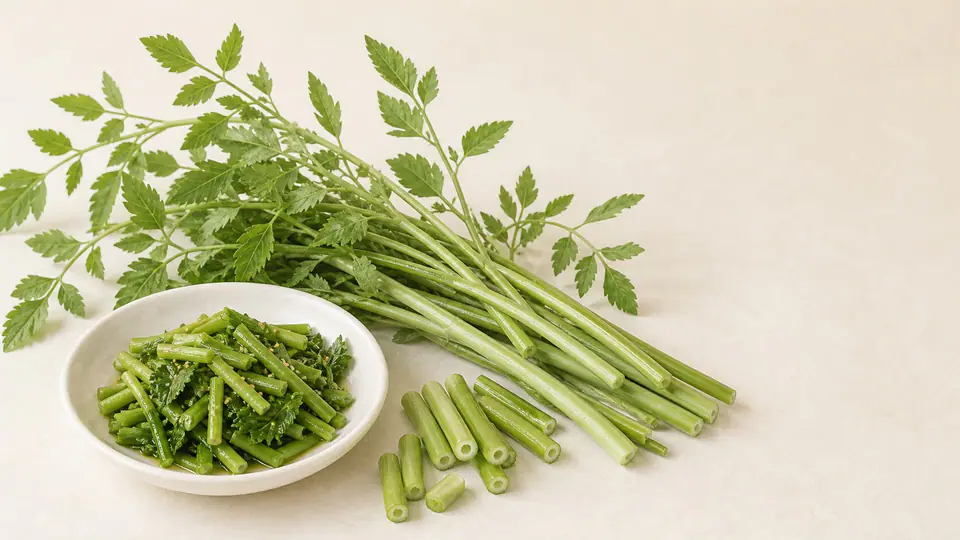
From fragrant spring greens in fields and streams to detox and hangover juices
If you drink water dropwort juice because it is said to be good for liver detoxification or hangovers, will it sober you up faster or protect your liver? In short, there is currently insufficient evidence for such expectations. Water dropwort is an edible vegetable, and one small hangover study reported in 2026 was merely the result of administering a specific extract before a single instance of drinking; it does not mean that water dropwort juice consumed at home prevents liver damage.
Water dropwort is a vegetable where the young stems and leaves of Oenanthe javanica, a perennial wetland plant of the Apiaceae family, are consumed. Kew classifies this plant as a species native to Asia, including Korea. This herb, familiar as a spring mountain vegetable or a side dish with grilled pork belly, has earned the name 'detox' along with its fragrant scent. However, fragrance and traditional use do not immediately translate into clinical effects for detoxifying the liver or reducing hangovers.
Where did the nickname 'detox' come from?
The unique scent and traditional use of water dropwort led to stories of 'detox.' However, nutritional components or antioxidant activity in test tubes are not results of directly measuring the liver detoxification capacity of humans. In other words, just because a component shows antioxidant activity does not mean it neutralizes liver toxins or sobers a person up faster within the human body.
In clinical evidence involving humans, it has not been established that water dropwort detoxifies the liver or treats hepatitis or fatty liver. Therefore, the claim that it is 'good for the liver' is merely an empirical image as a food item, not evidence supporting the treatment of a disease.
Why you must first verify the identity of the plant
Water dropwort is a cultivated edible vegetable. However, one must not confuse it with other wild plants of the Oenanthe genus with similar names, or confuse the trade name 'dol-minari' (stone water dropwort) with the plant's actual identity. Since some species in the Oenanthe genus are toxic, it is dangerous to personally harvest and eat plants that look similar from wild watersides.
Even for water dropwort cultivated and distributed for consumption, thorough washing is fundamental. Only when the identity of the raw material is clear can discussions on safety and efficacy follow. So, what should you look for? Instead of choosing based solely on the name 'water dropwort' on the packaging or at the point of sale, the first step is to verify whether the cultivation and distribution source is reliable.
Differences in product form: cooked greens vs. concentrated juice
Fresh, blanched, soup ingredients, juices, powders, and standardized extracts of cultivated water dropwort differ in intake amount and concentration. Cooked water dropwort side dishes and extract formulations made with specific solvents and ratios differ in the components and amounts that enter the body, so they cannot be treated as interchangeable.
Fresh greens, cooked greens, and juices concentrated from multiple bunches are not the same amount. One glass of concentrated juice drunk daily may have a different concentration than one plate of side dishes. If you have liver disease or are taking various medications, you must check the full ingredients of concentrated products. This is because the juice may contain ingredients other than water dropwort or components that changed during the concentration process.
What the 2026 hangover study demonstrated
A 2026 randomized, double-blind, crossover trial administered a specific water dropwort extract formulation to 36 healthy adults 30 minutes before drinking. Among the 33 participants who completed the study as planned, a reduction in blood alcohol/acetaldehyde curves and hangover scores was reported.
However, this result is from a small, single trial involving a specific extract and a single instance of drinking. It is not evidence that water dropwort side dishes or commercially available juices produce the same effect or prevent liver damage. A change in hangover scores and blood alcohol surrogate markers is a different result from a reduction in the risk of accidents from excessive drinking, hepatitis, fatty liver, or chronic liver disease.
To put it another way, the fact that the blood alcohol curve appeared temporarily lower is not a basis for increasing the amount of alcohol consumed or advancing the time when one can drive.
The gap between antioxidant/anti-inflammatory research and human treatment
Many studies on the antioxidant, anti-inflammatory, and liver-protective effects of water dropwort are at the component, cellular, or animal level. Such research cannot determine the treatment dose or long-term safety for humans. While the possibilities emerging from test tubes and animals are interesting, the stage of translating them directly into the treatment of human liver disease or hangover prevention is not yet complete.
Therefore, when you hear the term 'liver protection,' you should first ask at what level the evidence was derived. It is important to distinguish whether it was a cellular or animal study, a clinical trial on humans, and what formulation and dose were used in that trial.
Concurrent Medications and Individual Circumstances
If you experience recurring symptoms such as oral itching, hives, vomiting, or respiratory issues after eating water parsley or other Apiaceae family vegetables, you must stop consumption and seek a medical evaluation. This indicates a possible allergic reaction to the food.
You should not increase your alcohol intake or shorten the time before driving based on trust in hangover relief products. The key is not to use small studies showing lowered blood alcohol levels as a basis for safety judgments. Jaundice, dark urine, changes in consciousness, persistent vomiting, or severe pain in the upper right abdomen should not be monitored with water parsley juice; you must seek an immediate medical evaluation.
Distinguishing Between Similar-Looking Things
When organizing information about water parsley, three distinctions frequently overlap. First, cultivated water parsley versus wild Oenanthe species of uncertain identity. Second, raw vegetables, blanched greens, juices, powders, and experimental extracts. Third, blood alcohol and hangover surveys versus the treatment of liver damage, fatty liver, and hepatitis.
These three pairs answer different questions. The identity of wild plants is a matter of safety, the product form is a matter of concentration and ingredients, and the research indicators are a matter of the scope of expected effects. If these are mixed to conclude that 'water parsley is good for the liver,' the actual nature of the raw material becomes blurred.
Criteria to Check Today
Rather than the nickname 'detoxifying greens,' first verify the exact plant and its cultivation/distribution source, the amount of food versus concentrate, the gap between a single small hangover trial and the treatment of liver disease, and the amount of alcohol consumed along with warning symptoms.
Water parsley is still a fragrant spring vegetable. However, there is currently no evidence that its fragrance detoxifies the liver or speeds up recovery from alcohol. The criteria for verification differ depending on whether it is enjoyed as a vegetable on the dining table or consumed as a daily concentrated juice.
References
- Kew Plants of the World Online: Oenanthe javanica.
- Oenanthe javanica extract and hangover: randomized crossover trial.
- Oenanthe javanica traditional use, phytochemistry and evidence review.
- Wild Apiaceae misidentification and poisoning: case report.
This text explains the origin of the raw materials, the scope of research, and precautions before consumption. As this cannot replace individual diagnosis or treatment, please consult a medical professional if you are taking medication or if symptoms persist. If sudden and severe symptoms such as difficulty breathing or decreased consciousness occur after consumption, seek help from 119 or the emergency room.

Medical Staff Review
Director Choi Yeon-seung
Chief Director of Baekrokdam Korean Medicine ClinicWater Parsley Dictionary Entry, reviewed the safety of expressions and the scope of verification before administration.
Review scope: Ingredient origin, human studies, concomitant medications, safety of intake · Last reviewed 2026-08-17
- Graduated from Kyung Hee University College of Korean Medicine
- Providing Korean medicine treatment since 2010
- Consultations for Gongjindan, Gyeongokgo, Nokyong (Deer Antler) restorative medicine, and customized restorative herbal medicine