From a vitamin that prevents oxidation to a preventive capsule
Can I take high-dose Vitamin E products daily for antioxidant effects and skin or vascular health? In short, not necessarily.
Vitamin E is a fat-soluble antioxidant nutrient that rarely causes issues when consumed through food, but the story changes when taken as a high-dose single supplement. Let's explore that difference.
The Identity of Vitamin E: Chemical Forms Hidden Behind the Name
The name 'Vitamin E' refers to several different compounds. It is a collective term for fat-soluble substances in the tocopherol and tocotrienol families, and human nutritional requirements are primarily determined based on alpha-tocopherol activity. Therefore, behind the label 'Vitamin E,' one must look at which form and how much alpha-tocopherol activity is contained. While they may all look the same as 'Vitamin E,' there are actually several branches, including natural, synthetic, and mixed tocopherols.
Deficiency is rare in healthy individuals
Vitamin E deficiency occurs clearly rarely in healthy adults. It primarily becomes an issue in specific contexts, such as conditions where fat absorption is difficult or rare genetic disorders. Therefore, when the general public chooses a multivitamin or a high-dose single agent, they must first distinguish whether they are in a situation where a deficiency needs to be corrected. Choosing a high-dose product for prevention or antioxidant purposes rather than for deficiency is a different matter.
mg vs. IU and Natural vs. Synthetic forms
The first thing encountered when comparing Vitamin E products is the unit. mg and IU are different ways of expressing the same amount, and there is a difference in actual activity between natural and synthetic alpha-tocopherol when converted to IU. If you conclude that 'this product is higher' based only on the label numbers, you may misunderstand the actual amount of alpha-tocopherol. For example, synthetic and natural forms have different activities in the body even with the same IU number. Therefore, after determining the purpose of intake, it is necessary to check both the amount of alpha-tocopherol based on mg and its form.
Are food and supplements the same thing?
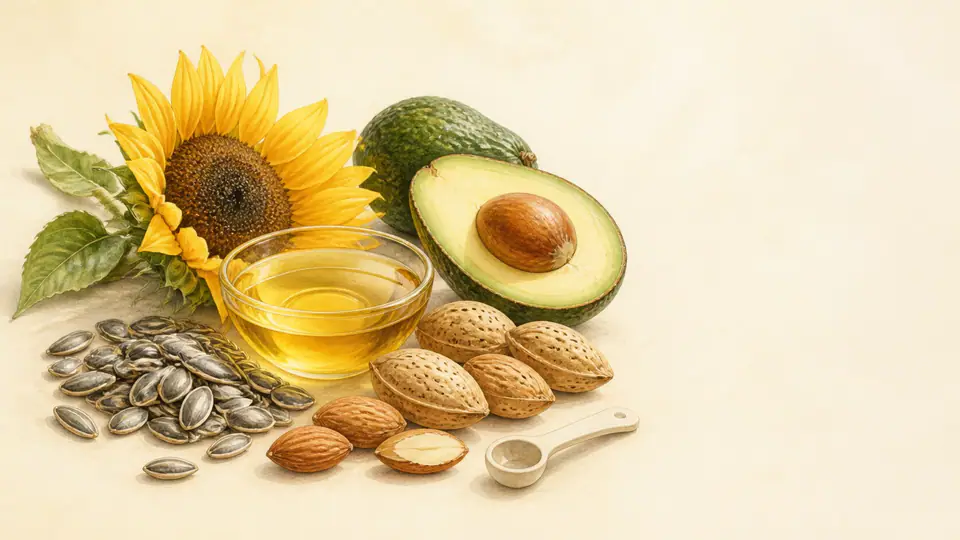
There is no reason to limit Vitamin E obtained from foods such as nuts, seeds, and vegetable oils. This is because Vitamin E in food comes along with other nutrients and is not delivered in concentrations as high as high-dose single supplements. On the other hand, high-dose alpha-tocopherol in capsule or tablet form can affect platelet aggregation and coagulation. The safety of food should not be extended to the safety of supplements, nor vice versa.
Trials expecting prevention of cardiovascular disease or cancer
Large-scale clinical trials have not provided evidence that Vitamin E supplements routinely prevent cardiovascular disease or overall cancer. In the SELECT trial, men who took 400 IU of synthetic Vitamin E daily had a relatively 17% higher rate of prostate cancer diagnosis after approximately 7 years compared to the placebo group. This is a case that not only showed no preventive effect but also indicated a specific risk signal. A meta-analysis of randomized stroke trials showed no overall reduction in stroke, and some analyses raised the possibility of an increase in hemorrhagic stroke. These results show the gap between the expectation that 'it will help because it is an antioxidant' and the actual evidence in humans.
Evidence for eye health is a result of complex formulations, not single ingredients
The AREDS2 evidence related to macular degeneration is not for Vitamin E alone. These results were based on a complex formulation containing Vitamin C, zinc, copper, lutein, and zeaxanthin in specific proportions, and the data came from a specific patient group. The effects of this complex formulation should not be interpreted as applying to a Vitamin E single agent. If you add Vitamin E for eye health, you must also check whether the total amount of the product you are currently taking overlaps with the AREDS2-style product.
Bleeding Risk and Concurrent Medications
The most specific safety concern regarding high-dose alpha-tocopherol supplements is bleeding. It can increase the risk of bleeding by affecting platelet aggregation and coagulation. If you are taking warfarin, anticoagulants, antiplatelet agents, or aspirin, or if you have a scheduled surgery, you must inform your medical team of the vitamin E dosage in all products you use. You should stop taking the supplement and seek a medical evaluation if you experience easy bruising, nosebleeds that do not stop, black stools, hematuria (blood in urine), severe headaches, or neurological symptoms.
Consult Your Medical Team Regarding Concurrent Use During Chemotherapy or Radiation Therapy
The use of antioxidant supplements while receiving chemotherapy or radiation therapy must be discussed with your treatment team. This approach applies to antioxidant supplements in general, not just vitamin E. Since this involves the efficacy and safety of your treatment, it is important not to start or stop these supplements arbitrarily.
The 1 g Upper Limit Is Not a Guarantee of Safety
Although the upper limit for adult supplements is set at 1 g, or 1,000 mg, this is not a target intake level or a long-term safety guarantee. Adverse signals have been reported even at lower doses. Therefore, there is no reason to take a dose close to the upper limit; in particular, taking a single 400 IU dose over a long period lacks sufficient evidence and has raised significant concerns in some trials.
First, Determine the Purpose of Use
When choosing vitamin E, first distinguish between three purposes: dietary supplementation, treatment of a deficiency, or antioxidant/disease prevention. The required form and dosage vary depending on the purpose. You should also check if the total amount of vitamin E overlaps with other products such as multivitamins, AREDS2 formulations, or omega-3 products. Summing up vitamin E found across multiple products may lead to a higher dose than intended.
Final Decision Criteria
When selecting vitamin E, verify the purpose of use before focusing on its label as an 'antioxidant vitamin.' Next, you must consider the actual mg and IU of alpha-tocopherol, overlapping products, the lack of efficacy or harm signals in prevention trials, and any bleeding-related medications or treatment situations. Remember that when attempting to replace nutrients from food with high-dose capsules, expectations and scientific evidence often diverge.
References
- NIH ODS Vitamin E fact sheet for health professionals.
- NIH ODS Vitamin E fact sheet for consumers.
- NCI: SELECT trial results and questions.
- Vitamin E supplementation and stroke: meta-analysis.
- USPSTF evidence review of vitamin and mineral supplements.
This text explains the origin of the raw materials, the scope of research, and precautions before consumption. As this cannot replace individual diagnosis or treatment, please consult a medical professional if you are taking medication or if symptoms persist. If sudden and severe symptoms such as difficulty breathing or decreased consciousness occur after consumption, seek help from 119 or the emergency room.

Medical Staff Review
Director Choi Yeon-seung
Chief Director of Baekrokdam Korean Medicine ClinicVitamin E Preliminary Items, reviewed the safety of expressions and the scope of verification before administration.
Review scope: Ingredient origin, human studies, concomitant medications, safety of intake · Last reviewed 2026-08-17
- Graduated from Kyung Hee University College of Korean Medicine
- Providing Korean medicine treatment since 2010
- Consultations for Gongjindan, Gyeongokgo, Nokyong (Deer Antler) restorative medicine, and customized restorative herbal medicine