A Nutrient Starting from Sunlight: Is it Okay to Keep Taking it Without a Test?
Is it okay to continue taking Vitamin D without having a test? In short, it is difficult to recommend taking high doses for a long time without knowing the reason for intake or the total amount from various products. Correcting a deficiency is not the same as additional intake by a healthy person who has not confirmed whether a deficiency exists.
Vitamin D is a fat-soluble vitamin of the calciferol family, obtained through skin synthesis, certain foods, fortified foods, and supplements. Both D2 and D3 in supplement form increase blood 25(OH)D levels, but their sustained effects may differ even at the same dose. The first things to check here are the purpose of intake and the total amount, rather than the form. In other words, even for the same 'Vitamin D', the judgment changes depending on why you are taking it.
Context of the Question: Where Did Intake Without Test Values Begin?
Vitamin D status is primarily evaluated by serum 25(OH)D. However, a single optimal value applicable to all health outcomes has not been established. This means that even if a test is available, there is no absolute standard that says 'this value is sufficient.' Nevertheless, as test values have been interpreted as evidence of deficiency, the use of supplements has naturally expanded. It is important here that the clinical purpose of correcting a deficiency and the additional intake by a healthy person for preventive purposes without confirming a deficiency are different situations. The former aims to prevent specific diseases or correct a condition, while the latter expects higher levels in a state that may already be sufficient.
The Nature of the Ingredients: D2, D3, and Skin Synthesis
Vitamin D is a fat-soluble vitamin obtained through skin synthesis, food, fortified foods, and supplements. D2 and D3, commonly seen in supplements, both increase blood 25(OH)D, but their maintenance effects may differ at the same dose. This difference does not necessarily mean one is absolutely superior. While both forms are used to raise 25(OH)D, the difference in persistence should be used as a criterion for selection.
Why Expectations Grew: The Gap Between Observational Studies and Causality
The reason Vitamin D has garnered expectations for preventing various diseases beyond bone health is that observational studies have repeatedly linked low 25(OH)D levels with various health problems. However, observational results do not prove a causal relationship. Low Vitamin D levels may be the cause of a disease, or the disease state or lifestyle habits may have lowered the levels. By simplifying this without distinction to 'low is dangerous, high is preventive,' Vitamin D has become a representative ingredient that individuals take on their own based on test values.
Differences in Supply Routes: Food, Sunlight, and Supplements
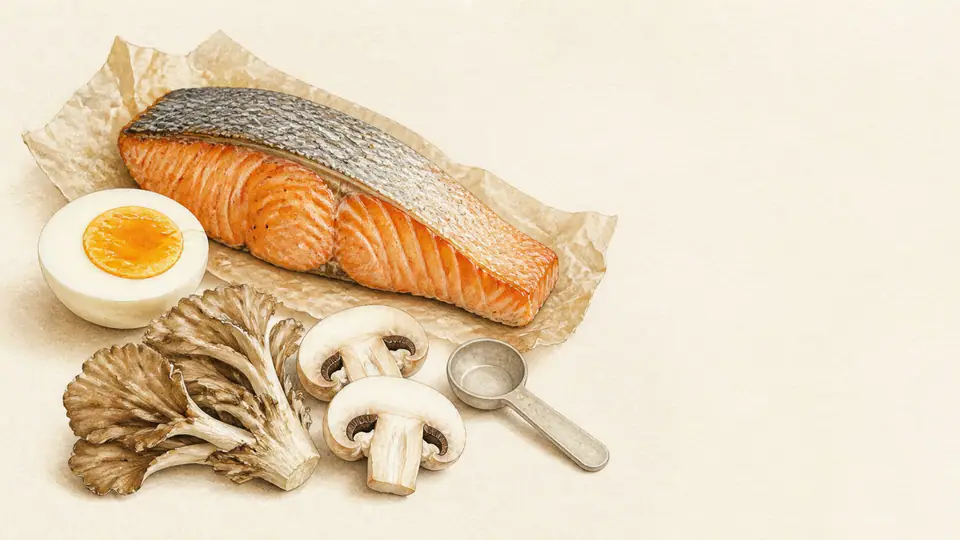
Vitamin D is also obtained from some foods, fortified foods, and skin synthesis. Sunlight exposure itself is not a cause of typical Vitamin D toxicity. This helps distinguish high-dose supplements from natural supply routes. While overdose rarely occurs through sunlight, high-dose supplements can create a state of excess. The difference between food and supplements is not simply 'natural vs. artificial,' but a matter of how quantitatively it is ingested and whether it overlaps with other products.
Product Forms and the Risk of Excess: How High is Too High?
Excess from high-dose supplements can cause hypercalcemia and serious abnormalities related to the kidneys and heart. This is the exact opposite of the intuition that 'taking more makes you healthier.' In particular, taking multivitamins, calcium products, and single Vitamin D products together can make the total amount of Vitamin D larger than intended. Therefore, it is necessary to sum the Vitamin D in various multivitamin and calcium products and avoid long-term high-dose intake without test values or a prescription.
When Using with Medications or Supplements
Because Vitamin D is involved in calcium absorption and metabolism, it can interact with other medications or supplements. Orlistat, certain statins, steroids, and thiazide diuretics may interact with absorption, metabolism, and calcium status. Questions to check before intake are: whether the total amount of Vitamin D overlaps with multivitamin or calcium products, whether you are taking thiazide diuretics, steroids, or orlistat, and whether you have kidney, parathyroid, or hypercalcemia issues. If you have kidney disease, kidney stones, hypercalcemia, or parathyroid disease, you must consult a medical professional before supplementation.
| Category | Checklist |
|---|---|
| Supplement Overlap | Total Vitamin D in multivitamins and calcium products |
| Drug Interactions | Thiazide diuretics, steroids, orlistat, etc. |
| Individual Condition | Presence of kidney disease, parathyroid issues, or hypercalcemia |
Evidence in Humans: What do studies on healthy individuals show?
In a VITAL sub-study of 25,871 healthy middle-aged and elderly adults, vitamin D3 supplementation did not reduce overall, non-vertebral, or hip fractures. This suggests that additional intake may not provide the expected benefits for bone health in healthy individuals. Furthermore, a meta-analysis of 80 randomized trials reported a possible slight reduction in all-cause mortality, but did not confirm a reduction in specific cardiovascular diseases or deaths. This demonstrates that evidence must be distinguished by outcome. A broad outcome like 'all-cause mortality' and a specific outcome like 'cardiovascular death' do not share the same level of evidence.
Distinguishing Similar Situations: Deficiency correction vs. preventive intake
The most clear efficacy in the history of vitamin D is the prevention of deficiency diseases related to bone health. However, this efficacy does not automatically extend to additional intake for healthy individuals. Deficiency correction is a clinical purpose to rectify a specific condition, whereas preventive intake is pursuing higher levels in someone who may already have sufficient amounts. Treating these two as the same leads to a culture of continuous high-dose supplementation without testing.
Comparison with Similar Ingredients: D2 vs. D3, Sunlight vs. Supplements
Comparing similar ingredients is useful for establishing selection criteria. Both vitamin D2 and D3 increase 25(OH)D, but their sustained effects may differ at the same dose. The purpose and evidence for deficiency correction differ from those for general preventive intake. While sunlight exposure is not a typical cause of toxicity, high-dose supplements carry a risk of excess. These three comparisons allow us to view vitamin D not as a single ingredient, but as various scenarios divided by supply route and purpose of intake.
Final Judgment Criteria: What to Verify Today
So, what should be checked first today?
If you are taking vitamin D, prioritize checking the reason for intake, overlapping products, testing context, and the risk of hypercalcemia over simply taking a large amount. If you have not had a test, first check why you started taking it, whether it overlaps with other products, and what your current dosage is. Severe thirst, frequent urination, vomiting, muscle weakness, confusion, and irregular heartbeat are signals that an evaluation for excess or hypercalcemia is necessary. While vitamin D is an important nutrient for preventing deficiency, the image of it being a panacea created by test values and high-dose products is an extension beyond the boundaries of evidence. Those boundaries must be re-verified.
References
- NIH ODS Vitamin D fact sheet for health professionals.
- NIH ODS Vitamin D fact sheet for consumers.
- Supplemental vitamin D and incident fractures: VITAL randomized trial.
- Vitamin D, mortality and cardiovascular outcomes: meta-analysis of 80 RCTs.
This text explains the origin of the raw materials, the scope of research, and precautions before consumption. As this cannot replace individual diagnosis or treatment, please consult a medical professional if you are taking medication or if symptoms persist. If sudden and severe symptoms such as difficulty breathing or decreased consciousness occur after consumption, seek help from 119 or the emergency room.

Medical Staff Review
Director Choi Yeon-seung
Chief Director of Baekrokdam Korean Medicine ClinicVitamin D Dictionary Entry, reviewed the safety of expressions and the scope of verification before administration.
Review scope: Ingredient origin, human subject research, concomitant medications, intake safety · Last reviewed 2026-08-16
- Graduated from Kyung Hee University College of Korean Medicine
- Providing Korean medicine treatment since 2010
- Consultations for Gongjindan, Gyeongokgo, Nokyong (Deer Antler) restorative medicine, and customized restorative herbal medicine