The yellow vitamin in milk and eggs: when is it nutritional supplementation, and when is it a migraine research dose?
If my lips often crack and I feel fatigued, will taking vitamin B2 help? Is that the same as taking 400 mg for migraines? This question captures the most common confusion surrounding vitamin B2, or riboflavin. This is because two different narratives, with different purposes and evidence, exist under the same name. One is nutritional supplementation at dietary levels, and the other is a high dose used in adult migraine prevention studies. Distinguishing between the two is the first criterion when choosing this ingredient.
Riboflavin is a water-soluble vitamin that serves as a precursor to coenzymes called FMN and FAD, aiding energy metabolism and various redox reactions. Riboflavin itself is yellow, but this color does not indicate the magnitude of its efficacy. In particular, the bright yellow urine that appears after taking high doses is often simply the color of remaining riboflavin being excreted; it is not a sign that a deficiency has vanished or that treatment is progressing well.
To organize the context of the question, three different situations are mixed together.
Cracked corners of the mouth and fatigue, migraine prevention, and sudden severe headaches are different issues. Symptoms such as cracking around the lips can be associated with riboflavin deficiency, but B2 deficiency cannot be diagnosed by this symptom alone. Cheilitis, changes in the tongue, skin symptoms, and anemia are also merely possibilities that are mentioned together. Furthermore, deficiency often appears alongside other nutrient deficiencies rather than in isolation. Therefore, rather than increasing single B2 intake just because symptoms exist, it is more reasonable to look at dietary patterns and overall nutritional status together.
Migraine prevention is another area entirely. In adult studies, using 400 mg for approximately 3 months showed signals of reduced headache frequency, but there is heterogeneity between studies, and it is not a medication to stop acute headaches. Evidence that high-dose B2 improves general fatigue in people with sufficient levels must be distinguished from evidence for migraine prevention. This means the results of the 400 mg study cannot be applied directly to fatigue or cracked corners of the mouth.
The identity of riboflavin is simple. However, that simplicity can sometimes lead to misunderstandings.
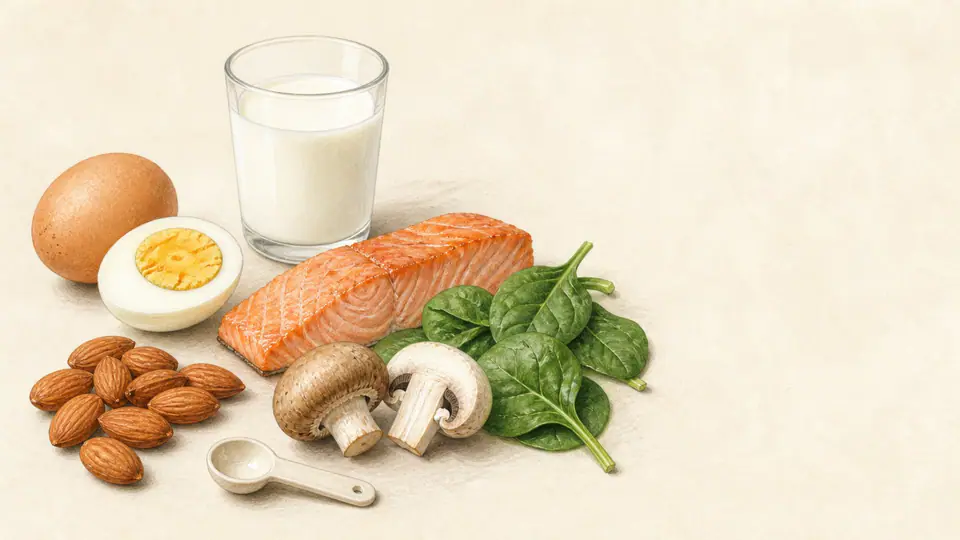
Vitamin B2 is a single substance called riboflavin. As a water-soluble vitamin, it becomes FMN and FAD coenzymes in the body, participating in energy metabolism and redox reactions. The NIH ODS recommended daily allowance for adults is 1.3 mg for men and 1.1 mg for women. Sources include eggs, lean meat, milk, mushrooms, spinach, and fortified grains. This amount can be met through a daily diet.
Because the name 'Vitamin B2' encompasses high-dose studies for migraine prevention, general nutritional supplementation and therapeutic research doses can feel like the same thing. However, the recommended allowance and 400 mg have different purposes. The former is a dietary level for maintaining nutritional status, while the latter is a research dose aimed at preventing specific symptoms.
Expectations have been built around its yellow color, urine changes, and high-dose studies.
Riboflavin is sensitive to light. It can be lost if milk is kept in a transparent container for a long time, but it is relatively stable under heat. The yellow color of this substance is visually intense, giving the impression that 'something is working.' The experience of urine turning fluorescent yellow after taking high doses is an extension of this. However, this is not a marker of efficacy or the degree of deficiency. It is simply a phenomenon that occurs during the process where absorption in the body is limited and the remaining amount is excreted.
Migraine prevention studies have placed expectations on this high dose. However, it must be remembered that there is heterogeneity between studies and that it is not a drug to stop acute headaches. The possibility of prevention and immediate pain relief are different questions.
Vitamin B2 from food and B2 from supplements are the same substance, but the criteria for choosing them differ.
Riboflavin consumed through food and riboflavin in single or B-complex supplements are chemically the same raw material. The difference lies in the amount and the context. Food provides it along with various nutrients at the recommended allowance level, while supplements are used to fill deficiencies in specific situations or for specific purposes.
When choosing a B-complex product, you should first check whether it is a single B2 supplement, a B-complex, or a multivitamin. If you are taking multiple products, it is necessary to calculate the total amount of riboflavin, as the same vitamin may be contained in several different bottles.
When taken alongside medications or other supplements, high doses require separate caution.
Oral riboflavin has limited absorption and low toxicity, so no upper limit has been established. However, the absence of an upper limit does not mean that high doses are necessary for everyone. Mild adverse reactions, such as diarrhea or changes in urine volume, have been reported at high doses.
When starting high doses for migraine prevention, it is necessary to inform your medical provider or pharmacist about existing preventive medications, pregnancy, breastfeeding, or kidney condition. If you experience the worst headache of your life starting suddenly, paralysis, slurred speech, changes in consciousness, or a headache accompanied by high fever, do not wait and see with supplements; you must call 119 or receive an evaluation at an emergency room. This applies regardless of how safe B2 may seem.
When considering individual circumstances, first ask if there is a risk of deficiency
A plant-based diet, restriction of dairy products, pregnancy, breastfeeding, and malabsorption can increase the risk of deficiency. In these situations, it is more accurate to examine dietary patterns and overall nutritional status rather than simply approaching it as 'B2 for when I feel fatigued'.
It must also be distinguished whether there are only symptoms on the lips and tongue, recurring migraines, or a headache accompanied by sudden neurological symptoms. The first is a matter of nutritional evaluation, the second is a matter of preventive research, and the third is a matter of emergency evaluation. In other words, the appearance of the symptoms does not determine the dosage. It is more important to determine which category the symptoms fall into.
The gap between human-based evidence and expectations arises from the conditions of the research
In adult migraine research, there were signals of reduced frequency when 400 mg was used for approximately 3 months, but there is heterogeneity between studies. This means that not all studies showed the same results, and the extent to which it applies to an individual varies. Additionally, since this dose is a therapeutic research dose much higher than the recommended daily intake for adults, it should be separated from the choice of general nutritional supplements.
Evidence for high doses regarding general fatigue improvement must be distinguished from evidence for migraine prevention. Evidence that B2 resolves fatigue in a state of sufficient nutrition must be verified separately. Even if the high dose is the same, if the evidence differs, one should not conclude that it is effective.
The difference between similar ingredients comes from the form, dosage, and purpose
Riboflavin in food and single or B-complex supplements are the same substance, but the quantity and context differ. The dose for correcting deficiency and the 400 mg used in migraine prevention research have different purposes. Yellow urine is not the same as an actual therapeutic response. The nutritional cause of cracked corners of the mouth and other causes such as infection or skin diseases require different approaches, even if the symptoms are similar.
These four distinctions are the axes that should be kept in mind when choosing riboflavin. If a product is chosen based on only one axis, one might give 400 mg to someone who only needs the recommended dose, or mistake migraine prevention research for a general fatigue solution.
The final judgment criterion is not urine color or high-content numbers
Diet, deficiency risk, and the purpose of intake must be verified rather than urine color or high-content numbers. The key is not to combine nutritional supplementation and migraine prevention treatment into the same question. So, what should be looked at? First, distinguish whether B2 is sufficient in the current diet, whether there are risk factors for deficiency, and whether the purpose of choosing B2 is deficiency correction, general supplementation, or an approach at the level of migraine prevention research. When that distinction becomes clear, Vitamin B2 finds its proper place even under the same name.
References
- NIH ODS: Riboflavin fact sheet for health professionals.
- NIH ODS: Riboflavin fact sheet for consumers.
- Vitamin B2 for migraine prophylaxis: systematic review and meta-analysis.
This text explains the origin of the raw materials, the scope of research, and precautions before consumption. As this cannot replace individual diagnosis or treatment, please consult a medical professional if you are taking medication or if symptoms persist. If sudden and severe symptoms such as difficulty breathing or decreased consciousness occur after consumption, seek help from 119 or the emergency room.

Medical Staff Review
Director Choi Yeon-seung
Chief Director of Baekrokdam Korean Medicine ClinicVitamin B2 Dictionary Entry, reviewed the safety of expressions and the scope of verification before administration.
Review scope: Ingredient origin, human studies, concomitant medications, safety of intake · Last reviewed 2026-08-17
- Graduated from Kyung Hee University College of Korean Medicine
- Providing Korean medicine treatment since 2010
- Consultations for Gongjindan, Gyeongokgo, Nokyong (Deer Antler) restorative medicine, and customized restorative herbal medicine