A Name for Seeing in the Dark, and the Different Toxicities Behind It
If you are considering taking Vitamin A for your eyes, skin, or immunity, you might wonder whether retinol or beta-carotene is safer, and if it is okay while preparing for pregnancy. In short, although both fall under the name 'Vitamin A,' they follow different pathways in the body. Preformed forms, such as retinol and retinyl esters, are used directly and can accumulate in the liver, making excess intake a problem. Beta-carotene is converted by the body only as needed, but high-dose capsules have shown different risks for smokers or those exposed to asbestos. If you are preparing for pregnancy, you should first check the total amount of preformed Vitamin A and whether you are using prescription retinoids.
Vitamin A is a fat-soluble nutrient essential for vision, immunity, growth, reproduction, and organ maintenance. However, the fact that it is 'essential' does not mean that 'taking more makes it better.' In particular, as the principles of maintaining night vision and epithelial health extend to skin, immunity, and antioxidant supplements, as well as prescription retinoids for acne and psoriasis, the benefits and risks vary depending on the form of the raw material, the dosage, and individual circumstances.
To use these materials safely, you must first understand several different types of toxicity hidden behind the names and units.
Same Name, Different Pathways in the Body
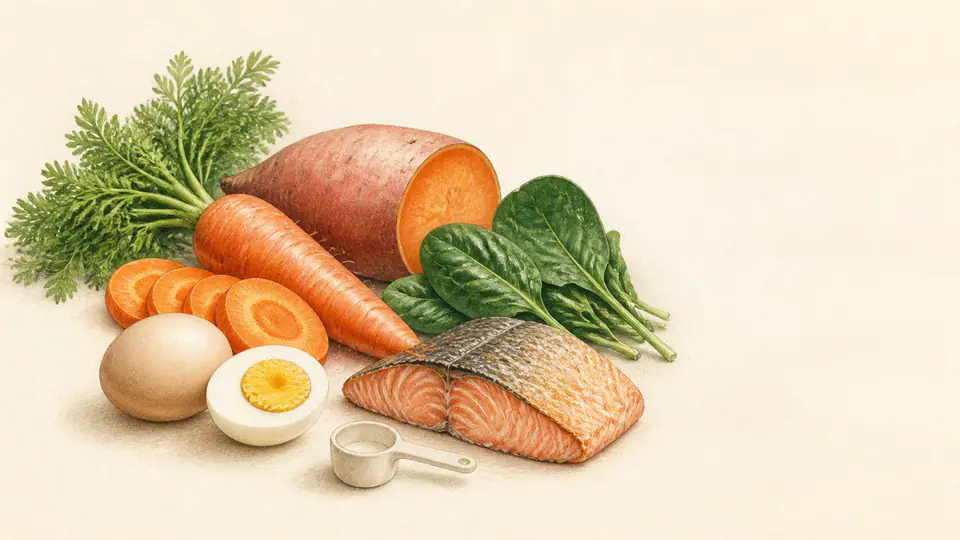
Vitamin A is not a single substance. Preformed Vitamin A, such as retinol and retinyl esters found in animal-based foods and supplements, is absorbed and used directly, with the remaining amount stored primarily in the liver. In contrast, beta-carotene from plants is a provitamin A, which the body converts into Vitamin A when needed. Even though they are both called 'Vitamin A,' these two pathways differ in the nature of their toxicity.
Simply saying 'Vitamin A' does not distinguish whether it is retinol or beta-carotene, a supplement or a food, or whether the unit is IU or μg RAE. The NIH ODS explains that Vitamin A is fat-soluble and that excess preformed forms primarily accumulate in the liver. These differences cannot be compared using the same color or the same IU number.
Then, what should you look for? You must look at the name of the raw material and the unit together.
Why Expectations are Tied to the Eyes and Skin
The fact that Vitamin A is essential for vision, epithelium, and immunity does not mean that people without a deficiency will improve their vision, skin, or immunity by taking high doses. Because there are basic mechanisms involved in dark adaptation, the normal maintenance of the cornea and epithelial cells, and the differentiation of immune cells, symptoms appear during deficiency and improve upon correction.
However, a different logic is required when this essentiality is translated into high-dose supplementation aimed at skin beauty, immune enhancement, or anti-aging. Correcting a deficiency is not the same as creating higher concentrations in a state that is already sufficient.
Foods, Supplements, Liver Oil, and Retinoids Speak Different Languages
There are four main routes for Vitamin A intake: food, general supplements such as multivitamins, liver oil, and prescription retinoids. These all differ in form, toxicity, and units.
Beta-carotene from food varies in conversion rates by individual, while animal-based foods containing preformed Vitamin A act relatively directly. Liver oil contains concentrated preformed Vitamin A, so the total amount increases sharply when overlapped with supplements. Prescription retinoids are chemically related to Vitamin A but follow a separate safety system as medications.
In particular, the conversion values for IU and μg RAE vary depending on the form of the raw material. Even if the same IU is written on the product label, the actual μg RAE differs depending on whether it comes from retinol or beta-carotene. Therefore, when calculating the total amount, it is necessary to check the form of the raw material and convert it to μg RAE.
The Liver Remembers Retinol Excess
The upper limit for preformed Vitamin A in adults is 3,000 μg RAE per day. Chronically exceeding this limit can lead to dry skin, muscle and joint pain, fatigue, and abnormal liver function levels. A very large acute dose can cause severe headache, blurred vision, vomiting, and ataxia.
This toxicity is different from that of beta-carotene. Carotenemia, where the skin turns yellow due to excessive beta-carotene intake, is usually reversible. However, the fact that there is no established upper limit for beta-carotene does not mean that high-dose supplementation is safe for smokers or in all situations.
Pregnancy and Retinol: The Axis of Teratogenic Risk
If you are pregnant or may become pregnant, you must be especially cautious about an excess of preformed vitamin A. Excess intake during early pregnancy is associated with the risk of malformations of the eyes, skull, lungs, and heart. Therefore, you should check multivitamins, cod liver oil, skin supplements, and prescription retinoids together.
Prescription retinoids such as isotretinoin and acitretin should not overlap with vitamin A supplements and must follow strict pregnancy prevention and testing guidelines. If you are planning a pregnancy, do not arbitrarily use high-dose retinol, retinyl esters, or cod liver oil; instead, prioritize confirming the form and total μg RAE of your prenatal vitamins with a healthcare provider.
Beta-carotene for Smokers: Vegetables and Capsules are Different
While beta-carotene does not show the same teratogenic toxicity as preformed vitamin A, a separate risk of lung cancer has appeared in specific high-risk groups. In the ATBC trial for male smokers, 20 mg of beta-carotene, and in the CARET trial for those at high risk of smoking and asbestos exposure, a combination of 30 mg of beta-carotene and retinyl palmitate increased the risk of lung cancer and death.
These results show that the effects of consuming vegetables through food cannot be directly applied to high-dose capsules. Eating vegetables and taking high-dose beta-carotene capsules should not be viewed as having the same evidence. For current or former smokers or those exposed to asbestos, avoiding high-dose beta-carotene supplements is the reviewed safety standard.
Combination Use and Individual Circumstances: What to Ask First
When choosing a vitamin A supplement, check these three things first. First, whether the product contains retinol, retinyl palmitate, or beta-carotene, and what the total μg RAE is when combined with multivitamins, cod liver oil, and skin products. Second, whether you are pregnant, breastfeeding, planning pregnancy, a current or former smoker, exposed to asbestos, or have liver disease or high alcohol consumption. Third, whether you are using prescription retinoids such as isotretinoin or acitretin, or other fat-soluble vitamin products.
If you have liver disease, consume a large amount of alcohol, or take multiple multivitamins, cod liver oil, skin, and eye products simultaneously, it is advisable to consult about the total amount of preformed vitamin A and undergo liver function tests. If severe headache, blurred vision, repeated vomiting, jaundice, or decreased consciousness occur, or if an overdose during pregnancy is suspected, stop using the product and seek immediate help from a healthcare provider, the emergency room, or 119.
Between Correcting Deficiency and Additional Supplementation
The key to vitamin A is the boundary between 'as much as needed' and 'more.' If there is a deficiency, correction is necessary. However, the evidence differs when someone who already has sufficient levels takes high doses to further enhance vision, skin, or immunity. Preformed vitamin A accumulates in the liver, beta-carotene increased lung cancer risk in specific high-risk groups, and there is a risk of malformation during early pregnancy.
In other words, vitamin A is a life-saving nutrient when correcting a deficiency, but it becomes a toxic substance when it accumulates beyond necessity or is used in high doses in the wrong form.
Criteria to Check Today
When selecting vitamin A, you should look at the raw material form, total amount, and individual circumstances rather than a name like 'eye and skin vitamin.' Check whether it is retinol or beta-carotene, what the total amount converted to μg RAE is, and your status regarding pregnancy, smoking, liver health, and the use of prescription retinoids. Distinguishing between maintaining essential physiological functions and expecting additional high-dose effects is the starting point for using this ingredient safely.
References
- NIH ODS: Vitamin A and carotenoids fact sheet for health professionals.
- NIH ODS: Vitamin A and carotenoids fact sheet for consumers.
- NIH ODS: Dietary supplements and pregnancy — vitamin A.
- CARET beta-carotene and retinyl palmitate follow-up in smokers and asbestos-exposed adults.
- ATBC beta-carotene trial design in male smokers.
This text explains the origin of the raw materials, the scope of research, and precautions before consumption. As this cannot replace individual diagnosis or treatment, please consult a medical professional if you are taking medication or if symptoms persist. If sudden and severe symptoms such as difficulty breathing or decreased consciousness occur after consumption, seek help from 119 or the emergency room.

Medical Staff Review
Director Choi Yeon-seung
Chief Director of Baekrokdam Korean Medicine ClinicVitamin A Reference Entry, reviewed the safety of expressions and the scope of verification before administration.
Review scope: Ingredient origin, human studies, concomitant medications, safety of intake · Last reviewed 2026-08-17
- Graduated from Kyung Hee University College of Korean Medicine
- Providing Korean medicine treatment since 2010
- Consultations for Gongjindan, Gyeongokgo, Nokyong (Deer Antler) restorative medicine, and customized restorative herbal medicine