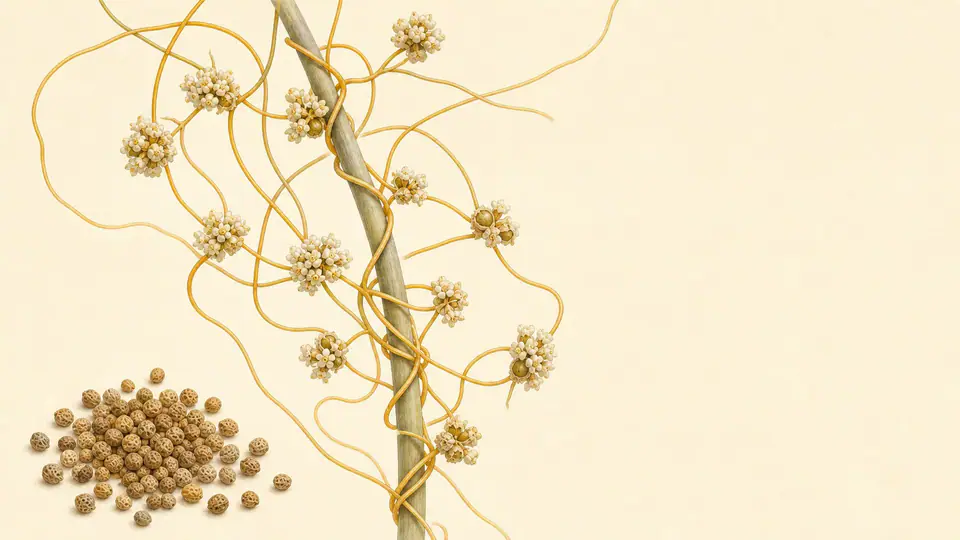
Small Seeds of a Parasitic Vine, Still a Question Mark for Humans
Can I eat Cuscuta seed as a food supplement for men's health or pregnancy preparation? At this stage, it is difficult to conclude that. While Cuscuta is a material with a long history of medicinal use, there are significant gaps in the evidence regarding its efficacy and safety in humans. Furthermore, eating the raw seeds is not the same as taking a concentrated extract.
It is essential to distinguish this gap. Which should we check first: the parts used in tradition, the limitations of animal studies, or the form of the product?
The Identity Behind the Name: Seed or Vine?
Cuscuta refers to the mature seeds of the parasitic plant Cuscuta chinensis Cuscuta chinensis Lam. The Standard Korean Medicine Terminology also defines these seeds as the medicinal unit. However, having the same name does not mean they are the same. Thread-like pre-shoots, parts attached to the host plant, seeds of other Cuscuta species, processed products steamed with alcohol, and water extracts can all easily be mixed under the name 'Cuscuta'.
When people hear 'Cuscuta', they often think of the entire vine, but the medicinal unit is the seed. The exposure pattern varies depending on whether the seeds are used raw, made into powder, or formulated as a supplement using concentrated extracts. Therefore, the results of a single study cannot be generalized to all Cuscuta products.
Why the High Expectations: The Gap Between Preclinical Signals and Humans
A 2014 systematic review summarized various pharmacological activities of Cuscuta. However, the evidence was centered on in vitro and animal models, and it stated that more pharmacokinetic and toxicity studies in humans are needed. This means that preclinical results regarding sexual function, infertility, osteoporosis, or liver and kidney protection cannot be directly translated into therapeutic effects in humans.
It is true that the changes observed in animals are interesting. However, those signals do not automatically translate to the same mechanism, dosage, or safety profile in humans. In the case of Cuscuta, that link is still insufficient.
How Form Changes Meaning: Raw Material, Extract, and Concentrate
Cuscuta products are largely divided into raw seeds, water extracts, processed products, and prescription blends. These result in different exposure levels. The traditional method of using small amounts of raw seeds and the concentrated extracts common in modern supplements differ in the amount and form that enter the body, even if the raw material is the same.
In a 14-day and 28-day water extract study in mice, changes in body weight, blood, liver enzymes, and tissues were observed in the very high repeated-dose group. However, this is not data used to determine the appropriate or harmful dose for humans. It can, however, be read as a signal that concentrated extracts should not be taken lightly over a long period.
| Category | Characteristics | Points to Note |
|---|---|---|
| Raw Seed/Powder | Traditionally used form | Lack of human evidence regarding dosage and intake method |
| Water Extract | Form used in research | Centered on animal studies, safe human dose not established |
| Concentrated extracts / Capsules | Modern supplement form | Exposure amount may differ significantly |
| Prescription Combination | Used in combination with other medicinal herbs | Results for single raw materials cannot be applied as is |
When taking together: Medications and Supplements
When using Cuscuta chinensis (Tosaja) with other health foods or medications, several factors must be checked first. It is important to determine the form of the product, the goal of use, the possibility of pregnancy, the presence of liver disease or bleeding issues, and any current medications being taken.
In particular, if you have liver disease or are taking medications that may affect liver enzyme levels, it is necessary to consult a medical professional or pharmacist before starting concentrated extracts. This is because liver-related changes were observed in animal studies. Safety and drug interactions for long-term high-dose use, children, and breastfeeding have not been established.
Individual circumstances and safety signals
As a rule, you should not self-administer Cuscuta chinensis if you are pregnant or there is a possibility of pregnancy. This is due to preclinical signals related to reproduction and the uterus, and a lack of safety data in humans. Extra caution is required when choosing it for infertility or pregnancy preparation.
If jaundice, dark urine, severe lethargy, persistent vomiting, or abdominal pain occur during use, stop immediately and seek a medical evaluation. These may be signs of liver dysfunction.
Similar names, different ingredients
Four distinctions are necessary when choosing Cuscuta chinensis. First, Cuscuta chinensis seeds and the whole plant of the dodder are different parts. Cuscuta chinensisand other plants of the Cuscuta genus are different species even if they belong to the same genus. Third, the combination in traditional prescriptions and single concentrated supplements have different contexts of use. Fourth, pharmacological signals in animals are not the same as clinical effects in humans.
These distinctions are not simply matters of scientific names. This is because what can and cannot be expected varies depending on the species, the part used, and the processing method of the raw materials listed on the product label.
Criteria to Check Today
If you are selecting or taking Cuscuta chinensis, please check these five things first. Whether the product is the seed or the whole plant, Cuscuta chinensisor another plant of the Cuscuta genus, and whether it is in the form of raw material, water extract, or concentrated extract is the first criterion. You must also check the goal of use (such as men's health, infertility, or back pain), whether the cause has been evaluated, the possibility of pregnancy, liver disease, bleeding issues, and current medications.
In other words, the realistic approach to this material is to prioritize verifying the exact species, medicinal part, processing method, and current diagnosis over expectations of reproductive health, and to avoid using concentrates as a substitute for treatment when human evidence is lacking.
References
- Cuscuta chinensis entry based on the Standard Korean Medicine Terminology of the Society of Korean Medicine.
- Cuscuta chinensis: systematic review of ethnopharmacology and pharmacology.
- Acute and sub-acute toxicity of Cuscuta chinensis water extract in mice.
This text explains the origin of the raw materials, the scope of research, and precautions before consumption. As this cannot replace individual diagnosis or treatment, please consult a medical professional if you are taking medication or if symptoms persist. If sudden and severe symptoms such as difficulty breathing or decreased consciousness occur after consumption, seek help from 119 or the emergency room.

Medical Staff Review
Director Choi Yeon-seung
Chief Director of Baekrokdam Korean Medicine ClinicCuscuta chinensis Dictionary Entry, reviewed the safety of expressions and the scope of verification before administration.
Review scope: Ingredient origin, human studies, concomitant medications, safety of intake · Last reviewed 2026-08-17
- Graduated from Kyung Hee University College of Korean Medicine
- Providing Korean medicine treatment since 2010
- Consultations for Gongjindan, Gyeongokgo, Nokyong (Deer Antler) restorative medicine, and customized restorative herbal medicine