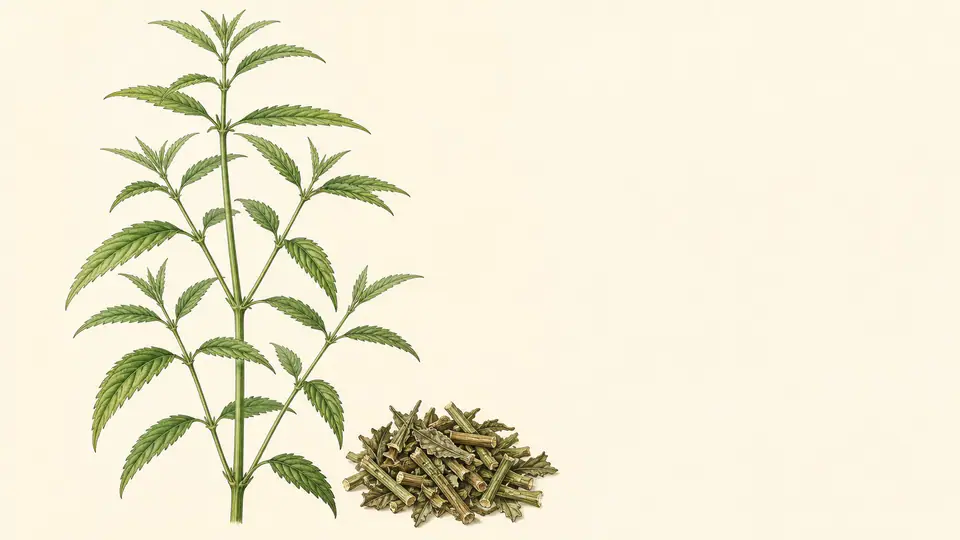
Square stems of the wetlands, a name harvested before flowering
Can I drink Taekran as a tea for irregular menstruation or swelling? It is difficult to answer based solely on the name 'Taekran.' The answer changes depending on whether it was harvested before or after flowering, whether it is the aerial part or the root, and whether it is the Lycopus species according to domestic standards or a different Lycopus species. Current medications and the possibility of pregnancy must also be considered.
So, what should we look for? The first thing to verify is the identity of the raw material.
What is Taekran: Aerial parts before flowering
According to domestic standards, Taekran is the aerial part of Lycopus lucidus Lycopus lucidus Turczaninov before flowering. There are two important points here. First, the species is L. lucidus, and second, the harvest time is before flowering and the part used is the aerial part. Roots, the whole plant after flowering, European L. europaeus, or North American L. americanusmay be called by the same name, but they are not the same raw material according to standards. Taekran extracts or isolated flavonoids also do not share the same evidence as raw herbal tea. Therefore, the word 'Taekran' alone does not reveal which part of which plant was harvested and when.
Expectations tied to the name: Menstruation and edema
Taekran refers to the aerial parts of Lycopus lucidus, which grows in wetlands, harvested before flowering. This plant, characterized by its square stems, has traditionally been linked to women's menstruation and edema. However, this link is not based on definitive clinical evidence from human subjects. Domestic L. lucidusquality research only compared the components of samples from various origins using mass spectrometry and chromatography; it was not a study testing clinical effects. Antioxidant research also consists of data dealing with extract fractions and in vitro reactions. Therefore, expressions such as 'circulating the blood' should be understood in the context of traditional use and cannot be interpreted as modern medical treatment effects.
Current state of research: Cells, animals, and component analysis
L. lucidus Research on extracts related to fatty liver was conducted on liver cells and high-fat diet obese mice. This cannot be interpreted as a treatment effect for fatty liver in humans. Similarly, signals related to antioxidants, liver fat accumulation, and renal transporters are primarily at the in vitro and animal levels. Definitive human evidence for Taekran alone regarding irregular menstruation or edema is still insufficient. Therefore, when placing expectations on this material, one must first distinguish the level of evidence.
Similar names, different species: European Bugleweed
Lycopus europaeusThere are open studies on the thyroid using , but the species is different. Therefore, it cannot serve as evidence for the efficacy or safety of domestic Taekran, which is L. lucidus. L. lucidusand L. europaeus, raw herbal tea, concentrated extracts, traditional uses for menstruation and edema, and modern clinical evidence for humans are all axes that must be distinguished. Similarity in name does not automatically allow for the transfer of evidence.
Difference in Formulation: Raw Tea and Concentrates Are Not the Same Amount
Brewing Taekran as a raw herbal tea should not be treated as the same dosage as taking it in the form of concentrated extracts or capsules. This is because there is insufficient data on long-term use in humans, safety during pregnancy and lactation, and drug interactions. A cup of raw herbal tea and a pill of concentrated extract have different concentrations and exposure levels, even if they use the same raw material. Therefore, checking the product form is not a simple choice, but the first step in safety.
When Taking Together: What Medications Are You Taking?
There are cases where Taekran products should not be combined arbitrarily. If you are taking anticoagulants, antiplatelet agents, diuretics, medications excreted through the kidneys, or thyroid medications, it is necessary to first inform your medical provider or pharmacist about the concentrated Taekran product. This is a preventive approach due to a lack of related data, rather than confirmed interactions. Additionally, if you are pregnant or there is a possibility of pregnancy, do not self-medicate based on traditional uses for menstruation, but consult a medical provider first.
Personal Circumstances and Emergency Signals
If you experience heavy vaginal bleeding, unilateral pelvic pain, a feeling of fainting, or pain or bleeding accompanied by a possibility of pregnancy, this is not a matter to be handled by waiting for Taekran tea. In such cases, immediate medical evaluation is the priority. Taekran is not a means to mask these symptoms and must not be used for that purpose. Identifying the cause of bleeding or pain that falls outside the normal range must come first.
Criteria to Check Today
If considering Taekran, first check the following. First, L. luciduswhether it is the aerial part before flowering, the root, or another Lycopus species. Second, whether it is a raw herbal tea, a complex prescription, or a concentrated extract, and what the actual goal is among irregular menstruation, edema, or pain. Third, whether there is a possibility of pregnancy, abnormal bleeding, kidney disease, or medications being taken such as diuretics, anticoagulants, or thyroid drugs. Rather than the traditional expression 'circulating the blood,' the realistic standard for handling this material is to first check the species, harvest time, part used, formulation, bleeding, possibility of pregnancy, and current medications, Lycopus and not to translate other species or preclinical results into therapeutic effects for humans.
References
- Ministry of Food and Drug Safety Korean Pharmacopoeia: Taekran.
- Lycopus lucidus chemical identification and quality evaluation.
- Lycopus lucidus in cell and mouse fatty-liver models.
- Lycopi Herba and renal organic-anion transporters.
- Lycopus europaeus thyroid study: species-boundary reference.
This text explains the origin of the raw materials, the scope of research, and precautions before consumption. As this cannot replace individual diagnosis or treatment, please consult a medical professional if you are taking medication or if symptoms persist. If sudden and severe symptoms such as difficulty breathing or decreased consciousness occur after consumption, seek help from 119 or the emergency room.

Medical Staff Review
Director Choi Yeon-seung
Chief Director of Baekrokdam Korean Medicine ClinicTaekran Dictionary Entry, reviewed the safety of expressions and the scope of verification before administration.
Review scope: Ingredient origin, human studies, concomitant medications, safety of intake · Last reviewed 2026-08-17
- Graduated from Kyung Hee University College of Korean Medicine
- Providing Korean medicine treatment since 2010
- Consultations for Gongjindan, Gyeongokgo, Nokyong (Deer Antler) restorative medicine, and customized restorative herbal medicine