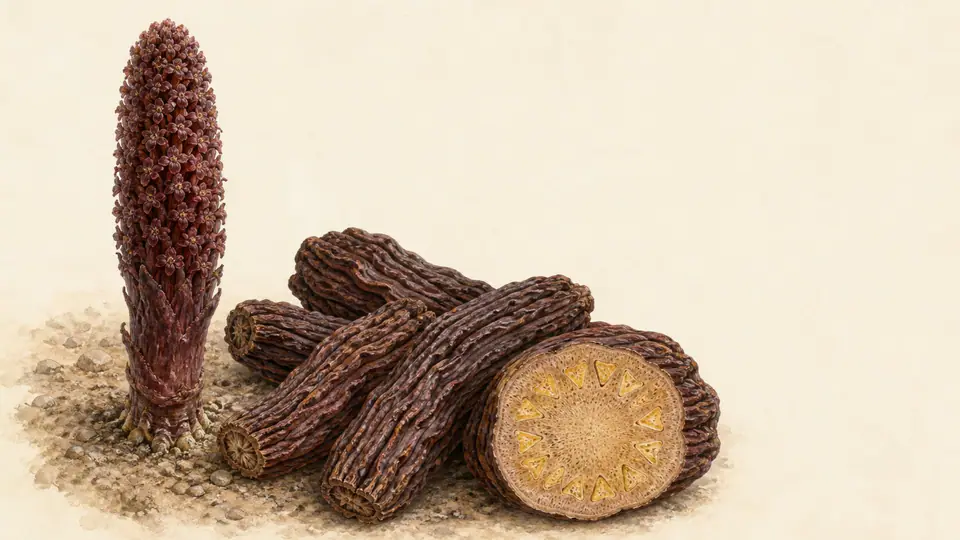
A symbol of tonicity that became a leafless root
Can I take Cynomorium songaricum for energy or sexual function? This is the most common starting point for questions about Cynomorium songaricum. In short, there is currently a lack of definitive evidence in humans to rely on it alone. While it has long been known as a tonic medicinal herb, modern research remains at the animal and cellular stages, and high-concentration extracts have shown warning signs regarding kidney function and coagulation.
Cynomorium songaricum is the fleshy stem of Cynomorium songaricum. It is a parasitic plant without chlorophyll that obtains nutrients by attaching to the roots of other plants. Perhaps this leafless, root-like appearance contributed to its image as a tonic. However, the appearance of the raw material and its historical image do not automatically translate to effects on the human body.
Where the questions begin: Fatigue and sexual function
People usually seek Cynomorium songaricum for two reasons: persistent fatigue, and expectations regarding sexual dysfunction or infertility. Both are areas where it is difficult to easily pinpoint the cause. Cardiovascular disease, endocrine abnormalities, medications currently being taken, lack of sleep, and psychological stress can all produce similar symptoms. However, Cynomorium songaricum is a name that leads people to place the solution in a single ingredient, bypassing these complex causes. Therefore, the first question should not be 'Do I need Cynomorium songaricum?' but 'Do I know the cause of my symptoms?'
The identity of the ingredient: Leafless fleshy stem
The National Institute of Food and Drug Safety Evaluation defines Cynomorium songaricum as the fleshy stem of Cynomorium songaricum. A fleshy stem is literally a thick, firm stem part. The fact that it is a parasitic plant without chlorophyll is the most distinct characteristic of Cynomorium songaricum. It does not perform photosynthesis and survives by depending on other plants. Apart from the tonic image, this unique ecology may have given it chemical properties that modern science is noting. A 2024 comprehensive review summarized 98 components and various preclinical activities. However, the authors clearly pointed out that further research is needed to confirm the mechanism of action and effects in humans.
Why expectations exist: Results from animals and cells
Expectations for sexual function and anti-fatigue effects of Cynomorium songaricum mainly stem from animal experiments or studies on isolated components. Results related to reproduction from Cynomorium songaricum flavonoids were observed in mouse and cell models damaged by drugs. This does not mean there is a treatment effect for erectile dysfunction or infertility in humans. While indicators seen in animal models may appear similarly in humans, it is not proven. A large number of studies does not automatically support effects in humans. 'Cynomorium songaricum flavonoids' and 'raw Cynomorium songaricum medicinal herb' are not the same material.
Differences in product form: Raw material, extract, fraction
Cynomorium songaricum fleshy stem, water extracts, flavonoid/polysaccharide fractions, and other tonic medicinal herbs all involve different materials and exposure levels. Decoctions made from raw herbs, concentrated extracts, and products that isolate only specific components differ in the amount and types of ingredients that enter the body. Safety reviews include cases where vomiting and acute kidney injury were reported after consuming excessive amounts of water extract. This does not mean raw materials are unconditionally safe and only extracts are dangerous. It means that when the form changes, the exposure amount and risk profile also change. Therefore, if a product label only says 'Cynomorium songaricum', you must first check whether it is the raw material, a water extract, and at what concentration it is concentrated.
When taking in combination
People with kidney disease, a tendency to bleed, or those taking anticoagulants should avoid arbitrarily adding concentrated extracts. This is because changes in prothrombin time and reproductive organ indicators were reported in high-exposure groups in some 90-day animal tests. While animal results cannot be directly applied to humans, signals regarding coagulation and the kidneys are worth noting. The same applies when using it with other tonic medicinal herbs or supplements. When multiple ingredients are stacked under the same name of 'tonic', the exposure amount becomes opaque, and it becomes difficult to track individual interactions.
Individual circumstances and safety signals
Human safety data for long-term use, pregnancy, lactation, and children have not been established. Long-term dosages for healthy adults and drug interactions have also not been established. If repeated vomiting, decreased urination, edema, or severe dizziness occur after intake, you must stop use and seek medical evaluation. Adverse reactions may vary depending on the product form, dosage, and the individual's underlying conditions. The reason to avoid self-medication is not simply because it is 'dangerous', but because it is unpredictable due to a lack of safety data.
The Gap Between Human Evidence and Expectations
Research on Cynomorium songaricum is primarily at the preclinical stage. Reproductive indicators in animals and sexual function in humans are different. The traditional tonic image and clinical diagnosis are also different. If these two are not distinguished, the statement 'there are many studies' is misinterpreted as 'it is effective'. The fact that a 2024 review summarized 98 components only shows the chemical diversity of Cynomorium songaricum; it is not evidence that it treats a specific disease in humans. In other words, it is correct to view it as having an interesting starting point, but no clinical conclusion yet.
Differences from similar raw materials
Cynomorium songaricum fleshy stem and other tonic medicinal herbs are not the same material. You should not expect similar effects based on the name alone. Raw herbs, water extracts, and flavonoid fractions are also not the same material. When choosing a product, you must first check what is contained under the name 'Cynomorium songaricum' and how it has been processed. What should you look for? The name of the raw material, extraction method, concentration ratio, content labeling, and your own current medications and underlying conditions.
Criteria to Check Today
Instead of equating the term 'tonic' with effects on human sexual function, first check the product form, underlying conditions, and the cause of fatigue or sexual dysfunction. Whether Cynomorium songaricum is necessary is a subsequent question. If you have erectile dysfunction, infertility, or persistent fatigue, prioritizing a cause evaluation and receiving standard treatment is the priority. Cynomorium songaricum cannot replace that process. Extra caution is required during pregnancy, lactation, childhood, long-term use, or while taking anticoagulants. This gap must be clearly distinguished.
References
- National Institute of Food and Drug Safety Evaluation Herbal Specification: Cynomorium songaricum.
- Cynomorium songaricum pharmacology and safety review.
- Cynomorium flavonoids in mouse reproductive injury.
- Cynomorium and male hamster reproductive activity.
This text explains the origin of the raw materials, the scope of research, and precautions before consumption. As this cannot replace individual diagnosis or treatment, please consult a medical professional if you are taking medication or if symptoms persist. If sudden and severe symptoms such as difficulty breathing or decreased consciousness occur after consumption, seek help from 119 or the emergency room.

Medical Staff Review
Director Choi Yeon-seung
Chief Director of Baekrokdam Korean Medicine ClinicCynomorium songaricum Dictionary Entry, reviewed the safety of expressions and the scope of verification before administration.
Review scope: Ingredient origin, human studies, concomitant medications, safety of intake · Last reviewed 2026-08-17
- Graduated from Kyung Hee University College of Korean Medicine
- Providing Korean medicine treatment since 2010
- Consultations for Gongjindan, Gyeongokgo, Nokyong (Deer Antler) restorative medicine, and customized restorative herbal medicine