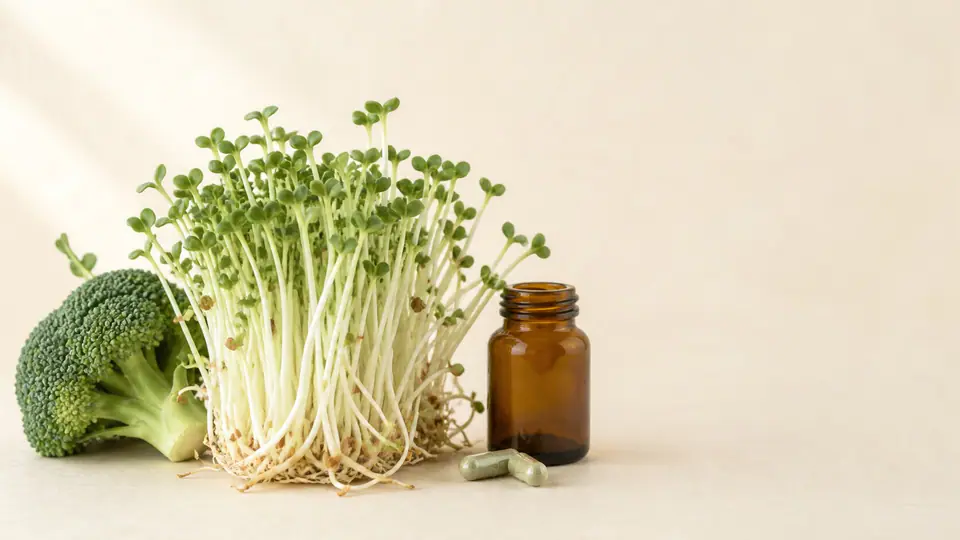
Unstable Components Born from Cut Broccoli
Would taking broccoli sprouts or sulforaphane capsules help with detoxification and cancer prevention, and is it enough to only look at the glucoraphanin content? This question asks something more: whether the epidemiological value of a plate of vegetables and the disease-treatment claims of concentrated supplements are based on the same evidence.
In short, sulforaphane is an isothiocyanate produced when a precursor called glucoraphanin in cruciferous vegetables, such as broccoli and broccoli sprouts, meets the enzyme myrosinase. However, the glucoraphanin content and the actual amount of sulforaphane produced are not the same number. The numbers on the label alone are insufficient.
Where the Questions Begin
Many people first look at 'how much glucoraphanin is contained' when choosing broccoli sprouts, seed extracts, or sulforaphane capsules because they have heard research that cruciferous vegetables are good for health. However, the epidemiological value of eating vegetables as part of a meal and the disease-treatment claims of concentrated sulforaphane supplements are not based on the same evidence. The former estimates the effect of long-term dietary patterns, while the latter claims to prevent or cure diseases by concentrating a specific component. The strength of evidence and the scope of interpretation for the two are different.
Sulforaphane is Not a Finished Product
Sulforaphane is not stored in plants as a finished product. It is produced when glucoraphanin and myrosinase meet when tissues are damaged, that is, when broccoli is chewed, cut, or ground. Only when this reaction occurs does sulforaphane appear. Therefore, the glucoraphanin content in the raw material alone cannot determine the actual amount of sulforaphane that will enter the body.
Even if a product label says 'sulforaphane,' it often actually contains the glucoraphanin precursor. Conversely, products that only list the glucoraphanin content do not indicate whether active myrosinase is present or how much is converted into sulforaphane.
Strong Terms: Nrf2 and Detoxification
Sulforaphane has gained attention due to research showing that detoxification enzymes change via the Nrf2 pathway. Such biomarker changes have been reported in cell experiments and some human studies. However, a biomarker indicating that the Nrf2 pathway and detoxification enzymes have changed does not mean that cancer treatment or disease prevention has been proven. It means that just because a biomarker moved, it does not necessarily mean that cancer decreased or survival increased.
In human studies, formulations with active myrosinase showed several times higher exposure to sulforaphane metabolites than formulations containing only the precursor, and individual differences were significant. Even when consuming the same amount of precursor, actual exposure varied by person due to differences in enzyme activity and gut microbiota.
How Processing Changes Conversion
Due to heating, processing, enzyme activity, and differences in gut microbiota, the actual sulforaphane exposure can vary greatly even with the same amount of glucoraphanin. If myrosinase is inactivated during the processing stage, the actual conversion may be low even if the glucoraphanin content on the label is high. In other words, the number may be high, but the active ingredient reaching the body may be small.
This is why a distinction must be made between broccoli foods and broccoli sprout/seed extracts, between glucoraphanin precursors and produced sulforaphane, and between active and inactive myrosinase products. Each has a different starting point and a different conversion process.
What to Look for When Choosing a Formulation
Then, what should you look for? First, check whether the label indicates sulforaphane itself or glucoraphanin, and whether it displays active myrosinase and the actual yield. You should also check which formulation it is, broccoli food, sprouts, seed extract, or stabilized capsules, and whether the daily dose is the same as the products used in research.
It must be remembered that actual exposure varies greatly by product. Even for ingredients with the same name, internal exposure can differ depending on the manufacturing method.
Concurrent Medications and Individual Circumstances
If you are currently receiving treatment for cancer, thyroid disease, or taking diabetes medication, you must first ask if you are attempting to replace these with supplements. During cancer treatment, do not use sulforaphane as a basis for replacing chemotherapy or adjusting dosages; inform your oncology treatment team about the product and dosage.
If there is a risk of thyroid disease or iodine deficiency, there is no reason to arbitrarily prohibit vegetable intake, but long-term use of high-dose sprouts or extracts should be discussed with the treatment team. In a 12-week broccoli sprout beverage trial of 45 women, there were no changes in thyroid function or autoimmune markers, but this does not guarantee the safety of all high-dose products and long-term use.
Safety Signals and Adverse Reactions
Concentrated products may cause gastrointestinal symptoms such as abdominal pain, nausea, and diarrhea. If you experience persistent vomiting, severe abdominal pain, or jaundice, you must stop taking the product and seek a medical evaluation. For difficulty breathing, facial swelling, or decreased consciousness, call 119 or seek help at an emergency room.
The Gap Between Human Evidence and Expectations
A systematic review of 8 randomized trials in cancer patients reported changes in various genetic and tissue biomarkers. However, due to differences in cancer types, dosages, and formulations, no conclusion could be reached regarding therapeutic efficacy. This further demonstrates that changes in Nrf2, genes, and metabolites are not the same as clinical outcomes such as cancer occurrence or survival.
In other words, while the pathways sulforaphane activates within the body are largely known, clinical evidence that it prevents or treats specific diseases has not yet been established.
Final Decision Criteria
Rather than focusing on the word "detox," check the labeling and actual yield of glucoraphanin, sulforaphane, and myrosinase, and distinguish between biomarker changes and the prevention or treatment of disease. Do not equate eating vegetables as part of a meal with viewing concentrated supplements as tools for treating disease. Additionally, if you are currently undergoing treatment, make it a habit to inform your medical team about the product and dosage.
References
- Broccoli or sulforaphane: source, formulation, bioavailability and dose.
- Sulforaphane in cancer management: systematic review of randomized trials.
- Broccoli sprout beverage and thyroid safety: 12-week randomized trial.
- Myrosinase increases sulforaphane bioavailability: randomized crossover study.
This text explains the origin of the raw materials, the scope of research, and precautions before consumption. As this cannot replace individual diagnosis or treatment, please consult a medical professional if you are taking medication or if symptoms persist. If sudden and severe symptoms such as difficulty breathing or decreased consciousness occur after consumption, seek help from 119 or the emergency room.

Medical Staff Review
Director Choi Yeon-seung
Chief Director of Baekrokdam Korean Medicine ClinicSulforaphane Glossary Entry, reviewed the safety of expressions and the scope of verification before administration.
Review scope: Ingredient origin, human studies, concomitant medications, safety of intake · Last reviewed 2026-08-17
- Graduated from Kyung Hee University College of Korean Medicine
- Providing Korean medicine treatment since 2010
- Consultations for Gongjindan, Gyeongokgo, Nokyong (Deer Antler) restorative medicine, and customized restorative herbal medicine