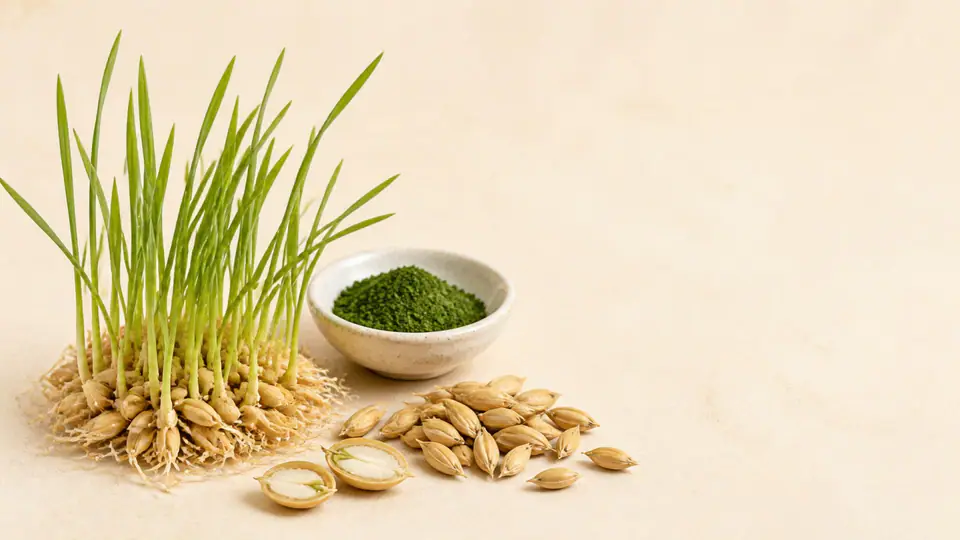
Can grass cut before heading be a substitute for medication?
Can taking barley grass powder for blood sugar, cholesterol, or uric acid replace barley rice or medication? In short, based on human studies to date, it is difficult to make such a switch. While some small-scale trials have shown changes in values, this is not evidence to replace medication or medical treatment.
This raw material is not as simple as its name suggests. Barley rice, sprouted barley grains, young leaf powder, pressed juice powder, extracts, and beta-glucan isolated from mature barley grains all come from different parts of the plant and have different ingredient compositions. However, in the market, these are often lumped together. As we follow this discussion, the criteria for deciding what to buy and how to consume it will become clearer.
1. What kind of plant is barley grass?
Kew classifies barley Hordeum vulgareas an annual plant of the Poaceae family. Commercial barley grass generally refers to the leaves and grass harvested during the young vegetative growth stage after sprouting barley seeds. Recent reviews describe young barley as the young leaf stage 7 to 15 days after sprouting, before the heads emerge; however, the harvest date, variety, cultivation, and drying methods of commercial products are inconsistent. Even under the same name, the ratio of ingredients can vary depending on when it was cut in the field and how it was processed.
2. Why there are high expectations for detoxification, blood sugar, cholesterol, and uric acid
Green leaves attract attention due to chlorophyll and antioxidant capacity in test tubes. However, antioxidant levels measured in a test tube are not the same as results measuring liver detoxification in humans. Because there are studies on beta-glucan in mature barley grains, it is easy to assume that young leaf powder will have similar effects. However, research on beta-glucan in mature barley grains does not prove the efficacy of young leaf powder. This is where continuity in naming is mistaken for scientific continuity.
3. Product form affects the composition of ingredients
Products made by freeze-drying or hot-air drying whole leaf powder and pressed juice have different ratios of insoluble fiber and heat-sensitive components. These products cannot be compared simply by their green color or the weight of one spoonful. Whole young leaf powder, juice powder dried after pressing, extracts, sprouted barley grains, mature barley grains, and beta-glucan isolated from grains differ in the part of the raw material used and their fiber and ingredient composition. What should you look for? First, check the part of the plant used and the processing method listed on the product label, the daily intake amount, and whether there are human studies conducted specifically on that product.
4. Human studies are still small and short-term
A 2026 critical review identified about 5 human intervention studies on young barley alone and evaluated that clinical effects cannot be confirmed because the formulations, subjects, and designs differed. A study on barley grass powder involving 59 adults with diabetes reported changes in blood sugar and lipids, but it is not evidence for replacing medication as it lacked randomization and blinding and was short-term at 60 days. In a 2025 single-center non-blinded trial of 90 adults with hyperuricemia, 74 completed the study; the group using barley grass concurrently with a balanced diet showed a slightly greater decrease in uric acid than the balanced diet alone, but the results were borderline and there were some differences in baseline values. This uric acid trial did not measure the reduction of gout attacks or kidney protection, and the results of one specific barley green product cannot be applied to all barley grass powders.
5. Concurrent use and medication: Inform your doctor instead of switching
If you are taking diabetes medication or uric acid-lowering agents, do not switch your medication to barley grass; instead, inform your medical provider about your intake and any changes in your test results. If you are pregnant, breastfeeding, or taking multiple medications, do not arbitrarily increase the intake of concentrated extracts beyond normal food levels, as long-term safety data is insufficient. It is easy to assume they are safe because they feel like 'natural foods,' but concentrated powders or extracts may not be.
6. Why you must check for gluten and safety labels
Barley is a gluten-containing grain. If you have celiac disease or require strict medical avoidance of gluten, do not assume it is safe just because it is a leaf; check for verified gluten-free labels and cross-contact management. Depending on the raw materials and manufacturing of powder and juice products, the possibility of pesticide, microbial, heavy metal, and gluten cross-contact varies, so check the test reports and manufacturing quality.
7. Which signals should not be monitored with green juice alone
If you experience acute joint redness, severe pain, symptoms of hyperglycemia, jaundice, or difficulty breathing, do not simply monitor your condition with green juice; seek medical evaluation. These symptoms are not issues that should be resolved merely by stopping barley grass, but are signals that must be evaluated by medical professionals.
8. Similar names, different ingredients
Young barley leaves, sprouted barley grains, and mature barley grains are the same plant but at different stages. Whole-leaf powder, pressed juice powder, and standardized extracts use the same leaves but differ in processing methods. Saponarin, chlorophyll, and antioxidant tests are different measurements from blood glucose, lipid, uric acid, and disease outcomes. Barley grass and barley beta-glucan should also be viewed as different ingredients. In other words, research on barley beta-glucan should not be applied indiscriminately to barley grass powder.
9. Criteria to verify today
Rather than the name "green detox powder," first verify the plant part, harvest stage, processing method, actual daily dosage, the products and subjects of limited human studies, the gap between surrogate markers and disease treatment, gluten labeling, and your current medications. This is not about giving up hope, but about determining where to place your expectations.
References
- Kew Plants of the World Online: Hordeum vulgare.
- FDA: Gluten and Food Labeling.
- Young barley preparations: phytochemistry and clinical relevance review.
- Barley green in hyperuricemia: randomized controlled trial.
This text explains the origin of the raw materials, the scope of research, and precautions before consumption. As this cannot replace individual diagnosis or treatment, please consult a medical professional if you are taking medication or if symptoms persist. If sudden and severe symptoms such as difficulty breathing or decreased consciousness occur after consumption, seek help from 119 or the emergency room.

Medical Staff Review
Director Choi Yeon-seung
Chief Director of Baekrokdam Korean Medicine ClinicBarley Grass Glossary, reviewed the safety of expressions and the scope of verification before administration.
Review scope: Ingredient origin, human studies, concomitant medications, safety of intake · Last reviewed 2026-08-17
- Graduated from Kyung Hee University College of Korean Medicine
- Providing Korean medicine treatment since 2010
- Consultations for Gongjindan, Gyeongokgo, Nokyong (Deer Antler) restorative medicine, and customized restorative herbal medicine