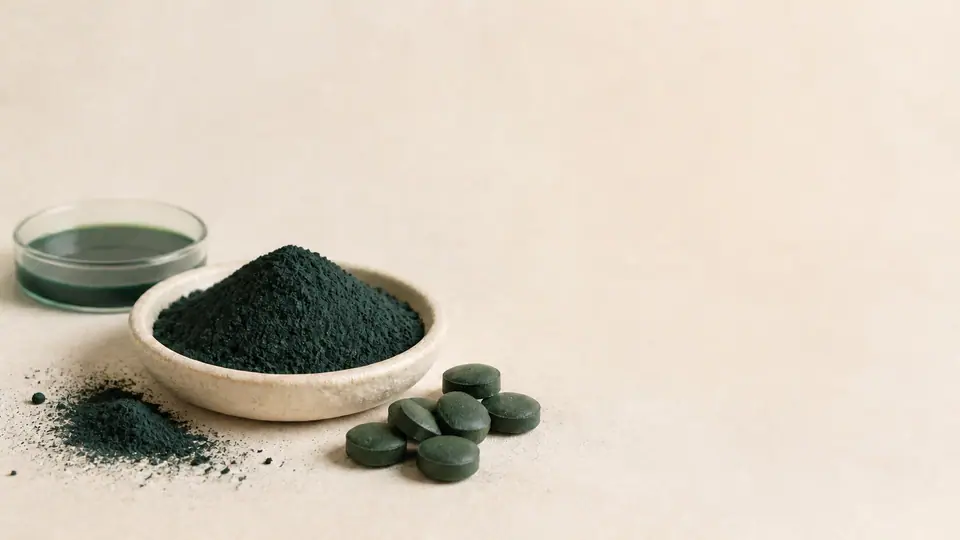
Cyanobacteria behind the blue-green name
Would taking spirulina help with nutritional supplementation or blood pressure management? In short, while some studies have shown small changes in blood pressure, the clinical significance is unclear, and safety varies by product. Therefore, you must first verify the identity of the raw materials, the formulation, and the quality testing.
Based on the name, spirulina feels like a plant-based green algae. However, spirulina is a cyanobacterium. The 'spirulina' commonly used in commercial foods and supplements mainly Arthrospira platensis or A. maximarefers to dried biomass. Although powders, tablets, and extracted pigments are distributed under the same name, these are not the same products.
Why Spirulina?
Spirulina is known for its image as a blue-green 'superfood,' but behind that image is its lesser-known identity as a cyanobacterium. FDA GRAS data also specifies Arthrospira platensisand A. maximaunder the common name spirulina. In other words, even though the raw material species is specified, the labels consumers see often only state 'spirulina'.
When names are grouped together, products with different raw material species, cultivation environments, and manufacturing methods appear similar. However, the safety of products with different species, cultivation, and manufacturing cannot be applied interchangeably. You must first recognize that products with the same name can be different products.
Are dried biomass and extracts the same?
The first thing to look at when choosing a spirulina product is the formulation. Since dried biomass and phycocyanin extracts differ in composition and purpose of use, research results from one formulation cannot be applied directly to another. If the label only says 'spirulina,' you must verify which form and which species it is.
What do blood pressure studies show?
One of the expectations for spirulina is blood pressure management. A 2021 meta-analysis of 5 randomized trials involving 230 people reported signals of blood pressure reduction. However, the number of studies was small, and there was significant heterogeneity in the systolic blood pressure results. A 2025 meta-analysis comparing spirulina and chlorella evaluated that the change in diastolic blood pressure for spirulina was small and its clinical significance was uncertain.
In other words, whether something was statistically visible is a different matter from whether it is actually a meaningful change. If the number of studies is small and results are inconsistent, it is impossible to know how it applies to an individual. There is no evidence to suggest that spirulina can replace blood pressure medication or provide various promoted benefits all at once.
Quality and safety vary by product
The clinical evidence of the raw material itself is a separate issue from the presence of other cyanobacteria or microcystin contamination. The USP safety review S. maximaand S. platensisevaluated it as a grade capable of being included in quality specifications, but this does not guarantee the quality of all commercial products.
The FDA explains that microcystin contamination in cyanobacteria products can be a health risk, necessitating testing and management. Therefore, when choosing a product, it is reasonable to check for third-party quality testing and data on microcystin, microorganisms, and heavy metal tests. Remember that the safety of products with different raw material species, cultivation, and manufacturing cannot be applied interchangeably.
How to consider concurrent use and individual circumstances
If you are taking blood pressure medication or have low blood pressure, consult a healthcare provider or pharmacist before adding spirulina supplements. This is a basic procedure to verify the possibility of concurrent use. If adverse reactions such as new gastrointestinal symptoms, headache, or rash occur after intake, stop use and consult a professional while preserving the product name and batch number.
The important thing here is to discard the assumption that something can be taken at any time just because it is made from 'natural ingredients.' You must consider its interaction with medications you are currently taking, your blood pressure status, and whether the product has undergone quality testing.
Are Spirulina and Chlorella the Same?
Spirulina and chlorella are often marketed with similar images. However, they are different organisms. Even in a 2025 comparative meta-analysis, the magnitude and clinical significance of changes in diastolic blood pressure differed. The effectiveness of the raw materials, product quality, and potential for contamination must also be viewed separately.
Spirulina is a cyanobacterium, while chlorella is a eukaryotic green alga. Even if they are placed in the same 'green supplement' category, they cannot share the same biological identity or safety evidence. When comparing raw materials, the criteria should be the species, formulation, and test data, rather than the marketing image.
Criteria to Check Today
Then, what should you look for? First, verify the species of the raw material. Arthrospira platensis or A. maximaSecond, distinguish whether it is dried biomass, a tablet, or a phycocyanin extract. Third, first consider whether you are taking blood pressure medication or have a condition of hypotension. Fourth, check if the manufacturer has test data for microcystins, microorganisms, and heavy metals.
Prioritize verifying the raw material species, formulation, the clinical significance of small effects, third-party quality testing, and your current treatment over the label of 'superfood.' Since there is no evidence that spirulina can replace specific treatments, do not arbitrarily discontinue existing prescriptions or management.
References
- FDA GRAS Notice 424: Arthrospira (Spirulina).
- FDA Blue-Green Algae Products and Microcystins.
- Spirulina and blood pressure: systematic review and meta-analysis.
- USP safety evaluation of spirulina.
This text explains the origin of the raw materials, the scope of research, and precautions before consumption. As this cannot replace individual diagnosis or treatment, please consult a medical professional if you are taking medication or if symptoms persist. If sudden and severe symptoms such as difficulty breathing or decreased consciousness occur after consumption, seek help from 119 or the emergency room.

Medical Staff Review
Director Choi Yeon-seung
Chief Director of Baekrokdam Korean Medicine ClinicSpirulina Dictionary Entry, reviewed the safety of expressions and the scope of verification before administration.
Review scope: Ingredient origin, human subject research, concomitant medications, intake safety · Last reviewed 2026-08-16
- Graduated from Kyung Hee University College of Korean Medicine
- Providing Korean medicine treatment since 2010
- Consultations for Gongjindan, Gyeongokgo, Nokyong (Deer Antler) restorative medicine, and customized restorative herbal medicine