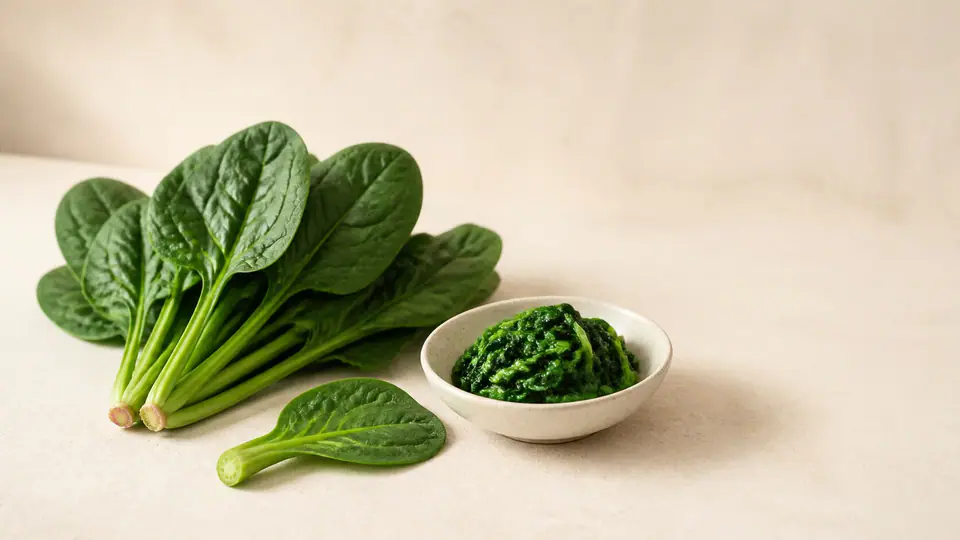
Leaves That Became a Symbol of Strength, but the Story Starts with the Weight of a Single Cup
Is spinach, known for being good for iron and eye health, better when blended raw than when blanched? In short, it depends on the form, the amount, and what you expect. While a raw cup and a blanched cup both use the unit 'one cup,' they actually contain different amounts of leaves. When you add spinach powder, nitrate drinks, and thylakoid extracts to the mix, everything under the name 'spinach' becomes a different formulation. You must first understand these differences for the numbers to make sense.
Spinach is a green leafy vegetable consisting of the leaves of Spinacia oleracea, consumed as raw greens, seasoned side dishes, soups, frozen, or as juice. These green leaves, which became a symbol of strength in cartoons, have been rebranded under keywords like iron, lutein, nitrates, and thylakoids to become juices and diet extracts. However, these keywords are not the same as a plate of whole leaves.
First, the Weight of a Cup Differs
One cup of raw spinach is approximately 30 g of loosely packed leaves. One cup of blanched and drained spinach contains significantly more leaves. Therefore, comparing numbers like 'Vitamin K, iron, and potassium per cup' directly results in an interpretation that mixes cooking effects with actual intake. You must first verify that the amount of leaves contained differs even if the unit is the same.
Vitamin K and Warfarin: Consistency Over Avoidance
The NIH ODS suggests that one cup of raw spinach contains approximately 145 μg of Vitamin K. While people taking warfarin are often told to 'stop eating spinach,' institutional guidance differs. The key is to maintain a consistent daily intake of Vitamin K rather than avoiding spinach entirely. The problem lies in suddenly stopping or binge-eating; consult your prescriber when changing the dose or form. In the relationship with warfarin, the stability of the total daily Vitamin K intake is what matters, not the vegetable 'spinach' itself.
The Truth About Iron: Content Does Not Equal Absorption
Spinach provides non-heme iron. Non-heme iron has a lower absorption rate than animal-based heme iron, and oxalates and the food matrix within spinach also affect absorption. Therefore, the detected iron content is not the total amount absorbed by the body. If iron-deficiency anemia is suspected, a single vegetable or juice cannot replace medical treatment; blood tests and a cause evaluation are necessary. Symptoms such as shortness of breath, chest pain, or fainting must be evaluated immediately.
Oxalates and Stones: Be Cautious of Concentrated Juices
The NIDDK lists spinach as a high-oxalate food for people who have had calcium oxalate stones. However, this does not mean you should unconditionally reduce dietary calcium. Water intake, sodium, and the type of stone must be considered together. In particular, spinach juice is a concentrated form of many leaves, so caution is needed if you have a history of stones. Severe flank pain, hematuria (blood in urine), vomiting, or decreased urine output can be signs of stones or urinary tract obstruction and require emergency medical care.
Nitrates and Blood Pressure: Acute Single-Meal Levels vs. Long-term Outcomes
In a crossover trial where 220 mg of spinach-derived nitrates were given as a single meal to 26 healthy adults, a reduction in systolic blood pressure was reported for a few hours. However, in a study of 38 adults with stable blood pressure who consumed leafy greens for 7 days, there was no difference in blood pressure or arterial stiffness. An acute change in levels from a single meal is not the same as a long-term cardiovascular outcome. In other words, it is difficult to view a plate of spinach as a replacement for blood pressure medication simply because it contains nitrates.
Thylakoids and Satiety: Two-Hour Feelings vs. Evening Calories
In a single-dose trial of 60 overweight or obese adults, 5 g of spinach thylakoid extract increased subjective satiety for two hours. However, it did not reduce evening calorie intake, and whole spinach or long-term weight loss were not tested. A single dose of extract is different from a usual plate of seasoned vegetables, and it cannot be concluded that the subjective indicator of satiety leads to weight loss.
Differences in Form: Whole Leaves, Juice, Powder, and Extracts
Spinach is encountered in various forms: raw leaves, blanched seasoned vegetables, frozen, juice, powder, and thylakoid extracts. Although all are called 'spinach,' they are not the same formulation as a plate of vegetables. Research on nitrates in leafy greens or thylakoid extracts tested specific amounts and processed products, which is not the same as the therapeutic effect of a usual plate of seasoned vegetables or salad. So, what should you look for? You must first distinguish whether you are consuming raw leaves, blanched leaves, juice, powder, or an extract, and exactly how many grams are consumed at once.
Combinations and Individual Circumstances
When choosing spinach, you must also consider your current medications and health status. If you are taking warfarin, maintain a consistent pattern of vitamin K intake. If you have a history of calcium oxalate stones, avoid consuming concentrated juices or powders all at once, and coordinate your intake of fluids, sodium, and dietary calcium with your medical staff or a nutritionist. If you have been instructed to limit potassium due to chronic kidney disease, follow your dietary guidelines rather than increasing juice or powder intake simply because they are considered health foods.
Ask yourself what you are expecting
It is necessary to first determine whether you intend to use spinach instead of medicine or supplements for iron, eye health, blood pressure, or weight management. If your expectation is to treat a disease or control specific clinical values, a single type of vegetable may be insufficient. If your expectation is dietary diversity, it is more realistic to accurately examine the form and quantity of the vegetable.
Final Decision Criteria
Look at the actual intake weight and the method of cooking or concentration first, rather than the green color or the large numbers on the nutrition label. You must simultaneously consider the consistent intake of vitamin K for warfarin, the verification of a history of stones, and the gap between a single-meal marker and long-term health outcomes. Spinach remains a good vegetable. However, the standard this discussion leaves is to consume it by distinguishing what form it takes under that name, how many leaves it contains, and which expectation it supports.
References
- NIH ODS: Vitamin K fact sheet for health professionals.
- NIDDK: Eating, diet and nutrition for kidney stones.
- Nitrate-rich spinach meal and acute vascular measures: randomized crossover trial.
- Nitrate-rich leafy vegetables for 7 days and blood pressure: randomized crossover trial.
- Spinach thylakoid extract and acute satiety: randomized crossover trial.
This text explains the origin of the raw materials, the scope of research, and precautions before consumption. As this cannot replace individual diagnosis or treatment, please consult a medical professional if you are taking medication or if symptoms persist. If sudden and severe symptoms such as difficulty breathing or decreased consciousness occur after consumption, seek help from 119 or the emergency room.

Medical Staff Review
Director Choi Yeon-seung
Chief Director of Baekrokdam Korean Medicine ClinicSpinach Dictionary Entry, reviewed the safety of expressions and the scope of verification before administration.
Review scope: Ingredient origin, human studies, concomitant medications, safety of intake · Last reviewed 2026-08-17
- Graduated from Kyung Hee University College of Korean Medicine
- Providing Korean medicine treatment since 2010
- Consultations for Gongjindan, Gyeongokgo, Nokyong (Deer Antler) restorative medicine, and customized restorative herbal medicine