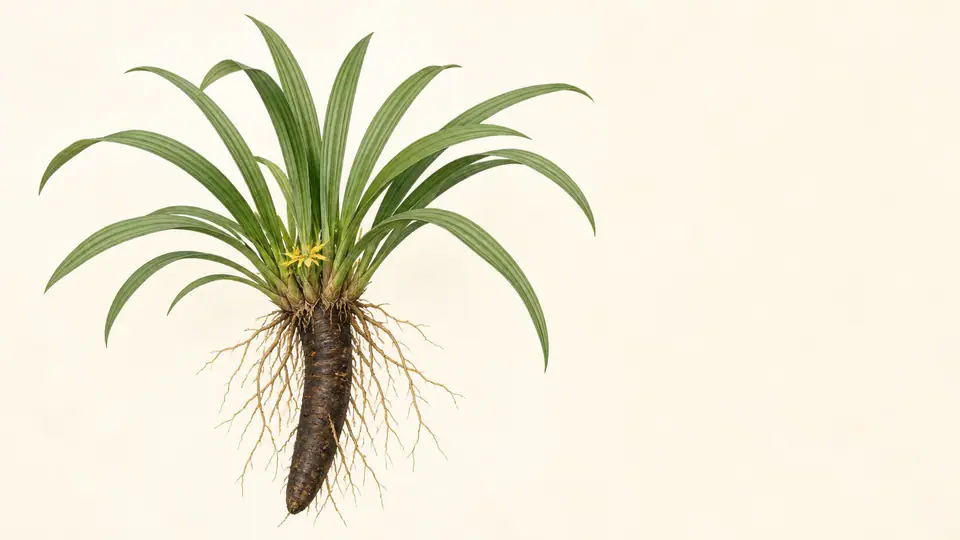
First, a Look at the Nicknames of the Black Rhizome
Can I take Curculigo extract because it is said to be good for menopause or sexual function? This question appears repeatedly in the health functional food and herbal medicine markets. In short, there is currently no set of clinical trials that have established therapeutic effects in humans; rather, since it is an ingredient with signals of hormone sensitivity, it is better not to add it indiscriminately.
Curculigo refers to the rhizome of Curculigo orchioides Gaertner. While its thin, blackish rhizomes have earned nicknames related to tonicity and sexual health, it is an ingredient where uterine responses in ovariectomized rats and issues regarding endangered resources are more prominent than human clinical data. This discussion is not simply about adding efficacy, but about how to interpret the name, part used, formulation, hormonal signals, and resource origin.
Context of the Question: Nicknames for Tonicity and Sexual Health
Expectations for Curculigo are mainly focused on tonicity and sexual health. A 2010 review summarized various preclinical activities but failed to present a set of clinical trials establishing therapeutic effects in humans. In other words, while expectations are high, there is still insufficient evidence to conclude that the same effects occur in the human body. In this context, phrases like 'good for menopause or sexual function' may be interpretations that exceed the boundaries of the research.
Identity of the Ingredient: The Rhizome as the Key Part
The Ministry of Food and Drug Safety (MFDS) standards define Curculigo as the rhizome of C. orchioides. It specifies that fibrous roots and petioles should not be mixed in and sets standards for heavy metals and pesticides. Therefore, when looking at Curculigo products, the first step is to verify if it is the rhizome rather than simply looking for the name 'Curculigo'. Using fibrous roots, leaves, or the whole plant does not constitute the same ingredient or exposure.
How do ingredients with similar names differ?, Distinguishing from Kali Musli
While the medicinal part according to domestic standards is the rhizome of Curculigo, the species and part cannot be confirmed solely by the trade name 'Kali Musli' used in India. Kali Musli may remain a product where the species, part, extraction ratio, and contamination tests are unclear, and it is better to avoid such products. Even if the names are the same, if the biological identity differs, the exposure differs.
Reasons for Expectations: The Boundaries of Preclinical Research
Data supporting expectations for sexual function or menopause are primarily preclinical. There is research showing that alcohol extracts caused changes in uterine weight, endometrium, and vaginal epithelial markers in ovariectomized rats, exhibiting estrogenic signals. However, these are not results of direct measurements of efficacy or risk in humans. The response in rats cannot be assumed to appear identically in humans; rather, the fact that there is hormonal action is a reason to be more cautious regarding safety.
Exposure Varies by Formulation
A study comparing traditional decoctions with aqueous-alcohol extracts addressed composition as well as cytotoxicity and genotoxicity tests. This shows that exposure and test results can vary depending on the formulation. The raw rhizome, alcohol extract, and the single component Curculigoside are not the same ingredient or exposure. Therefore, one should not expect the same effect or safety based solely on the phrase 'contains Curculigo'.
| Category | Checkpoints |
|---|---|
| Raw rhizome | Species, part, heavy metal/pesticide standards |
| Alcohol extract | Extraction ratio, solvent, test reports |
| Curculigoside single component | Exposure to a single component differs from whole-plant extract |
| Kali Musli trade name | Species identification, part used, and extraction information |
When taking with other substances: Hormone sensitivity is key
When using Curculigo with other supplements or medications, the first things to consider are hormone-sensitive diseases and the use of hormone medications. If you have a hormone-sensitive disease of the breast, uterus, ovaries, or prostate, or are receiving hormone therapy, it is advisable not to arbitrarily add concentrated Curculigo products. Since sexual dysfunction or menopausal symptoms may be caused by cardiovascular, endocrine, or drug-related factors, Curculigo should not replace professional diagnosis and standard treatment.
Individual circumstances and safety signals
Avoid self-administration during pregnancy, when preparing for pregnancy, or while breastfeeding, as there is insufficient human safety data and pre-clinical hormonal signals. Concentrated Curculigo products should also not be added arbitrarily for those with a history of hormone-sensitive cancers, endometriosis, or uterine fibroids. Contrary to the impression that this material is safe because it is a 'natural ingredient,' it is a material in which biological activity signals have been clearly observed.
The Gap Between Human Evidence and Expectations
To date, no set of clinical trials establishing therapeutic effects in humans has been presented. Estrogenic signals observed in pre-clinical studies are not the same as human menopausal treatment. While expectations are high, the evidence does not yet reach that level. What then should be checked? Priority should be given to verifying the species, the part of the plant used, the extraction method, and your own hormone-sensitive condition.
Differences from similar raw materials
The rhizome, fibrous roots, and whole plant of Curculigo are different parts; for domestic Curculigo and those under the trade name Kali Musli, the species and part used may not be confirmed. Raw medicinal herbs, alcohol extracts, and curculigosides do not represent the same material or exposure. These distinctions are not merely academic issues but determine the types and concentrations of substances actually entering the body.
Final Decision Criteria
If considering Curculigo, verify the species, rhizome, concentration level, hormone-sensitive condition, and resource origin rather than relying on nicknames like 'tonic' or 'sexual health.' Since C. orchioides is introduced as a resource under high wild-harvesting pressure, products of unknown origin must be checked for both species misidentification and sustainability issues. The realistic criteria for verification today are simple: ask whether it is a raw material or an extract, whether the part used is the rhizome, whether there are hormone-sensitive diseases or pregnancy/breastfeeding conditions, and whether the species and origin can be proven.
References
- Ministry of Food and Drug Safety (MFDS) Herbal Medicine Standards: Curculigo.
- Curculigo orchioides review.
- Estrogenic activity in ovariectomized rats.
- Decoction and hydro-alcoholic extract bioactivity comparison.
This text explains the origin of the raw materials, the scope of research, and precautions before consumption. As this cannot replace individual diagnosis or treatment, please consult a medical professional if you are taking medication or if symptoms persist. If sudden and severe symptoms such as difficulty breathing or decreased consciousness occur after consumption, seek help from 119 or the emergency room.

Medical Staff Review
Director Choi Yeon-seung
Chief Director of Baekrokdam Korean Medicine ClinicCurculigo Dictionary Entry, reviewed the safety of expressions and the scope of verification before administration.
Review scope: Ingredient origin, human studies, concomitant medications, safety of intake · Last reviewed 2026-08-17
- Graduated from Kyung Hee University College of Korean Medicine
- Providing Korean medicine treatment since 2010
- Consultations for Gongjindan, Gyeongokgo, Nokyong (Deer Antler) restorative medicine, and customized restorative herbal medicine