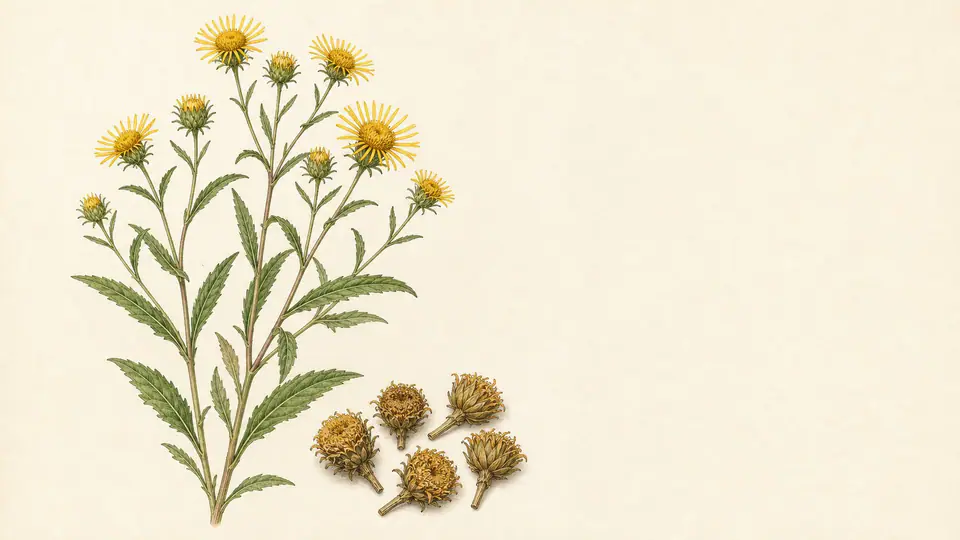
From Yellow Field Flowers to Cough Medicine, and the Evidence Still Missing
If a cough and phlegm persist, is it okay to drink Seonbokhwa as a tea? In short, while it may be consumed for temporary comfort, there is insufficient evidence to suggest it can cover or replace the treatment for the cause of a chronic cough. In particular, there is a significant gap between tea made from boiled dried flowers and the components focused on in modern research.
Seonbokhwa is a small yellow flower belonging to the Asteraceae family. It is a medicinal material made by drying or boiling the flowers of the common field plant known as Inula japonicaInula britannica Inula britannicaThe flowers are dried or decocted for use as a medicinal herb. Traditionally, it has been used to manage coughs and nausea, and its name sounds as familiar as a cup of tea in an old family home. However, familiarity does not guarantee efficacy. It is necessary to calmly examine how a single flower expands into research and where the evidence ends.
Flower, Leaf, or Stem: Why We First Ask About the Identity of the Raw Material
The manufacturing guidelines of the Ministry of Food and Drug Safety define Seonbokhwa as I. japonica or I. britannicathe flower of the plant. What is important here is that the guidelines specify the removal of foreign materials such as leaves, stems, and flower buds. Even for flowers on the same stem, the components can vary depending on which part is used.
Looking more broadly, Inula there are other plants such as Tomukhyang (Pogostemon crispum) within the same category. Tomukhyang is a medicinal material that uses the root, making it a different part, for a different purpose, and a different subject of research than Seonbokhwa. Even when reviewing studies on Inula anti-inflammatory and anti-cancer activities, the species, plant part, and extraction methods all differ, so they cannot be interpreted as a single raw material. Therefore, when you hear that "Seonbokhwa is good," you must first verify whether it is the flower, another part of the plant, or a different plant entirely.
Sesquiterpenes in Test Tubes: How Far Do the Promising Studies Go?
Most modern expectations for Seonbokhwa stem from a component called sesquiterpenes. I. japonica Papers studying the flower isolated various sesquiterpenes and observed toxicity toward cancer cells. Another study reported that components of the same flower affect DNA topoisomerase activity. Both of these results are component and cell studies conducted in test tubes.
Terms like "DNA topoisomerase" or "cancer cell toxicity" frequently appear in the early stages of drug development. However, the fact that a component isolated in a test tube showed a certain reaction does not mean that a decoction made by boiling dried flowers will produce the same effect in humans. Dosage, absorption, metabolism, and safety are all different questions. Thus, sesquiterpene research is merely an interesting starting point and cannot determine the efficacy or dosage of a single cup of tea.
Decoctions, Powders, and Concentrated Extracts: Different Questions for Different Forms of the Same Flower
Consuming Seonbokhwa usually involves making a decoction by boiling dried flowers. However, powder, concentrated extract, or capsule forms are also available on the market. When the form changes, both the concentration of the components and the method of safety evaluation change.
Tea made by decocting dried flowers is closest to the traditional method of use. In contrast, powders or concentrated extracts are more potent concentrations of the same flower, meaning the amount of sesquiterpenes will inevitably differ from that in tea. While higher concentrations may contain more of the components observed in in vitro studies, there may be a corresponding lack of safety data. In particular, you should avoid arbitrarily increasing the dose of powders or concentrated extracts. If it is a complex prescription, it is necessary to inform your medical staff of both the constituent ingredients and any prescription medications.
Relationship with Asteraceae Plants: To What Extent is Contact Allergy Possible?
Seonbokhwa (Inula flower) belongs to the Asteraceae family. Reviews of contact sensitization for Asteraceae herbs include other Inula species as well. It is also known that sesquiterpene lactones in Asteraceae plants may be associated with contact allergies.
However, this cannot be converted into the oral allergy incidence rate of Seonbokhwa itself. Records of reactions when touching the skin are different events from records of problems in the mouth, throat, or respiration when drinking tea. If a rash, swelling of the lips and throat, or difficulty breathing occurs after taking Seonbokhwa, use must be discontinued. For severe reactions, it is appropriate to receive an evaluation by 119.
Pregnancy, Lactation, Pediatrics, Liver and Kidney Disease: Safety Gaps Yet to be Filled
There is insufficient data on the long-term, high-concentration safety and drug interactions of single Seonbokhwa for pregnancy, lactation, pediatrics, and liver or kidney diseases. This does not mean it is "dangerous," but rather that it is "unknown." Caution is required when taking it for a long period or using concentrated products in this state of uncertainty.
If a cough persists for more than 3 weeks, or is accompanied by high fever, shortness of breath, chest pain, blood-streaked sputum, or weight loss, medical evaluation takes priority over tea. These symptoms may not be simple aftereffects of a cold. While Seonbokhwa may be a means to soothe symptoms, it is not a tool to identify the cause.
The Gap Between Human Evidence and Expectations
In other words, our expectations for Seonbokhwa are divided into three main branches. First, the empirical use of it being traditionally used for coughs and nausea. Second, the experimental results from modern papers showing that sesquiterpenes isolated from the flower showed activity in cell tests. Third, the safety signal that components of Asteraceae plants may be linked to contact allergies.
These three are at different stages. Traditional use provides literary context, cell tests provide clues for further research, and allergy signals demand caution. However, there is a significant gap in clinical trials, research on therapeutic effects and safety in humans, that connects these points. Inula Internal reviews also summarize this point. Therefore, it is premature to conclude that "Seonbokhwa is effective for coughs."
Similar Names, Different Ingredients: Things Often Confused with Seonbokhwa
When choosing Seonbokhwa, four distinctions are useful: the difference between flowers and flower buds, leaves, or stems; the difference between Inula britannica, Inula helenium, and Pogostemon cablin; the difference between a whole flower decoction and isolated sesquiterpenes; and the difference between traditional complex prescriptions and self-administration of a single ingredient.
| Category | Points to Check |
|---|---|
| Part | Whether it is the flower, and whether flower buds, leaves, or stems are not mixed in |
| Species | I. japonica·I. britannicaWhether it is, or other Inula plants of a different genus such as Pogostemon cablin |
| Formulation | Whether it is a dried flower decoction, or a powder/concentrated extract |
| Prescription | Whether it is a single ingredient, or a complex prescription with other herbs or prescription medications |
This table is not a simple comparison, but a set of distinctions that raise different evidence and different safety questions.
What Should You Ask if Taking it With Other Medications? The Final Safety Standard
If considering Seonbokhwa, first check the following: whether the product is the flower of Inula britannica or Inula helenium, and not the flower buds, leaves, stems, or the root of Pogostemon cablin. Whether it is a dried flower decoction, or a powder or concentrated extract. When and in what pattern the cough began. Whether you have Asteraceae contact allergies or asthma, whether you are pregnant or lactating, and whether you are taking prescription medications or other herbs. Since specific drug interaction data for Seonbokhwa itself is insufficient, it is important not to mistake a blank space of "unknown" for "safe."
Rather than directly linking the traditional use of yellow flowers and in vitro component research to the treatment of human coughs, the realistic starting point for using this ingredient is to first check the raw material, part used, formulation, and risk signals of the symptoms.
References
- Ministry of Food and Drug Safety Herbal Medicine Manufacturing Guidelines: Seonbokhwa.
- Bioactive sesquiterpenoids from Inula japonica flowers.
- Topoisomerase activity of Inula japonica flower constituents.
- Inula genus ethnopharmacology review.
- Contact sensitization from Compositae herbal remedies.
This text explains the origin of the raw materials, the scope of research, and precautions before consumption. As this cannot replace individual diagnosis or treatment, please consult a medical professional if you are taking medication or if symptoms persist. If sudden and severe symptoms such as difficulty breathing or decreased consciousness occur after consumption, seek help from 119 or the emergency room.

Medical Staff Review
Director Choi Yeon-seung
Chief Director of Baekrokdam Korean Medicine ClinicSeonbokhwa (Inula flower) Preliminary Items, reviewed the safety of expressions and the scope of verification before administration.
Review scope: Ingredient origin, human studies, concomitant medications, safety of intake · Last reviewed 2026-08-17
- Graduated from Kyung Hee University College of Korean Medicine
- Providing Korean medicine treatment since 2010
- Consultations for Gongjindan, Gyeongokgo, Nokyong (Deer Antler) restorative medicine, and customized restorative herbal medicine