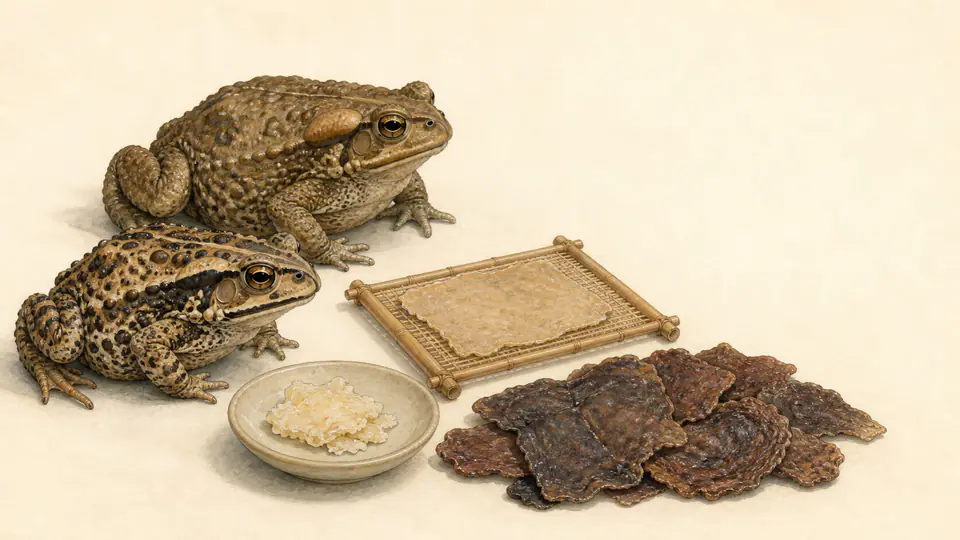
Is it okay to take pills or powder containing Chan Su (toad poison gland secretion) for pain or energy purposes?
Is it okay to take pills or powder containing Chan Su for pain or energy purposes? In short, oral administration for such purposes cannot be recommended. Chan Su is a potent animal-based medicinal material derived from the toad's poison gland, and bufadienolide, the core of its potency, carries risks of cardiotoxicity and arrhythmia. The promising anti-cancer and analgesic signals are not clinical evidence for treating humans, and they represent a completely different type of exposure than ingesting raw Chan Su or its powder.
It is essential to distinguish this gap. First, we must understand what Chan Su is, why it is considered a potent medicine, and which risks are inseparable from that potency.
Chan Su is not toad meat, but a secretion from the poison gland
Chan Su is an animal-based medicinal material made by collecting and drying the poison gland secretions of two toad species: Bufo bufo gargarizans Cantor and Bufo melanostictus Schneider. The National Institute of Food and Drug Safety evaluates these poison gland secretions as the identity of Chan Su and sets the bufosteroid content of the dried product at 5.8% or higher. The important point here is that Chan Su is not the entire toad, its eggs, or its skin. Only a small amount of secretion from the poison gland becomes the medicinal material.
A single name can easily obscure the facts. When people hear 'toad,' they often think of the meat or skin, but Chan Su is the secretion from the poison gland. This is why official standards are based on bufosteroid content. Just because it comes from the same animal does not mean it is the same type of exposure.
Bufadienolide possesses cardiotoxicity similar to digoxin
The toxicity of Chan Su comes from bufadienolide. This component causes cardiotoxicity similar to digoxin. A 2019 comprehensive review summarized 142 bufadienolides and various preclinical activities, but pointed out cardiotoxicity, neurotoxicity, and a gap in clinical and dosage data as core issues. In other words, while many activities have been reported, there is insufficient data to determine how safe and effective it is for humans.
In rat studies, decreased heart rate, ECG changes, and myocardial damage were observed depending on dose and time. This demonstrates that the toxicity of Chan Su is not theoretical but actually affects the heart.
Human cases have reported vomiting, bradycardia, arrhythmia, and death
The risks of Chan Su are not limited to animal studies. In a case group where six healthy men took an aphrodisiac product identical to Chan Su, vomiting and bradycardia occurred, and the first four died from arrhythmia. The latter two recovered after treatment with digoxin-specific Fab. This case shows that Chan Su can cause severe poisoning and that appropriate medical intervention can save lives.
To put it another way, the toxicity of Chan Su can be fatal, and its treatment is not something that can be done at home. Digoxin-specific Fab is an antidote treatment used by medical professionals after evaluating the state of poisoning. Therefore, if abnormal symptoms occur after ingestion, you must contact 119 immediately and bring the product with you.
Anti-cancer and analgesic research is currently at the cellular, animal, or isolated component stage
While anti-cancer cellular signals for Chan Su or bufalin have been reported, this does not imply safe oral anti-cancer therapy. Nor is it evidence to replace existing treatments. Most of the activities summarized in the 2019 comprehensive review are at the preclinical stage. These results come from cells, animals, or isolated components such as bufalin and cinobufagin.
This point is critical. Possibilities observed in a laboratory do not guarantee the same efficacy and safety in raw materials or powders ingested by humans. The more the toxicity and efficacy are closely linked in a raw material, the more dangerous this gap becomes.
Raw material, powder, pills, and bufalin do not represent the same level of exposure
When discussing Chansu (toad venom), it is essential to accurately distinguish the form of exposure. Raw Chansu, powder, pills of unknown origin, and isolated components such as bufalin are all different types of exposure. The National Institute of Food and Drug Safety Evaluation regulates the secretions from the poison glands of two specific toad species, and the standards for bufosteroid content apply to the dried raw material.
Chansu contained in complex pills may differ in concentration and composition from the raw material. Since bufalin is an isolated component, it may have a different toxicity profile than Chansu as a whole. What should you look for? First, verify whether the product is a raw secretion of Chansu, a complex pill, a topical agent, or an isolated component like bufalin.
Risk increases when used concurrently with digoxin, anti-arrhythmic drugs, or diuretics
Bufadienolides in Chansu act similarly to digoxin. Therefore, using them concurrently with digoxin, anti-arrhythmic drugs, heart medications, or diuretics increases the risk of toxicity or arrhythmia. Diuretics can affect the body's potassium balance, which may worsen ECG changes along with hyperkalemia or hypokalemia.
Pregnant or breastfeeding women, children, and individuals with heart or kidney disease should especially avoid exposure. These groups may be more susceptible to toxicity or have a reduced ability to detoxify and excrete the substance.
What warning signs after ingestion indicate danger?
If vomiting, severe dizziness, slow pulse, palpitations, chest pain, fainting, or confusion occur after taking or coming into contact with Chan Su, you must contact 119 immediately. For the same reason, raw materials, powders, or pills should not be placed on the tongue or wounds, as skin absorption can also be a route of toxicity.
In an emergency, it is important to inform medical staff of the actual amount ingested and the time of ingestion. Bringing the product packaging helps in identifying the ingredients and form.
The Gap Between Human Evidence and Expectations
Expectations for Chansu are primarily based on preclinical activity. However, as a 2019 comprehensive review pointed out, the core problem is the gap in clinical and dosage data. Without systematic research on humans, neither efficacy nor safety can be guaranteed.
In particular, taking Chansu for subjective symptoms such as pain or lack of energy is dangerous. This is because while the effects are uncertain, the toxicity is clear. If the image of it being a 'strong medicine' is interpreted only as efficacy, the toxicity is overlooked.
Distinguish between similar names and different exposures
Confusion surrounding Chansu arises between things with similar names. Chansu poison gland secretions are different from the whole toad or toad eggs. Raw medicinal materials are different from complex pills containing Chansu. Bufadienolide activity and digoxin-like toxicity are not separate. Preclinical anti-cancer signals are far from human treatment.
These distinctions are not mere classifications but standards for safety. The risk varies depending on the form, the components, and the level of evidence used for the approach.
Criteria to Check Today
When evaluating Chansu, do not view the image of it being a strong medicine only as efficacy; first check for the presence of Chansu, cardiotoxicity, and emergency symptoms. Ask whether the product is a raw secretion of Chansu, a complex pill, or an isolated component like bufalin. Check if you are taking digoxin, anti-arrhythmic drugs, or diuretics, or if you have heart or kidney disease. If vomiting, bradycardia, chest pain, fainting, or confusion occur, contact 119 immediately and bring the product.
Chansu is a potent medicinal material derived from small amounts of secretions from toad poison glands. That potency comes with the power to stimulate the heart, as well as the risk of arrhythmia, hyperkalemia, and death. Research signals that create expectation have not yet reached the threshold of human treatment. Therefore, it is not suitable for self-administration for pain or energy.
References
- National Institute of Food and Drug Safety Evaluation Herbal Medicine Standards: Chansu.
- Venenum Bufonis pharmacology and toxicology overview.
- Toad venom poisoning treated with digoxin-specific Fab.
- Toad venom poisoning and digoxin-like toxicity.
- Venenum Bufonis cardiotoxicity in rats.
This text explains the origin of the raw materials, the scope of research, and precautions before consumption. As this cannot replace individual diagnosis or treatment, please consult a medical professional if you are taking medication or if symptoms persist. If sudden and severe symptoms such as difficulty breathing or decreased consciousness occur after consumption, seek help from 119 or the emergency room.

Medical Staff Review
Director Choi Yeon-seung
Chief Director of Baekrokdam Korean Medicine ClinicChansu Dictionary Entry, reviewed the safety of expressions and the scope of verification before administration.
Review scope: Ingredient origin, human studies, concomitant medications, safety of intake · Last reviewed 2026-08-17
- Graduated from Kyung Hee University College of Korean Medicine
- Providing Korean medicine treatment since 2010
- Consultations for Gongjindan, Gyeongokgo, Nokyong (Deer Antler) restorative medicine, and customized restorative herbal medicine