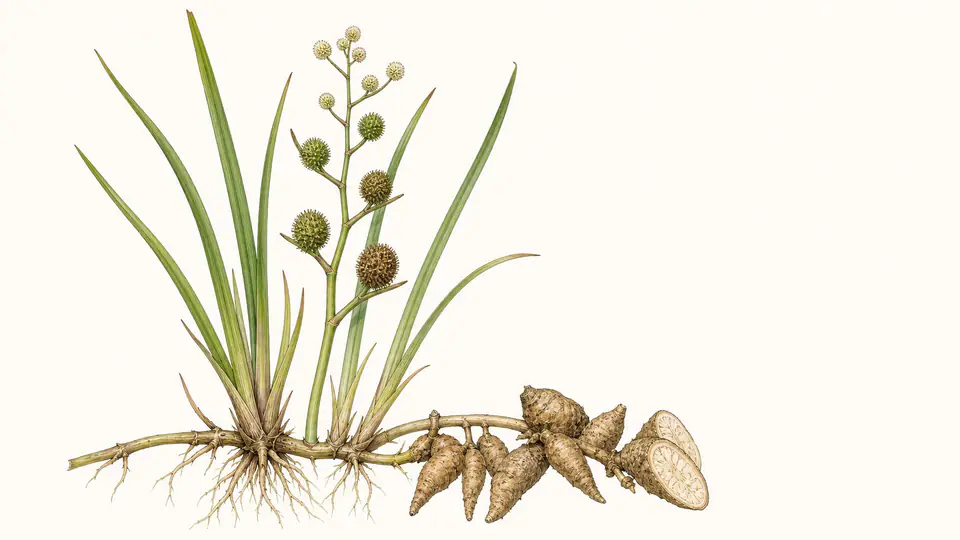
The tuber of an aquatic plant gains a firm name
Can I take Samreung because it is said to be good for menstrual pain or uterine fibroids? In short, it is currently difficult to translate those expectations into therapeutic effects in humans.
While Samreung has been intertwined with gynecological accounts in long-standing records, modern evidence mostly remains at the in vitro, animal, and isolated component stages, and safety signals regarding bleeding or pregnancy are also noted. Therefore, that gap must be clearly distinguished.
Where do the questions begin?
Questions about Samreung usually arise in two contexts: one regarding menstrual pain or irregular menstruation, and the other regarding uterine fibroids or abdominal masses. While such uses remain in traditional records, these records are not the same as therapeutic effects observed in humans. Data from the National Institute of Food and Drug Safety Evaluation defines Samreung as the tuber of Sparganium stoloniferum and presents identity and quality items, but it does not guarantee therapeutic effects for specific diseases. Therefore, one must first distinguish the basis from which the claim that it is "good" originated.
Identity of the raw material: The tuber is key
The medicinal part of Samreung is the tuber. This refers to the underground stem, not the leaves, flowers, or fruits of the aquatic plant. Among things called Samreung, rhizomes of other similarly appearing aquatic plants may be mixed in. Data from the National Institute of Food and Drug Safety Evaluation narrows the identity to the tuber of Sparganium stoloniferum and presents quality items. This is why it is necessary to first verify if the raw material is correct and how it was processed.
Why is it linked to the uterus?
The reason Samreung has remained in gynecological accounts for a long time stems from its name and form. A symbolic interpretation was attached, suggesting that the underground tuber of an aquatic plant resolves hard lumps and blocked flow. While there are records of it being used traditionally for menstrual pain, amenorrhea, and abdominal masses, this differs from results proving the reduction of uterine fibroid size or pain treatment in humans. Records only show the context of use; they do not prove efficacy.
Reasons for expectation: Preclinical activity signals
A 2021 comprehensive review organized approximately 180 components in Samreung and reported activities such as anti-tumor, anti-thrombotic, and estrogen antagonism. This is the basis that increased expectations for Samreung. However, most of this research is preclinical, and it also points out gaps in reproductive toxicity and quality/toxicity studies. A 2023 component study reported that ferulic acid sucrose esters isolated from the tuber inhibited ADP-induced platelet aggregation in vitro. However, this is not a clinical trial that measured bleeding or drug interactions in humans. In other words, it cannot be concluded that the phenomenon observed in a test tube occurs in the same way inside the body.
Different stories depending on the form
Samreung is divided into raw Samreung, Cho-samreung (processed with vinegar), and extracts or isolated components. These do not have the same form or exposure. Vinegar-processed products are included in traditional standards and some pharmacological differences have been reported, but processing alone does not resolve reproductive or bleeding risks, nor has a safe self-administration dose been established. Raw medicinal materials, concentrated extracts, and isolated phenylpropanoids each have different concentrations and exposure conditions. Therefore, it is dangerous to view all products as the same under the single name "Samreung".
| Category | Characteristics | Points to Check |
|---|---|---|
| Raw Samreung | Unprocessed tuber | Identity, quality standards |
| Cho-samreung | Vinegar-processed product | Difference in components before and after processing, uncertain safety |
| Extracts and isolated components | Concentrated form | Primarily preclinical signals, lack of human evidence |
When Taken with Other Medications or Supplements
The antiplatelet interaction of Samreung (Sparganium stoloniferum) has not been confirmed in humans. Therefore, while the risk is not definitive, the current prudent approach is to avoid using concentrated products due to preclinical signals. In particular, if you are taking anticoagulants or antiplatelet agents, or if you have an upcoming surgery, you must consult a medical professional before use. The same applies if you are receiving hormone therapy. Although estrogen antagonistic activity has been reported, this does not prove interaction in humans, so caution is advised when using them together.
Judgments Based on Individual Circumstances
Samreung should not be self-administered during pregnancy, when preparing for pregnancy, or while breastfeeding due to preclinical signals of reproductive toxicity and a lack of human data. The same applies to those with menorrhagia, unexplained bleeding, or anemia. If you experience sudden severe pelvic pain, a feeling of fainting, bleeding with a possibility of pregnancy, or bleeding that quickly soaks through pads, prompt medical evaluation takes priority over taking herbal medicine. It is not appropriate to try Samreung first in these situations.
The Gap Between Human Evidence and Expectations
Ultimately, modern evidence for Samreung shows in vitro platelet reactions, animal reproductive toxicity, and component changes before and after processing more clearly than the treatment of uterine fibroids in humans. Since most anti-tumor, anti-thrombotic, and estrogen antagonistic signals are at the cellular, animal, or isolated component stage, the therapeutic effect in humans for menstrual pain or uterine fibroids cannot be confirmed. A 2021 comprehensive review also concluded that more research on quality, toxicity, and clinical trials is needed. Therefore, the correct way to view this material is to acknowledge the gap between "expectation" and "proof."
Differences from similar raw materials
Four comparisons are helpful when choosing Samreung. First, the tuber of Samreung must be distinguished from the rhizomes of other aquatic plants. Second, raw Samreung and charred Samreung are not the same preparation form. Third, the raw herbal medicine and isolated phenylpropanoids represent different levels of exposure. Fourth, preclinical antiplatelet signals and the risk of bleeding in humans are not the same concept. These distinctions show that several different narratives coexist under the name Samreung.
Criteria to Check Today
If you are considering Samreung, first verify these three things: whether it is raw Samreung, charred Samreung, or a concentrated extract, and what the actual dose and duration are; whether you are pregnant, preparing for pregnancy, or breastfeeding, or if you have menorrhagia, anemia, or unexplained bleeding; and whether you are receiving anticoagulants, antiplatelet agents, or hormone therapy, or have an upcoming surgery or procedure. Do not translate the traditional term "resolving blood stasis" as a treatment for uterine fibroids or safety during pregnancy; the final standard for using this material is to first verify the origin, processing, bleeding risk, possibility of pregnancy, and a standard diagnosis.
References
- National Institute of Food and Drug Safety Evaluation Herbal Medicine Sensory Test: Samreung.
- Sparganii Rhizoma pharmacology and toxicity review.
- Phenylpropanoids and in-vitro antiplatelet activity.
- National Institute of Biological Resources Medicinal Plant Identity Comparison Data.
This text explains the origin of the raw materials, the scope of research, and precautions before consumption. As this cannot replace individual diagnosis or treatment, please consult a medical professional if you are taking medication or if symptoms persist. If sudden and severe symptoms such as difficulty breathing or decreased consciousness occur after consumption, seek help from 119 or the emergency room.

Medical Staff Review
Director Choi Yeon-seung
Chief Director of Baekrokdam Korean Medicine ClinicSamreung Dictionary Entry, reviewed the safety of expressions and the scope of verification before administration.
Review scope: Ingredient origin, human studies, concomitant medications, safety of intake · Last reviewed 2026-08-17
- Graduated from Kyung Hee University College of Korean Medicine
- Providing Korean medicine treatment since 2010
- Consultations for Gongjindan, Gyeongokgo, Nokyong (Deer Antler) restorative medicine, and customized restorative herbal medicine