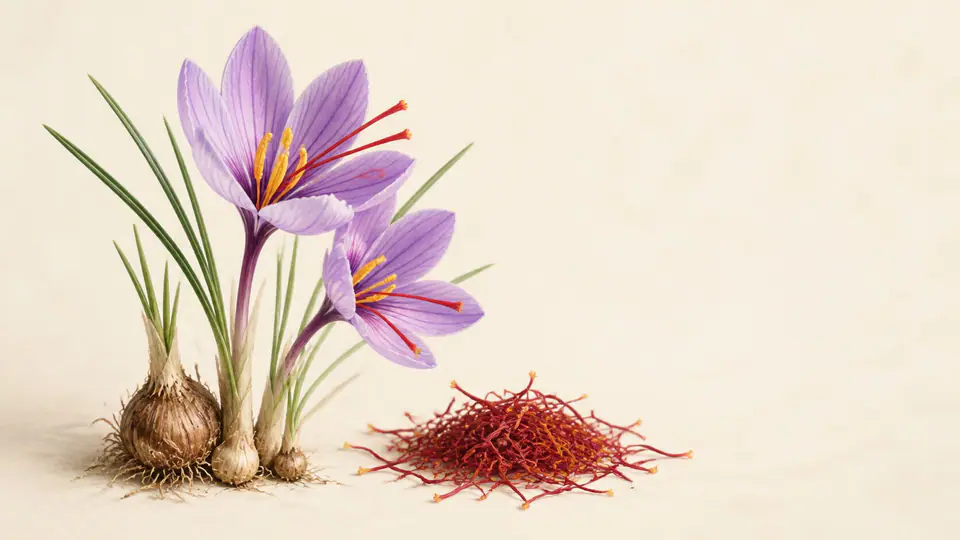
From three strands of a single flower to health capsules: the journey of the red stigma
When my mood drops and my sleep is disrupted, can I take saffron supplements instead of antidepressants? In short, based on current evidence, it is difficult to conclude that they can replace prescribed antidepressants. Saffron is a food spice and a raw material studied as specific extracts; its efficacy has not been proven identical across all products.
It is precisely this gap that must be distinguished.
What plant and which part is saffron?
Kew classifies it Crocus sativusis classified as a cultivated species originating from Greece. Saffron consists of the dried stigmas of this plant. Only three red stigmas can be obtained from a single flower, and they must be picked and dried by hand. This rarity has made saffron an expensive spice and dye.
What we call 'saffron' encompasses spices, stigma powder, aqueous or alcohol extracts, and products standardized for crocin or safranal. Their quantities and compositions differ. Therefore, you must first remember that several different substances are contained within the single term 'saffron'.
Rarity does not imply the magnitude of efficacy
Saffron is expensive because the amount of stigma obtained per flower is small and it must be harvested by hand. However, this rarity does not indicate the magnitude of its health benefits. While it is natural to infer that something rare and precious has a greater effect on the body, clinical research is not that simple.
What is typically used in research is a set amount of mg of stigma or a specific extract. Saffron sprinkled on food, powder, and standardized capsules are all different forms. Therefore, the mg and results of a specific trial cannot be applied to all spices or products.
Where do expectations for mood and sleep come from?
Interest in saffron primarily stems from research on depression, anxiety, and sometimes sleep. A 2026 meta-analysis of 34 randomized trials showed an average improvement in self-reported BDI and BAI scores. However, heterogeneity exceeded 90%, and there were no significant effects in clinician-rated HDRS and HARS.
This difference is important. For depression and anxiety scales, there are tools the patient answers and tools the clinician evaluates. In a recent review, the results of these two types did not align. An improvement in self-reported scores does not mean the condition improved to the same extent from the clinician's perspective.
The possibility of replacing antidepressants has not been confirmed
A 2025 meta-analysis of 8 trials reported that the difference in symptom reduction between saffron and SSRIs was not significant. However, due to limitations in sample size, region, and duration, equivalence or replaceability could not be established.
In other words, the fact that no statistical difference appeared does not mean saffron works exactly like an SSRI. This is because the trial scale and design were not sufficient to determine replaceability. Therefore, there is insufficient evidence to replace antidepressants with saffron or to discontinue them arbitrarily.
How to view differences by product form
Saffron research uses stigmas, petals, and various standardized extracts. Therefore, saffron in food, concentrated extracts, stigma powder, and standardized extracts are different products even if they come from the same raw material.
| Category | Characteristics | Research Applicability |
|---|---|---|
| Saffron in food | A few strands, spices used for fragrance and color | Differs from research dosage |
| Stigma powder | Ground dried stigmas | Composition differs from extracts |
| Standardized extract | Based on specific components such as crocin and safranal | Applicable to specific tests |
This table is simply for distinguishing forms. Research results cannot be directly applied to every product.
What medications and conditions require caution when taking this together?
When using saffron with other supplements or medications, you must first check your current medications. There is a possibility of overlapping effects and interactions if you are taking antidepressants, sleeping pills, anticoagulants, or blood pressure medications. Please consult a medical professional or pharmacist, and do not discontinue medication arbitrarily.
The safety of concentrated saffron exceeding culinary spice amounts has not been established during pregnancy. Due to concerns regarding the uterus and bleeding, self-administration is not recommended. Consultation with a professional is also necessary during breastfeeding.
What symptoms should prompt you to stop use and seek help?
Saffron was generally tolerable at typical short-term doses, but a 2026 systematic safety review reported an estimated 17.5% of adverse events and gastrointestinal symptoms. Data for long-term use or high-risk groups are insufficient.
Symptoms such as nausea, abdominal pain, headache, dizziness, and dry mouth may occur, and the long-term safety of concentrated products is not sufficiently established. You must seek emergency help immediately if you experience thoughts of self-harm or death, suspected extreme agitation or mania, fainting, severe bleeding, or allergic reactions.
The Gap Between Research Evidence and Daily Choices
While there are interesting studies on saffron, those studies do not apply to all everyday saffron products. There is a significant gap between self-reported mood scores and clinician evaluations, as well as between complementary use and the replacement of antidepressants.
Then, what should you look for? The first step is to check the product label to see if it is a spice, stigma powder, or extract, and to verify the daily dose and crocin/safranal standardization. Additionally, you must distinguish whether you are experiencing a temporary low mood, or depression, anxiety, and insomnia lasting more than 2 weeks, or if there is functional impairment or thoughts of self-harm.
Realistic criteria to check today
Saffron is a precious spice and a raw material subject to research. However, rather than focusing on the image of a 'natural antidepressant,' it is more important to first check the part of the plant used, the formulation, the daily dose, the severity of symptoms, and current medications. It is critical not to arbitrarily stop prescription medications or delay a risk assessment for self-harm.
If you are considering saffron, a realistic starting point is to discuss with a medical professional or pharmacist whether you are taking antidepressants, sleeping pills, anticoagulants, or blood pressure medications, whether you are pregnant or breastfeeding, and how long your symptoms have persisted and how much they interfere with daily functioning.
References
- Kew Plants of the World Online: Crocus sativus.
- Saffron and mood disorders: GRADE-assessed meta-analysis of 34 RCTs.
- Saffron versus SSRIs: meta-analysis of randomized trials.
- Adverse events of saffron: systematic review.
This text explains the origin of the raw materials, the scope of research, and precautions before consumption. As this cannot replace individual diagnosis or treatment, please consult a medical professional if you are taking medication or if symptoms persist. If sudden and severe symptoms such as difficulty breathing or decreased consciousness occur after consumption, seek help from 119 or the emergency room.

Medical Staff Review
Director Choi Yeon-seung
Chief Director of Baekrokdam Korean Medicine ClinicSaffron Dictionary Entry, reviewed the safety of expressions and the scope of verification before administration.
Review scope: Ingredient origin, human studies, concomitant medications, safety of intake · Last reviewed 2026-08-17
- Graduated from Kyung Hee University College of Korean Medicine
- Providing Korean medicine treatment since 2010
- Consultations for Gongjindan, Gyeongokgo, Nokyong (Deer Antler) restorative medicine, and customized restorative herbal medicine