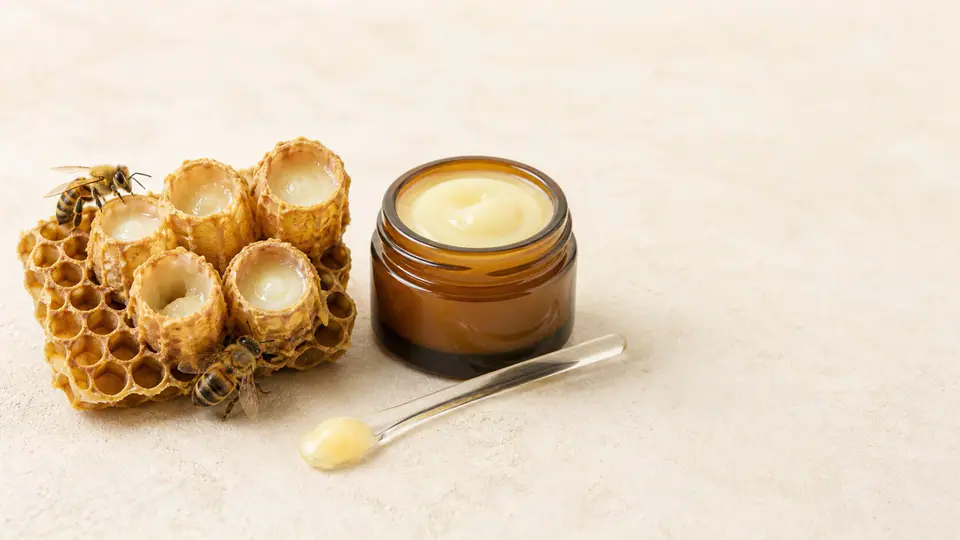
From the Queen Bee's Food to Human Capsules
Can I take royal jelly for energy or menopause? Is it safe as long as I don't have allergies to bee products? This question captures the most common misconceptions surrounding royal jelly in a single sentence.
In short, the absence of bee product allergies does not eliminate the possibility of severe allergic reactions, and the efficacy for improving energy or menopausal symptoms has not been definitively proven in humans. So, what should we check first behind the image of 'the queen bee's food'?
Where the Questions Begin: The Image of the Queen Bee
Royal jelly is a milky-white substance secreted from the hypopharyngeal and mandibular glands of worker bees. It is fed to larvae and potential queen bees. The process by which a bee larva develops into either a queen or a worker bee involves the type of food and the duration of intake. This biological fact is powerful, making it easy for people to expect that consuming this food might bring changes to their own vitality or youth.
However, the development of a queen bee is not the same as human health outcomes. NIDDK LiverTox describes royal jelly as a worker bee secretion and notes that general health claims have not been sufficiently proven in humans. The development of bee larvae is simply bee physiology; it is not a mechanism that directly translates to clinical results in humans.
Nature of the Ingredient: A Secretion, Not Honey
While royal jelly is a bee product like honey, it is not a food made by storing floral nectar. It is a secretion from worker bees. Therefore, it contains protein allergens. It is a different ingredient from honey, propolis, and bee pollen.
Raw royal jelly, freeze-dried powder, capsules, and cosmetics differ in moisture content, primary royal jelly protein, 10-HDA content, and route of exposure. This means that even if they share the same name, the form that contacts the body is different. Cosmetics are applied to the skin, capsules pass through the gastrointestinal tract, and raw royal jelly has different storage and spoilage risks. These differences are the primary criteria that must be distinguished when discussing efficacy and safety.
Reasons for Expectations: Small Trials and Uncertain Conclusions
Human trials have evaluated various outcomes such as PMS, menopause, lipids, and blood glucose using small samples and varying doses. It is difficult to group these results into a single definitive efficacy. Even if some studies showed changes in metabolic markers, it does not necessarily mean this leads to increased vitality or anti-aging.
Studies on menopause, lipids, and blood glucose often involve various formulations and doses and consist of many small trials. These are far from general claims of rejuvenation or immune strengthening. When efficacy is generalized while ignoring differences in study subjects and product forms, a gap opens between expectation and evidence.
Differences in Product Form: Raw, Freeze-dried, Capsules, Cosmetics
The first thing to check when choosing royal jelly is the product form. Raw royal jelly, freeze-dried preparations, capsules, and cosmetics have different exposure methods even if they use the same raw material. Raw products are sensitive to storage conditions, while freeze-dried powder is a form where moisture has been removed. Capsules are ingested with additional ingredients, and cosmetics act locally on the skin.
| Verification Criteria | Reason |
|---|---|
| Whether it is raw, freeze-dried, capsule, or cosmetic | Exposure routes and safety profiles differ |
| Royal jelly equivalent amount | The actual intake amount must be known |
| 10-HDA indication | Significant differences in content between products |
While 10-HDA is frequently cited as an indicator component of royal jelly, the content varies by product, and efficacy cannot be determined by this alone. It is more important to check the form and the actual amount.
Relationship with Medications: The Case of Warfarin
When taking royal jelly with other supplements or medications, potential interactions must be considered. There have been cases where the INR increased and bleeding occurred after concurrent use with warfarin. Users of anticoagulants should consult a healthcare provider or pharmacist before use.
Caution is also required for those taking blood glucose medications. Since blood glucose research results are inconsistent, it is safer to verify whether it may affect the efficacy of the medication. Safety for pregnancy, lactation, children, and long-term high-dose use has not been established.
Individual Circumstances and Safety Signals: A Lack of Previous Allergies Is Not a Guarantee
The absence of allergies to bee products does not guarantee safety. Acute asthma and anaphylaxis have been confirmed as IgE reactions to royal jelly proteins. Particular caution is needed for individuals with a history of asthma or atopic dermatitis.
Allergic reactions including hives, swelling of the lips or larynx, wheezing, hypotension, cardiovascular collapse, and in rare cases, death have been reported. If you have asthma, atopy, or allergies to bee products, avoid self-testing and prioritize a professional allergy evaluation. For difficulty breathing, throat swelling, or fainting, seek immediate help from 119.
The Gap Between Human Evidence and Expectations
No clinically evident link between royal jelly and liver damage has been reported. However, this does not imply overall safety or the absence of allergies. Just as there is a lack of links to liver damage, there are existing cases of allergy risks and drug interactions.
To bridge the gap between expectation and evidence, do not assume efficacy; instead, consider the number of studies, consistency, and limitations. Small changes in metabolic indicators are different concepts from vitality and anti-aging. It is risky to overinterpret a single study result as an overall improvement in health.
Differences from Similar Ingredients: Honey, Propolis, Bee Pollen
Royal jelly is a different bee product from honey, propolis, and bee pollen. Honey is a food made from stored nectar, propolis is a resinous substance collected by bees, and bee pollen is pollen gathered by bees. Since the nature of the raw materials differs, allergy risks must be viewed separately.
Having an allergy to one bee product does not necessarily mean you will react to others, but the possibility of cross-reactivity cannot be ignored. If there is a history of anaphylaxis of unknown cause, it is appropriate to receive a professional allergy evaluation before taking royal jelly.
Realistic criteria to check today
When choosing royal jelly, prioritize checking the formulation, actual amount, history of asthma, atopy, or allergies, and current medications over the image of it being 'food for the queen bee.' Check whether it is a raw product, freeze-dried powder, or capsule, and look for the royal jelly equivalent amount and 10-HDA indication. Check for asthma, atopy, bee product allergies, or a history of anaphylaxis of unknown cause. Consult a healthcare provider or pharmacist if you are taking anticoagulants such as warfarin, blood glucose medications, or if you are pregnant or breastfeeding.
Remember that severe reactions can occur even during the first dose. Signals such as hives, lip swelling, wheezing, hypotension, or fainting require immediate action. If choosing this for vitality or menopause, a realistic approach is to give the same weight to evidence and safety as you do to your expectations.
References
- NIDDK LiverTox: Royal Jelly.
- Royal jelly-induced asthma and anaphylaxis.
- Royal jelly and warfarin interaction case report.
- Royal jelly clinical evidence systematic review.
This text explains the origin of the raw materials, the scope of research, and precautions before consumption. As this cannot replace individual diagnosis or treatment, please consult a medical professional if you are taking medication or if symptoms persist. If sudden and severe symptoms such as difficulty breathing or decreased consciousness occur after consumption, seek help from 119 or the emergency room.

Medical Staff Review
Director Choi Yeon-seung
Chief Director of Baekrokdam Korean Medicine ClinicRoyal Jelly Dictionary Entry, reviewed the safety of expressions and the scope of verification before administration.
Review scope: Ingredient origin, human studies, concomitant medications, safety of intake · Last reviewed 2026-08-17
- Graduated from Kyung Hee University College of Korean Medicine
- Providing Korean medicine treatment since 2010
- Consultations for Gongjindan, Gyeongokgo, Nokyong (Deer Antler) restorative medicine, and customized restorative herbal medicine